50 fascinating facts about farming in America
50 fascinating facts about farming in America
Since just after World War II, the number of people employed in agriculture has dropped by half. Most of America's farms are small and nearly all are family-run鈥攂ut they're also disappearing. By 2019, that number had dropped to about .
COVID-19 put additional pressure on an already strained industry: In March 2020, . And in the 12-month period ending June 30, 2020, 580 . Issues during the pandemic included everything from breakdowns in the supply chain to the closures of processing plants.
To find out more about this complex and essential industry, 爆料TV compiled a gallery of 50 facts about U.S. farming. We've relied on authoritative sources that include the , the , and industry and trade groups.
In , according to the Bureau of Labor Statistics. Today, the United States Department of Agriculture (USDA) reports that in the U.S. Nevertheless, production is still huge. U.S. farmers raise hundreds of millions of egg-laying hens, harvest millions of tons of fruits and vegetables, and keep the rest of the world supplied with corn, wheat, and soybeans. A single acre of land can grow 50,000 pounds of strawberries or 3,000 pounds of wheat, according to the American Farm Bureau Federation; and in 2020 alone, an estimated $135 billion in U.S. agricultural products were exported around the world despite disruptions to the supply chain.
Keep reading to find more fascinating information about farming in the United States.
You may also like:
There are about 2 million US farms
Roughly 3 million people work for the country's more than . Nearly all of these farms are family-run.
A farm classification is based on a monetary threshold
The as a place producing and selling at least $1,000 of agricultural products in a year (or one that would have under normal conditions). Farm size is measured by gross cash farm income or GCFI.
90% of US farms are small
In the United States, a farm is considered small if its gross income is less than $350,000 a year. , accounting for 52% of the land and 26% of production.
Large-scale family farms represent just 2.5% of US farms but account for more than 50% of American produce
Large-scale family farms are those that earn between $1 million and $4.9 million a year. They comprise just 2.5% of U.S. farms鈥攂ut account for over two-thirds of dairy production and more than half of fruit and vegetable production.
Farmers in the US are overwhelmingly white
All but roughly 5% of American farmers are white, according to the 2017 . The number of Hispanic farmers has grown to 112,451, while only about 46,000 U.S. farmers are Black.
One US farm can feed 166 people
Based on this average, in order to meet demands by the year 2050. At that point, the global population is expected to increase by 2.2 billion.
American farmland is worth $2 trillion
The with a real estate value of more than $2 trillion. As the number of farms has decreased, the average land size for the average farm has increased.
Women today comprise a third of all US farm operators
The spiked by 27% between 2012 and 2017, according to the government's farming census. Today, more than half of all farms in this country boast at least one woman making business decisions.
Agriculture represents 1% of our GDP
The Agricultural exports from the United States in 2019 were .
Commercial egg farms produce more than 65 billion eggs each year
A a year. China is the largest egg producer in the world, with roughly 160 billion a year.
Soybean production is key to making crayons
Most of the soybeans grown in the U.S. go toward feeding livestock, but they're also used in the production of other goods like crayons. One acre of
Every baseball requires 150 yards of wool
The United States is home to 47 breeds of sheep. One pound of wool can make 10 miles of yarn. Inside a baseball, the core is wrapped in 150 yards of wool yarn.
Windbreaks provide protection for American fruit farms
Tall, dense lines of trees are often planted around the edges of fruit farms. They act as windbreaks to protect trees and help prevent soil erosion.
45.6 million acres of US cropland was used for wheat in 2019
One weighs about 60 pounds and contains about 1 million individual kernels. It can yield about 42 pounds of white flour, 60 pounds of whole wheat flour, about 45 24-ounces boxes of wheat flake cereal, or about 42 pounds of pasta. More than .
The invention of the wheat combine in 1934 changed farming forever
American Hiram Moore's invention of the wheat combine allowed for the automated process of removing wheat heads from stems and separating out the kernels. Each head on a Wheat is ready to be harvested when it dries out and turns golden.
Dairy cows in the US produced 218 billion pounds of milk in 2018
On average, a dairy cow produces 6.3 gallons of milk a day and 46,000 glasses of milk a year. It takes . As with any mammal, to produce milk a cow must give birth. Calves are separated from their mothers so that milk can be siphoned off for commercial production. Dairy calves are typically impregnated every year.
Net losses at US farms are on the rise
The number of between 2012 and 2017 rose 1.2% to 1.15 million. The number of farms reporting net profits dropped 8.3% to fewer than 900,000. The , higher than the median $61,000 for all households.
Farmers are getting older
The , up 1.2 years in half a decade. The average age of an organic farmer, meanwhile, is 52.
Most farmers need outside work to make ends meet
Only , and about two-thirds work another job. Slightly more than half of U.S. farms are very small, with annual sales of less than $10,000.
Less than 1% of US farmland is organic
The , far less than the average of 444 acres for all U.S. farms. The vast majority of the organic food consumed in the U.S. is imported.
California farms 20% of America's organic land
California has 2,700 organic farms, about one-fifth of the country's total organic land. Only two other states鈥擶isconsin and New York鈥攈ave more than 1,000 organic farms.
Cotton across the South
Cotton is grown in Arizona alone grows enough cotton each year to make more than .
The US accounts for 75% of global cranberry production
Nearly ., mostly in Wisconsin, as well as in Massachusetts, New Jersey, Oregon, and Washington. It takes about 4,400 cranberries to make a gallon of juice.
The US economy has left behind farm and ranch families
鈥攄own from 70% in 1840. That dramatic shift in America's workforce shows a complete metamorphosis in the country's .
The US is the world's third-biggest food supplier
About , including cropland and pastureland. U.S. farmers produce 10% of the world's wheat and 20% percent of the world's beef, pork, and lamb.
US peanut farmers produce 3 million tons of peanuts each year
in the U.S. produce their crops on about 1.5 million acres of land. About . Runner peanuts are used mostly in peanut butter, while Virginia and Spanish peanuts are often used for snacks and Valencia peanuts are used largely for roasting and boiling.
Over 92% of land in Nebraska is farmland
With over , Nebraska has the highest percentage of land dedicated to farming in America. The rest of the top five states, in order, are .
Cattle represent US farming's biggest sector
Over 600,000 farms received most of their income from . However, the number of cattle operations fell 6% between 2007 and 2012. There were roughly ; by 2014, that number fell to 29 million.
Pennsylvania grows the most mushrooms
Roughly a, with California and Florida coming in second and third for production. There are , 30 of which have been domesticated and 10 of which are produced commercially.
Idaho grows a third of all US potatoes
There's a reason the potato is the state vegetable of Idaho. The state grows a full third of , bringing in an estimated $27 billion a year. The state has almost 26,000 farms producing over 180 goods.
The US is the world's leader in corn production
The United States accounts for a third of all corn grown globally and is the biggest corn exporter in the world. Other corn-producing giants are China and Brazil. The biggest corn-growing states in the U.S. are Iowa and Illinois.
South Dakota grows the most sunflowers in the country
South Dakota farmers in 2018 grew , followed by North Dakota with 739 million pounds. About 217,000 in 2018 in the United States.
Washington is the biggest grower of hops
Total , used in making beer, was about 107 million pounds in 2018. Washington state grew the most, at almost 77 million pounds, while a distant second was Idaho with roughly 16 million pounds.
Contracts mitigate risk for American farmers
A third of to manage risk, price, quality, and markets. Production contracts are more common in livestock farming, including most poultry, egg, and hog farms. In a marketing contract, often used in tobacco and sugar beet farming, ownership of the commodity stays with the farmer during production. In a production contract, the buyer usually owns the commodity during production and the farmer is paid a fee.
Texas has the most farms in the US
There are 248,416 registered farms and ranches in Texas. of the state's 408,506 producers.
Wisconsin stands to lose the most in a dying dairy industry
Wisconsin has . But as struggles continue with declining milk prices, a transition to larger farms, international trade issues, and increased rates of suicide among farmers, the state lost more than alone.
U.S leads in GMOs
The United States has by far the worldwide including maize, soybean, cotton, canola, sugar beets, alfalfa, papaya, squash, and potatoes. Nearly all U.S. soybeans are genetically modified to tolerate herbicides.
Georgia isn't the biggest peach producer
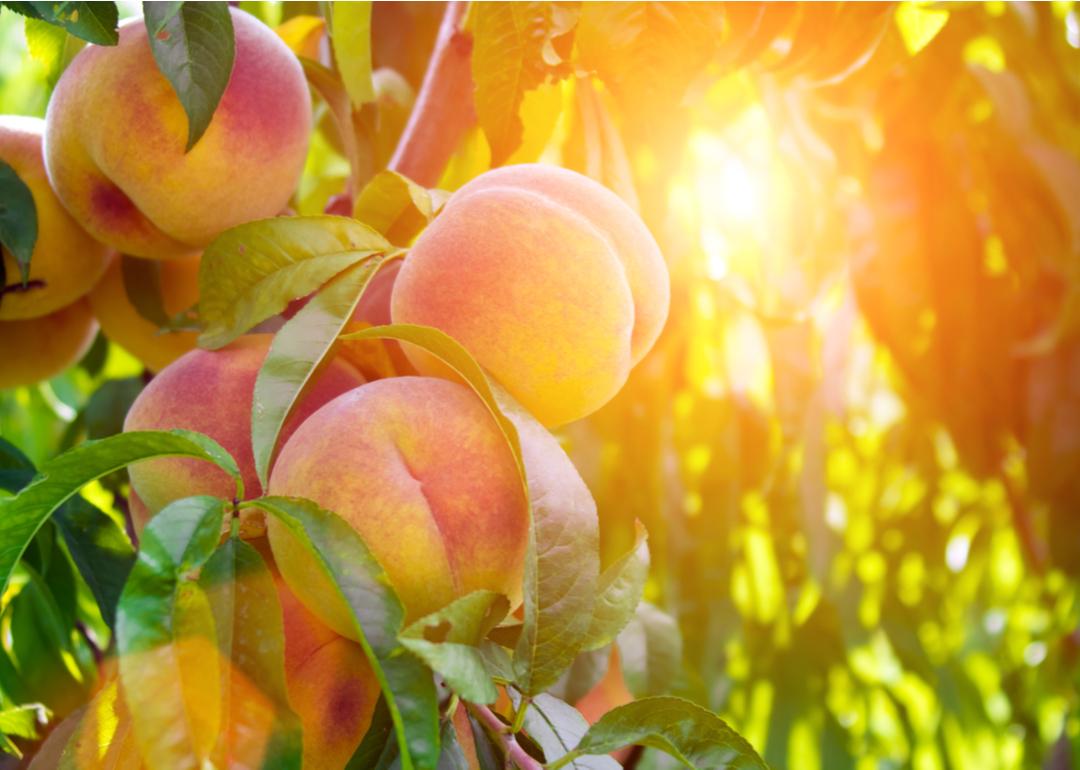
Georgia might be known as the "Peach State," but . The Golden State produced 479,000 tons of peaches in 2018, the bulk of the nearly 652,000 tons grown nationwide.
1.12 million tons of strawberries were grown in 2019
The United States grows the most strawberries of any country in the world, producing around . Most were grown in California, followed by Florida.
Hemp is becoming a huge US cash crop once again
Hemp came to North America in 1606. The plant's myriad uses led to its use as a staple crop: Farmers were actually legally bound to grow hemp throughout the 1700s. The plant needs no pesticides and little water, and its long roots help prevent erosion and retain topsoil. Several states, including .
The Dust Bowl swept away more than 100 million acres of soil
The Dust Bowl lasted for about a decade and left hundreds of thousands of people destitute. It was caused by intense drought and negligent farming practices that left land susceptible to wind erosion.
Early settlers learned to grow maize from indigenous tribes
Farming began around 10,000 B.C. when nomadic tribes started growing crops. Among the In the U.S. early settlers grew barley, peas, and maize, which native American tribes taught the settlers how to grow.
Tractors overtook horses and mules by 1954
In 1954, the for the first time. Technology and the use of tractors over animals marked the Second American Agricultural Revolution.
Jethro Tull's seed drill
English agricultural engineer . Before that, seeds were scattered by hand. Tull's drill allowed seeds to be planted efficiently in rows and helped American agriculture flourish.
Farming provides millions of American jobs
Some 40% of the world's population works in agriculture, making it the largest employer on the planet. Farming in the United States directly .
Goats are a growing enterprise in the U.S.
, and they are raised for their wool, milk, and meat. Texas, Tennessee, Georgia, Oklahoma, and Kentucky have the most meat goats, while Texas, California, Wisconsin, Iowa, and New York have the largest dairy goat herds.
Organic profits throughout the U.S. are on the climb
Organic farming typically requires than conventional farming. But organic products typically command higher prices and produce 10 times more profit.
CSAs across the US are waning in popularity
Community-supported agriculture, or CSA, was popular in the 1990s and early 2010s. With a CSA, a consumer subscribes to buy a farm's produce directly, typically in weekly deliveries. But CSAs are declining as large grocery chains carry more organic food and online meal kit subscriptions have proliferated.
Most farmers' markets source products within 50 miles
Nearly all U.S. farmers who sell at work within 50 miles of where they sell their produce. . On average, that store shoppers spend on food; those at farmers' markets take home more than 90% of food dollars.
Farm output has soared in the last 70 years
Technological innovations in animal and crop genetics, chemicals, equipment, and farm organization continued, even as the amount of land and labor in farming fell. Still, total U.S. between 1948 and 2015.