Are British Columbia mushrooms unfairly subsidized? US growers think so
Are British Columbia mushrooms unfairly subsidized? US growers think so
Mushrooms may not be the first crop that comes to mind when you think of high-tech agriculture. But in B.C., Agaricus bisporus — the fungal species sold in grocery stores as button mushrooms, creminis, and portobellos — is grown using cutting-edge techniques.
“If you go back 10 or 15 years, you would travel to Holland to find the most productive, leading-edge mushroom facilities in the world,” Lewis Macleod, CEO of South Mill Champs Mushrooms, said in an interview with . “Today, you travel to Holland and British Columbia.”
In 2017, Pennsylvania-based South Mill with Aldergrove-based Champ’s Mushrooms to form South Mill Champs. The company now supplies more B.C.-grown mushrooms to the U.S. market than any other, around 22,675 tonnes per year.
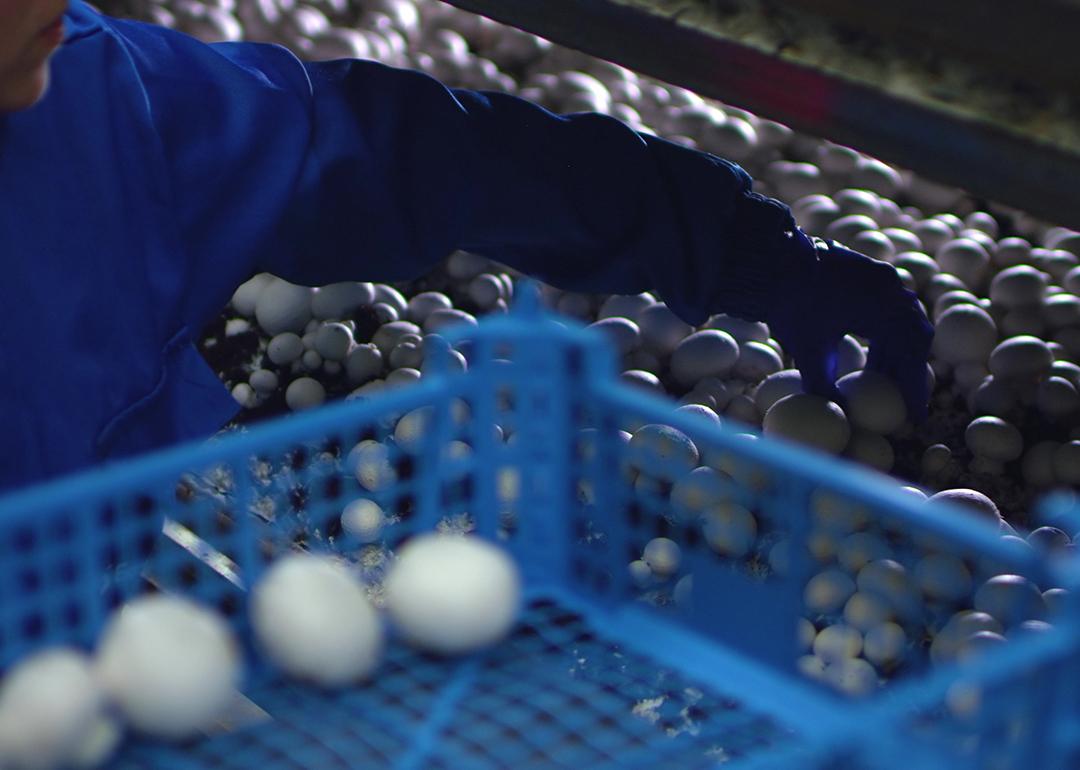
Before B.C.’s mushroom tech boom, farms often mimicked more natural growing conditions. Modern B.C. farms use what’s called the Dutch method: metal shelves heaped with a mixture of manure and straw to cultivate their crops. The mushrooms are grown in air-tight facilities that are closely controlled for temperature and humidity. Unlike other indoor crops, mushrooms don’t need much light to grow. The buildings are dim, the opposite of brightly lit commercial greenhouses. This method results in faster-growing, higher-quality mushrooms and fewer pests, according to Macleod. But it’s not as common in the U.S.
Nearly all Canadian mushroom exports — — are sold in the U.S. As B.C.’s technologically advanced mushroom industry has grown into a global leader, some American producers have accused Canadian growers of benefiting from unfair government subsidies. It’s set off a trade dispute that could reshape the cross-border market.
Summary
- B.C. is a world-leading mushroom producer with much of the provincial crop being exported to the United States.
- Recently, the United States Department of Commerce added tariffs to Canadian-grown mushrooms on the grounds they receive unfair government subsidies.
- One B.C.-based mushroom farm is fighting the tariffs, but more could be coming by the end of the year.
BC mushroom trade sparks US concerns
If you ask B.C. Agriculture Minister Lana Popham, mushrooms are among the most unique of the province’s commercial crops.
“They have to be harvested 24 hours a day and they grow in the dark,” Popham said in an interview. “There’s been a lot of technology that’s been coming around, a lot of innovation that is allowing for different types of harvesting [and] different types of lighting conditions.”
This innovation may be part of what sparked a trade complaint from a group of U.S. mushroom producers last year.
A September 2025 to the U.S. Department of Commerce from the Fresh Mushrooms Fair Trade Coalition argued fresh Canadian mushrooms are being “unfairly” subsidized by government programs.
“Canadian producers are exporting fresh mushrooms to the United States at prices below fair value and are benefiting from countervailable subsidies provided by the government of Canada,” the petition says. “These practices have resulted in significant negative impacts on U.S. mushroom growers and packers, including lost sales, depressed prices and declining profitability.”
In fact, none of the subsidies provided by Canadian governments specifically target the mushroom industry and are instead directed at farmers generally.
But in May, the Commerce Department and applied duties on some Canadian mushroom producers. The Canadian governments do unfairly subsidize mushroom production.
For now, about two dozen Canadian mushroom producers are facing a 2.84% tariff on the mushrooms they sell in the U.S.
South Mill Champs is the Commerce Department’s decision, which Mushrooms Canada, the national trade association representing Canadian mushroom growers, called “.”
“It’s using regulatory tactics to stifle healthy competition,” Macleod said.
Champ’s Mushrooms was handed a 1.62% tariff by the Commerce Department.
The Commerce Department has yet to decide on whether to hit Canadian mushrooms with anti-dumping duties, a type of tariff applied to imported goods that are being sold at lower prices, as a way to protect domestic producers.
Government subsidies aren’t specific to mushrooms, and US growers get them too
There’s no denying Canadian mushroom growers receive support from the government. B.C. producers do not have to pay provincial sales tax on equipment for their businesses and can also access that support agricultural operations.
The province also offers funding to help farms cover the cost of adopting new technologies, but Popham pointed out that none of the province’s programs are targeted specifically at bolstering B.C. mushrooms.
“It’s not specific at all to the mushroom industry,” Popham said. “It’s just the way we support farmers in B.C.”
And that means the Fresh Mushrooms Fair Trade Coalition’s complaint lacks merit under U.S. trade law, according to Mushrooms Canada CEO Ryan Koeslag.
“It is difficult to reconcile Commerce’s preliminary approach with the fact that exists in the United States,” Koeslag said in a after the Commerce Department’s preliminary duties were announced. “Canadian mushroom growers are not receiving special treatment. They are operating under ordinary rules that apply to farmers.”
The Commerce Department did not respond to questions about these criticisms of its decision and whether it will assess tax exemptions available to U.S. mushroom farmers before reaching its final decision on the tariffs. The Narwhal also contacted Giorgio Fresh Co., one of the U.S. companies that formed the Fresh Mushrooms Fair Trade Coalition, for comment, but did not receive a response.
Macleod doesn’t believe the trade complaint is really about subsidy programs at all.
“This case is not about the U.S. versus Canada — it’s about companies who have invested in new infrastructure and those who haven’t invested in new infrastructure,” he said.
Most Canadian-grown mushrooms are grown using the Dutch method, Macleod explained. This technique gives growers large, reliable yields quickly, he added, while also reducing pest pressures and creating mushrooms that consumers prefer.
In the U.S., the majority of mushrooms are grown on wood shelves, an older technique that isn’t as efficient as the Dutch method.
Growing mushrooms on wood makes it “very hard to consistently produce a fine-looking mushroom and ensure disease doesn’t, at times of the year, really damage the crop,” Macleod said.
South Mill Champs’ U.S. operations have learned a lot about the benefits of modern mushroom growing from their Canadian counterparts, he added.
Switching from wood-based cultivation to the Dutch method isn’t cheap, though government grant programs and tax exemptions can help take the edge off the costs. Macleod said it takes years for a mushroom farm to see a return on investment into a whole new cultivation set-up. But the new technology can reduce ongoing costs, increase revenue, and open the door to further technological innovation, he added.
With new cultivation systems in place, Popham said some B.C. farms are introducing robots to harvest their mushrooms.
“Technology is taking over what I would call mundane tasks,” she said, adding that human workers are still needed to oversee the machines.
“They don’t expect, as they bring in technology, to see displacement of labour. It’s adding to a better quality of workplace, which is really cool.”
Robots can’t harvest mushrooms grown using wood-based shelving, Macleod said, potentially putting old-style producers at even more of a disadvantage.
“If you don’t have new infrastructure, you have to build from scratch,” he said.
Final decision on additional cross-border costs for BC mushroom growers could take months
While additional duties on Canadian mushrooms could be announced within weeks, a final determination by the U.S. Department of Commerce may not come for months. Macleod is hopeful the final determination will be that Canadian-grown mushrooms do not harm U.S. producers.
“I really do not think less mushrooms will be exported from Canada into the U.S.,” he said. “Duties paid will mean ultimately the consumer pays more for mushrooms, which is bad for the consumer and the industry.”
Popham believes that B.C.-grown mushrooms are popular because of the industry’s embrace of innovation and its proximity to the U.S. market.
“I hope that what results from this most recent challenge is that there’s an acknowledgement that we’re just doing it really, really well,” she said.
At a time when many British Columbians want to support locally grown food, mushrooms are a perfect choice, she added.
“When we talk about being more resilient and growing more at home, mushrooms have been there the whole time,” Popham said. “I think that when consumers understand how big of an industry it is here and I think that this is another feather in our cap.”
was produced by and reviewed and distributed by ±¬ÁÏTV.