The burnout-proof office: 7 workplace design changes that protect employee mental health
The burnout-proof office: 7 workplace design changes that protect employee mental health
Employee burnout has moved from a human resources concern to a business crisis. The WHO working days are lost each year to depression and anxiety. Gallup鈥檚 2026 found global employee engagement fell to 20% last year (its lowest level since 2020), costing the world economy an estimated $10 trillion in lost productivity.
surveyed in point to burnout as being something that reduces engagement, up from 34% in 2025. Burnout has held steady year on year at 83%, which means its effect is intensifying. found mental fatigue, cognitive strain, and decision friction now outrank hours worked as the leading drivers鈥攏ot symptoms of working too hard, but working in environments that provide no refuge or recovery.
Offices are actively depleting workers. Cubicle farms and open-plan floors under buzzing fluorescent tubes, windowless conference rooms, and constant interruptions.
Two decades of environmental psychology, biophilic design research, and organizational science point to something foundational: the physical space where work happens, and how we engage socially within it. Look to how modern coworking spaces have designed spaces to allow professionals across diverse industries to ideate, connect, and relax in design-forward environments with thoughtful event programming.
Here, shares seven ways to redesign your workplace to reduce burnout and boost engagement.
1. Let the Light In With Intention.
Natural light is perhaps the most well-documented lever available to workplace designers, especially considering most . published in the Journal of Environmental Psychology found that participants working under natural light had lower cortisol levels and reported feeling more relaxed than those working under artificial light. of 313 office workers across five U.S. locations found that workers in daylit environments reported an 84% drop in eyestrain, headaches, and blurred vision, all indications of cognitive fatigue-causing disengagement. That said, office design needs to account for and even control light levels when necessary. Sun blazing through large windows can create unwanted heat, excessive glare, and intraoffice thermostat battles; drawing blinds or shades to reduce light immediately cuts all benefits of inviting natural light in. But solutions abound: auto-tinting "smart" windows, movable shade panels, and layouts that draw natural light deep into the floor plate.
"After two decades of studying how and where people work, one thing is clear: the most effective spaces are those that adapt to people鈥攏ot the other way around," says Janet Pogue McLaurin, global director of Workplace Research at Gensler.
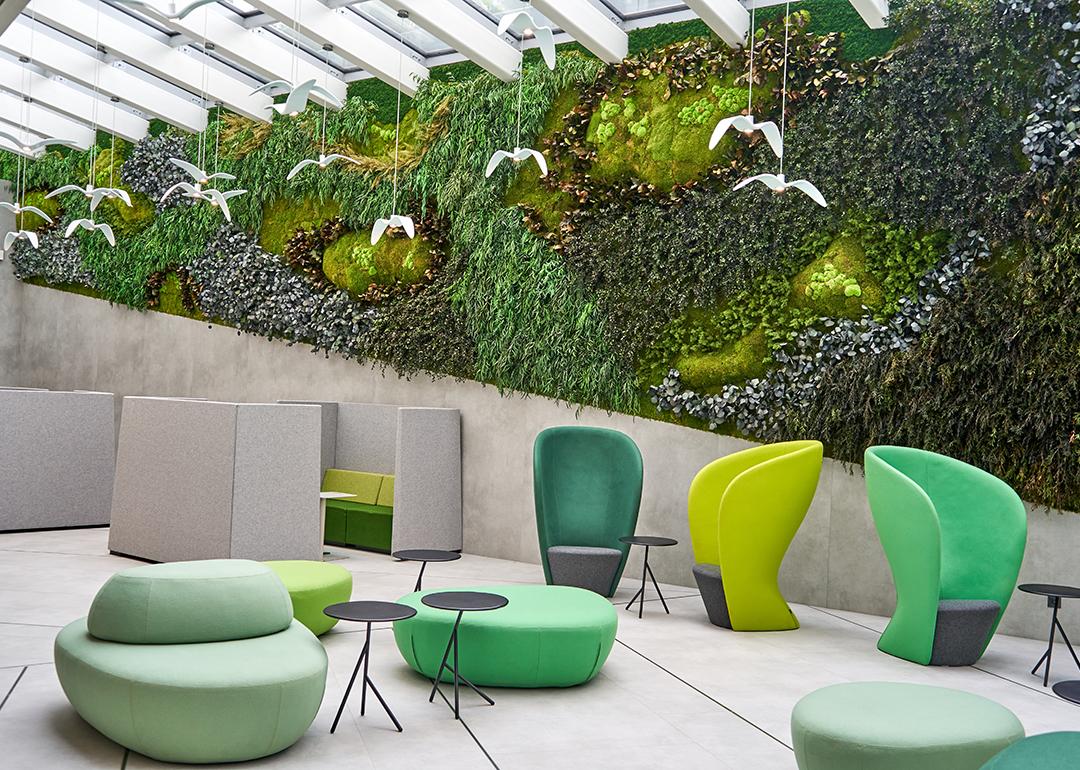
2. Bring the Outside In: The Case for Biophilic Design
Beyond light, the presence of living and natural things in the workspace is proven to reduce the stress hormone cortisol and enhance physical and mental well-being.
The Human Spaces research group found that employees in workplaces with strong biophilic features reported lower levels of stress and anxiety compared to those working in conventional office environments, and found creativity .
Speaking at the United Nations General Assembly's Science Summit in 2024, identified natural light, biophilic design, and acoustic management as the three pillars of what they termed ",鈥� spaces that actively restore cognitive function rather than merely avoid depleting it.
There are myriad ways to incorporate the natural world in our artificial office spaces. Fern walls and succulent gardens, water features, and the use of natural materials such as wood and stone all contribute to what environmental psychologists call "restorative environments,鈥� spaces that allow the prefrontal cortex to recover from the sustained cognitive load of modern knowledge work.
3. Design for Quiet: Acoustic Well-Being Boosts Productivity
Open-plan offices were widely adopted in the 2010s on the assumption that proximity fuels synergy and collaboration. The cost in concentration has been steep. , background noise in open offices鈥攑hone conversations, keyboard activity, footsteps, and HVAC systems鈥攃an reduce productivity on cognitive tasks by up to two-thirds, creating constant auditory distractions that make deep work nearly impossible.
"After any interruption鈥攊ncluding noise-driven ones鈥攚orkers take an average of 23 minutes and 15 seconds to fully return to their original task," notes Dr. Gloria Mark of the University of California, Irvine. A worker who is interrupted just four times in a morning loses nearly an hour and a half of productive time solely to recovery.
The antidote is zoning: a design language that provides collaborative areas and quiet retreats achieved through sound-absorptive wall panels, acoustic ceiling baffles, soft furnishings, and spatially separated focus zones. Salesforce's San Francisco offices include mindfulness areas and a library-inspired quiet zone on every floor. Microsoft's Building 83 in Redmond, Washington, designed by Bora and ZGF Architects, features acoustically insulated nooks and softly lit alcoves for private, distraction-free work alongside open collaborative areas.
4. Move More, Sit Less: Ergonomics as Mental Health Strategy
The connection between our physical posture and mental state flows both ways. Chronic sitting鈥攐ften in furniture poorly suited to how our bodies actually move鈥攃an cause physical stress, fatigue, mood dysregulation, and reduced ability to concentrate. Thankfully, ergonomic chairs and sit-stand desks, modular open-plan layouts, and dedicated relaxation and socialization areas are becoming standard, and some designers are pursuing ergonomics with rigor.
Yves B茅har, the San Francisco-based founder of fuseproject, designed Public Office Landscape for Herman Miller around the belief that the more people connect, the better they work. The modular system reimagines personal, group, and circulation desks as collaborative hubs that can be ergonomically configured鈥攖he inviting social chair can accommodate multiple workers and sitting postures and links to other chairs, desks, and storage units. Workers switch fluidly between deep-focus individual work and spontaneous conversations, meetings, and teamwork as they move through the office space. Ideas flow more quickly and with greater insight.
B茅har has described the result after his team relocated to a larger studio: "Having a variety of spaces to work and meet is great. This really speeds things along in our office, without sacrificing the exuberance and spontaneity of our old start-up space."
5. Create Community by Design, Not by Default
Loneliness is now a . Nearly two-thirds of U.S. workers say they have felt lonely at work, and 1 in 4 employees report not having a single friend in the workplace, . Research from Cigna estimates that loneliness costs U.S. employers in lost productivity, higher turnover, and increased healthcare expenses.
Former U.S. Surgeon General Dr. Vivek Murthy has framed the stakes plainly: "At work, loneliness reduces task performance, limits creativity, and impairs other aspects of executive function such as reasoning and decisionmaking."
Conversely, research consistently shows that workers who feel socially connected to colleagues are more engaged, more resilient, and significantly more likely to stay. Nearly two-thirds of employees say having friends at work makes them more likely to remain in a job. While periodic team-building events can help workers feel more connected, redesigning your floor plan around community鈥攍ounges, shared kitchens and dining spaces, meditation and yoga areas鈥攃reates space for connection all day, every workday.
6. Restore Autonomy Through Flexible Scheduling and Spaces
When workers feel they have no agency over when, where, or how they perform their best work, stress compounds rapidly. of 10,000 workers across six countries found that employees with rigid work schedules are 26% more likely to burn out than those with flexibility.
7. Invest in Wellness As Core Infrastructure
As 2026 takes shape, how we frame health and wellness, in work and life, is evolving, expanding beyond disease prevention and treatment to focus on longevity, performance, and quality of life. It tracks that wellness programming must move beyond reactive intervention and into the physical and social architecture of our workday.
In 2022, Gallup found that employees who believe their employer genuinely cares about their wellbeing are 69% less likely to seek another job, while teams with high engagement see 51% lower turnover and 23% higher productivity. Patagonia offers on-site and off-site yoga, an organic caf茅 at their headquarters, 100% college tuition reimbursement, and on-site childcare鈥攆inancial concerns, physical health, and family support are interconnected.
The data suggest that a comprehensive, strategically designed investment in employees鈥� social, mental, and physical health pays off. In 2010, Harvard Business Review reported that Johnson & Johnson鈥檚 leaders estimate that wellness programs cumulatively saved the company $250 million on health care costs in the previous decade; from 2002 to 2008, the return was . In Wellhub's 2024 Return on Wellbeing Report, 91 percent of HR leaders reported that healthcare benefit costs decreased as a result of their wellness program, 98 percent said their program reduces employee turnover, and more than half (56%) see $2 returned for every $1 invested.
was produced by and reviewed and distributed by 爆料TV.