How to make your website GDPR compliant in 8 steps
The is one of the world鈥檚 most comprehensive privacy laws that sets out strict requirements for how organizations should handle the personal information of individuals in the European Union (EU).
If you鈥檙e operating a website that processes EU-relevant personal user data, you鈥檒l have to align your data practices with the GDPR. Failing to do so can result in hefty financial penalties and corrective actions from regulatory authorities. (Note: After the UK鈥檚 exit from the EU, the United Kingdom implemented its own version of the law, known as the UK GDPR, which closely mirrors the EU GDPR. If your website serves or collects data from users in both the EU and the UK, you must ensure compliance with both frameworks.)
In this article, agentic trust platform to make your website GDPR compliant.
What is the GDPR, and how does it impact websites?
The GDPR sets rules to protect the personal data of people in the EU. It also grants them greater control over their information, including the right to access, correct, or delete it.
For , the GDPR lays out for processing personal data. These include:
- Transparency: Clearly communicating how and why data is collected
- Minimization: Collecting and storing only the minimum information necessary for a specific processing purpose
- Security: Implementing strong safeguards to prevent misuse or unauthorized access
Websites are often used to collect data, either through forms, cookies, or account signups, so they are typically subject to the GDPR. Even if your organization is based outside the EU, you must comply with the GDPR if your website is accessible to and collects data of people in the EU.
If you鈥檙e conflicted about whether to align your website with the EU or UK GDPR, here鈥檚 a quick breakdown:
- If your website targets or collects data from individuals in the EU, comply with EU GDPR.
- If your website targets or collects data from individuals in the UK, comply with UK GDPR.
- If your website targets or collects data from individuals in both regions, comply with both EU and UK GDPR (many companies simply adopt the stricter standard globally to streamline compliance).
鈥淓ven if only a small percentage of users are in the EU, GDPR is still applicable,鈥� says Connor Synder GRC subject matter expert at Vanta. 鈥淭ypically, the safest approach is to apply GDPR requirements and standards globally for simplicity and trust. In cases where this may not be practical, companies can take a hybrid approach by employing global core safeguards across the organization with EU-specific compliance for high-friction items as needed.鈥�
Why is GDPR compliance important for your website?
If your website falls in the scope of the GDPR, you鈥檙e legally obligated to follow all the requirements of the regulation. Noncompliance can result in of up to 鈧�20 million or 4% of your global revenue, whichever is higher.
Besides avoiding fines, there are other :
- Expanding into new regions: If you plan to enter the EU market, your website and operations must comply with the GDPR. Because many of the regulations鈥� requirements align with or exceed the standards of other international privacy laws, compliance can also streamline further expansion goals.
- Gaining and keeping trust: Demonstrating GDPR compliance shows your organization鈥檚 dedication to data security, which can help build trust among customers, partners, and investors.
- Strengthening data security: GDPR is one of the most rigorous data privacy laws, so implementing the required measures improves your organization鈥檚 security posture.
- Creating additional opportunities: A GDPR-compliant website signals strong data governance, which can give your business a competitive edge when finding potential partners.
8 steps to make your website GDPR compliant
Whether you鈥檙e operating within the EU and/or the U.K., or simply attracting visitors from there, these eight steps will help you align your website with the GDPR requirements and demonstrate accountability:
- Assess your GDPR compliance status
- Add permission requests where necessary
- Add data collection information to your website
- Investigate any third-party apps, plug-ins, or tools
- Create a way for data subjects to get in touch
- Update your data security
- Develop policies for GDPR compliance
- Confirm and document your GDPR compliance
Step 1: Assess your GDPR compliance status
The first step toward GDPR compliance is to assess how your website currently aligns with the regulation鈥檚 requirements. The assessment helps you understand your level of readiness and identify areas for improvement.
Start by conducting an internal , which involves:
- Reviewing to confirm they鈥檙e clear and up to date
- Assessing your controls against GDPR compliance criteria
- Determining whether all the information you鈥檙e collecting is necessary for processing activities
- Confirming whether your organization acts as a data controller, processor, or both, since
To make this process efficient, consider using that scans your website, security controls, and data processing practices against GDPR requirements. These tools can pinpoint gaps and risks, allowing you to prioritize updates that will have the largest impact on your website鈥檚 compliance status and user trust.
Step 2: Add permission requests where necessary
Consent is a key aspect of GDPR compliance. Under the regulation, websites must obtain explicit, informed consent before they start collecting user data. This is different from implied consent, where agreement is assumed when a user visits your website. Explicit consent requires a clear, affirmative action, such as clicking an 鈥淎ccept鈥� button before any data collection begins.
If your website collects data through cookies, analytics tools, mailing lists, or forms, you must inform users in advance and obtain their explicit consent before collecting nonessential data, as well as provide a way for them to opt out.
To ensure your consent process is transparent and compliant, you should:
- Display a clearly visible and accessible privacy notice on your website, explaining what data you collect and why
- Include simple opt-out options that allow users to withdraw consent at any time
- Add a link to your privacy policy in your website footer so visitors can review how their data is collected and used
Step 3: Add data collection information to your website
Transparency is another key principle of the GDPR. Your website must clearly inform visitors about:
- What data you鈥檙e collecting
- How you鈥檙e using this data
- How you鈥檙e processing the data
- Who can access this data
- Who you鈥檙e sharing the data with
- Whether the data is being shared across borders
- How long you retain the data
- Contact information visitors can use to exercise their
This information can be part of your privacy notice or policy and should be written in clear language free of jargon.
Step 4: Investigate any third-party apps, plug-ins, or tools
Third-party integrations are often essential for your website鈥檚 functionality, but they can also introduce new . Under the GDPR, you鈥檙e responsible for the data handling practices of any third-party apps, plug-ins, or tools that process data on your behalf.
Before integrating third-party software or services, conduct an assessment to verify they meet GDPR requirements and your internal criteria.
The biggest compliance gaps with third-party apps or plug-ins happen when functionality and efficiency are prioritized over data protection. Common issues include failing to disclose data sharing, improper , and excessive data collection.
To minimize these risks, you should:
- Conduct a technical assessment to ensure the third party has implemented adequate measures for protecting sensitive data
- Limit data collection and sharing to the minimum necessary for the stated purpose
- Define clear privacy and security expectations in your service-level agreements (SLAs) or data processing agreements (DPAs)
Step 5: Create a way for data subjects to get in touch
The GDPR grants individuals eight data subject rights, giving them greater control over their personal information and allowing them to hold organizations accountable. To comply, your website must make it easy for users to exercise these rights, which include accessing, correcting, or requesting the erasure of their data.
In practice, this means establishing clear communication channels, such as a phone number or an email address, that data subjects can use to reach your data protection officer (DPO) or privacy contact.
You should also establish structured, repeatable procedures for managing data subject requests to ensure you can address them within GDPR鈥檚 required time frames.
Document all requests and your responses to demonstrate compliance during audits or regulatory inquiries.
Step 6: Update your data security
To comply with the GDPR, you must protect all personal data collected through your website from unauthorized access and misuse. This requires implementing strong data security and access management measures, such as:
- Access controls
- Specific employee IDs
- Anti-virus software
- Firewalls
Beyond implementing specific safeguards, the GDPR emphasizes two key principles: 鈥減rivacy by design鈥� and 鈥減rivacy by default.鈥� Although closely related, they serve distinct purposes:
- Privacy by design means embedding privacy and data protection into every stage of system or product development, especially in the early stages rather than retrofitting controls after systems are built. It鈥檚 a proactive, architectural approach.
- Privacy by default ensures that all privacy-friendly settings are automatically enabled for all end users, without requiring manual configuration.
Another critical concept is data minimization: You should only collect, store, and process the least amount of data necessary to achieve the purpose of your processing activity.
Step 7: Develop policies for GDPR compliance
Establish clear governance policies that define responsibilities, guide decision-making, and ensure consistency across all GDPR data processing activities.
This includes creating and regularly testing an incident response plan. Under the GDPR, within strict time frames, typically 72 hours of detection. To minimize the risk of noncompliance, assign clear roles to each stakeholder and run regular simulations to make sure your team can respond quickly and effectively.
Your governance policies should also reinforce accountability across all GDPR-related activities, including how you manage data subject rights, maintain records, and monitor compliance processes.
Step 8: Confirm and document your GDPR compliance
Once your website meets the applicable GDPR criteria, you should maintain detailed documentation that demonstrates ongoing compliance in case of audits or regulatory reviews.
Some of the documentation you should keep includes:
- Record of processing activities (RoPA): A log mapping all personal data you collect, store, and process for a specific activity
- Data access logs: Records showing who accessed sensitive data and when
- DPAs and SLAs: Contracts with third parties that outline roles, responsibilities, and security obligations
- Training completion reports: Proof that all relevant stakeholders have completed GDPR awareness and compliance training
- Data protection impact assessment (DPIA) findings: Documentation of high-risk data processing activities and the measures you鈥檝e taken to mitigate threats
To make this process more efficient, use a compliance automation tool to regularly scan your website and confirm adherence to GDPR requirements. These tools automatically document your compliance controls, helping you ensure that user data is adequately protected and minimizing the risk of noncompliance.
Additional tips for maintaining GDPR website compliance
Making your website GDPR compliant is only the beginning鈥攌eeping it that way requires continuous oversight and regular updates as your operations and regulations evolve. GDPR compliance efforts should be reviewed at least once a year, and more often if you experience significant changes to your operations.
Here are a few practical tips to help you maintain compliance:
1. Assign a data protection officer
A data protection officer (DPO) is a stakeholder within your organization responsible for overseeing GDPR compliance and ensuring all privacy-related activities are coordinated and monitored. Having a designated leader helps centralize accountability, streamline decision-making, and maintain consistent adherence to data protection requirements.
Under the GDPR, appointing a DPO is only mandatory for:
- Public authorities
- Organizations that process large volumes of sensitive data
- Organizations that conduct large-scale, systematic monitoring of individuals
If your organization doesn鈥檛 meet these criteria, you are not required to appoint a DPO (although it鈥檚 still considered a security-first practice).
If your organization is not established in the EU or the UK but targets or monitors individuals in those regions, you may also need to appoint:
- An EU Representative (EU GDPR Article 27)
- A UK Representative (UK GDPR Article 27)
These must be separate entities, since the UK and EU are distinct jurisdictions post-Brexit. For example, a US-based SaaS company with customers in both France and the UK would need:
- One DPO (if required by law)
- One EU Representative (based in the EU)
- One UK Representative (based in the UK)
2. Use HTTPS for data encryption
Protecting data in transit is a crucial aspect of GDPR compliance. The most effective way to secure your website鈥檚 traffic is by using HTTPS instead of HTTP.
HTTPS encrypts the data exchanged between your website and its visitors, preventing unauthorized access. It also enhances user trust and boosts your website鈥檚 credibility, as modern browsers now flag non-HTTPS sites as 鈥渘ot secure.鈥�
3. Integrate data protection principles into your security controls
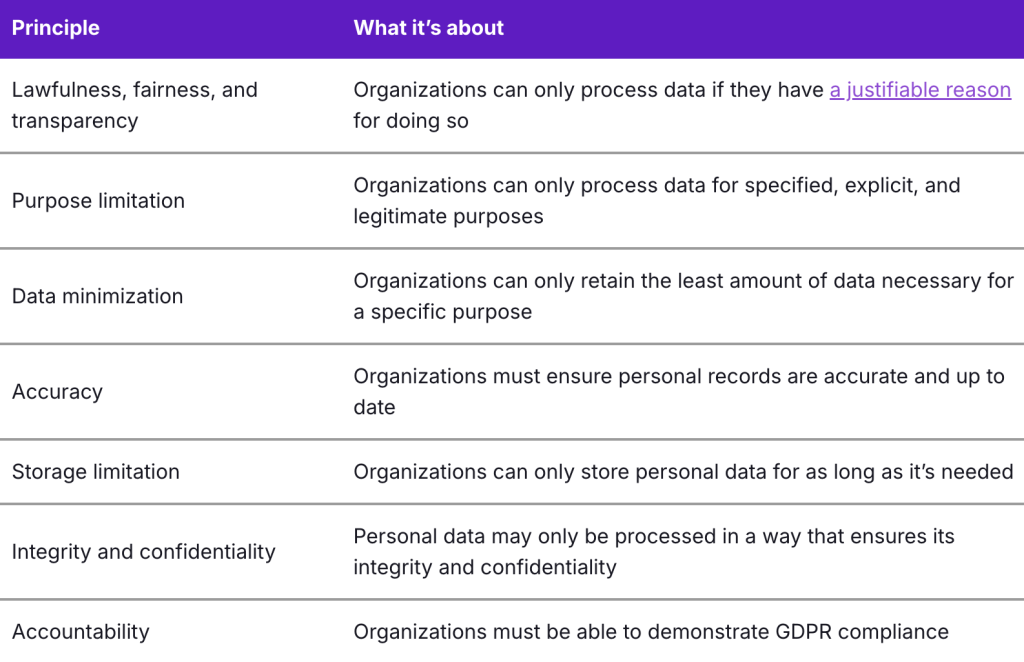
A key best practice of GDPR compliance is designing your security controls around the regulation鈥檚 . These principles shape how you collect, store, and process personal data, and particularly help your website data handling and supporting systems remain compliant and transparent.
Here鈥檚 quick overview of what the seven principles mean in practice.
4. Conduct regular data protection impact assessments
Before starting any new data processing activity, especially one that involves highly sensitive personal information, determine whether a data protection impact assessment (DPIA) is required.
Under the GDPR, DPIAs are mandatory when processing activities are likely to result in a high risk to individuals鈥� rights and freedoms, such as when using new technologies, tracking user behavior, or performing automated decision-making that could significantly affect data subjects.
While the GDPR does not specify exactly how to determine whether processing meets this 鈥渓ikely high risk鈥� threshold, many organizations use a threshold assessment as a best-practice step. A threshold assessment is a short screening exercise that helps you decide whether a full DPIA is necessary and documents your reasoning, demonstrating accountability under the GDPR.
The DPIA process involves:
- Describing the processing activity and its purpose
- Evaluating the necessity of the processing activity
- Identifying the potential risks to individuals
- Outlining measures taken to mitigate these risks
5. Anonymize sensitive data
Make sure that sensitive personal information can鈥檛 be traced to specific individuals by using various anonymization techniques, such as:
- K-anonymity: Grouping similar types of data so individuals can鈥檛 be singled out
- Randomization: Changing data values in a controlled way to make re-identification more difficult
- Masking: Replacing identifiable information with fictitious or scrambled data
6. Leverage automation
Maintaining GDPR compliance is an ongoing, resource-intensive process that demands continuous monitoring, documentation, and adaptation to evolving regulations. Relying solely on manual oversight can overwhelm teams, introduce inconsistencies, and increase the likelihood of human error鈥攁ll of which can lead to compliance gaps and regulatory exposure.
To manage this complexity efficiently, adopt an automated GDPR compliance platform that centralizes evidence collection, control testing, and reporting. Automation reduces repetitive manual work, accelerates audits, and provides real-time visibility into your organization鈥檚 compliance posture.
By integrating automation into your compliance program, your teams can focus on strategic data protection, proactive risk management, and continuous improvement, rather than chasing spreadsheets or manually tracking updates. The result is a stronger, more resilient compliance foundation that scales with your organization鈥檚 growth.
FAQs
Do I need a cookie banner in the EU?
Yes. Under the GDPR, you must obtain explicit consent before you can store any nonessential tracking cookies, such as those used for advertising or analytics.
Is Google Analytics GDPR compliant?
Google Analytics is generally considered a data processor under the GDPR, meaning it must comply with the regulation鈥檚 requirements.
Does GDPR apply to US websites?
The GDPR applies to US websites if they鈥檙e accessible to individuals in the EU and collect their data, offer goods or services, or monitor their behavior.
What if my website is not GDPR compliant?
If your website falls within the GDPR鈥檚 scope but doesn鈥檛 meet its requirements, you may face substantial fines and penalties as well as operational disruption.
How do I check if my website is GDPR compliant?
You can determine your website鈥檚 GDPR compliance by conducting an internal audit against relevant requirements or relying on an automated tool that scans your website, identifies risks, and provides actionable recommendations for remediation.
was produced by and reviewed and distributed by 爆料TV.