
How much do US companies save by hiring in Latin America?
If you鈥檝e spent any time thinking about hiring outside the U.S., you鈥檝e probably heard some version of this already: 鈥淐ompanies do it to save money.鈥�
That part isn鈥檛 surprising. But what many teams aren鈥檛 sure about is how much they鈥檇 save, and whether those savings are worth the perceived hassle of hiring internationally or having to work with a specialist recruiting partner or platform.
If you鈥檙e facing budget constraints, struggling to fill roles, or just trying to make your hiring dollars go further, this article is meant to help you answer one simple question: Is hiring in Latin America worth it?
To answer that, looked at data from its , which analyzed over 2,000 hires made by U.S. companies over the past year across 400 types of roles.
The savings, timelines, and patterns you鈥檒l see below reflect what companies are experiencing right now, not what鈥檚 theoretically possible.
Key Takeaways
- U.S. companies save $35,000 to $64,000 annually per hire when bringing on Latin American talent compared to equivalent U.S. positions, with savings ranging from 30%-70% depending on role and seniority level.
- Most companies hire in Latin America with a recruiting or staffing partner, and while fees apply, the majority of salary savings are preserved, making the ROI compelling.
- Hiring in Latin America works best for remote-friendly, self-directed roles. But any role that can be done remotely can be hired for in LatAm.
What companies save by hiring in Latin America compared to in the US
On average, U.S. companies save $35,000 to $64,000 annually per hire when they bring on Latin American talent compared to equivalent U.S. positions. That鈥檚 30%-70% in cost savings, depending on the role and seniority level.
The savings exist because of differences in the labor markets and cost of living. They are not a result of compromising on talent quality.
Here鈥檚 what the difference in salaries looks like for a selection of roles.
US vs. LatAm Salary Ranges
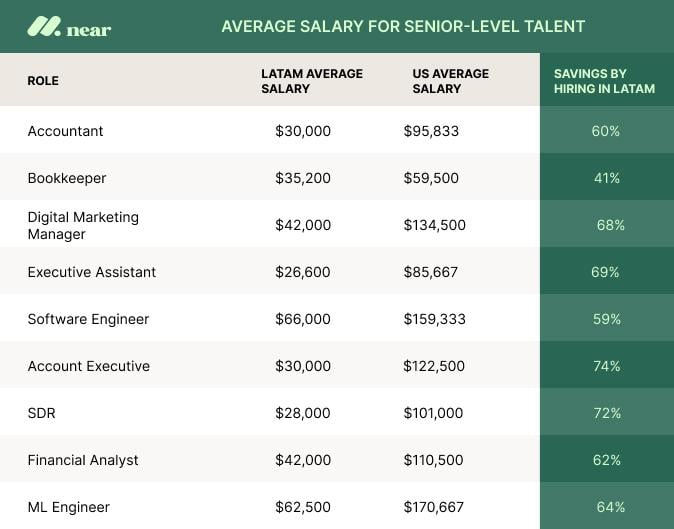
These aren鈥檛 marginal differences. Often, for the cost of one U.S. hire, you can bring on two to three experienced professionals from Latin America. Or you can hire a far more experienced person than you thought you could.
And, in fact, that is something more teams are doing.
The State of LatAm report shows that 84% of hires were for mid-level or senior positions. Most companies aren鈥檛 hiring junior talent in LatAm; they鈥檙e accessing experienced professionals who bring real expertise to their teams.
Plus, Latin American professionals working with U.S. companies often earn well above their local market rates, which can mean strong retention and genuine commitment to their work.
Hiring in Latin America isn鈥檛 just about saving money
The real value from isn鈥檛 just the lower salaries, though. It鈥檚 being able to hire the team you actually need instead of the scaled-down version your budget forces you to settle for.
With nearshore hiring, companies can:
- Fill roles they鈥檝e been unable to fill domestically because the salary expectations are too high.
- Access senior-level expertise they couldn鈥檛 afford or find in the U.S. market.
- Build entire departments before their budgets would otherwise allow.
- Redirect savings into growth initiatives, better tools, or strategic hires they otherwise couldn鈥檛 make.
- Scale operations 40%-100% or more in a single year without proportionally scaling costs.
When the math doesn鈥檛 work (even if the numbers look good)
This is important, and it鈥檚 something that doesn鈥檛 get said enough.
Hiring in Latin America is not a fit for every situation.
Even if the cost savings are there, it may not work well if:
- The rest of your team is fully in-office, and you鈥檙e hiring one remote person into a highly collaborative role. (For example: a remote marketing manager expected to Zoom into daily brainstorms with an in-office team.)
- You don鈥檛 have any remote infrastructure at all. You have no async workflows in place, no documentation, and no comfort with distributed work.
- 鈥�The role requires constant, real-time coordination with many stakeholders, and there鈥檚 no willingness to adapt how the team works.
That said, it can still work well for roles that are:
- More self-contained (accounting, bookkeeping, operations), even if the rest of the team is in the office.
- Primarily working with a founder or small leadership group.
- Measured on outputs rather than constant collaboration.
The setup matters just as much as the potential savings. If the role can be done remotely and the company already has other team members 鈥淶oom-ing in,鈥� hiring in LatAm is a great option.
So is hiring in Latin America worth it for US companies?
For most U.S. companies that are already open to remote work, the answer is yes.
Not because hiring in Latin America is 鈥渃heap,鈥� but because:
- The savings due to cost-of-living differences are substantial.
- The talent is skilled and experienced.
- The process is often faster than U.S. hiring with the right partner.
- The ROI holds up even after partner fees.
There is a fairly consistent pattern with companies:
- They start with one hire to test the waters.
- They experience both the cost savings and the seamless process.
- They return for another hire. Then another.
- Within months, they鈥檙e scaling from a few placements to entire teams.
- They expand hiring across multiple departments.
Final thoughts
The savings from hiring in Latin America are real and substantial. For most roles, you鈥檙e looking at $35,000 to $64,000 saved per hire.
Once teams understand the financial upside, their next questions tend to be broader:
- What roles are companies hiring for in Latin America?
- Which countries are best for different functions?
- What seniority level are companies hiring for?
- How long does hiring typically take?
The annual report looks beyond just cost savings. It breaks down the roles U.S. companies are hiring for most often, where they鈥檙e hiring, how senior those hires are, and what companies are actually achieving once they build teams in Latin America.
The full report goes beyond the focus of this article about the financial side of nearshore hiring. The data will give you a fuller picture of what hiring in Latin America looks like in practice today and whether it makes sense for your team.
Frequently Asked Questions
Can I hire outside the U.S. without working with a partner?
Yes, you absolutely can. But how you do it matters.
If you don鈥檛 have a local legal entity in the country where you鈥檙e hiring, your main options are:
- Employer of Record (EoR):
An on your behalf, handles payroll, taxes, benefits, and compliance, and invoices you monthly. This is the most common DIY route for companies hiring full-time international employees without setting up an entity. - Independent contractors or freelancers:
You can hire directly as a contractor or use a . This can work for short-term or project-based roles, but it comes with trade-offs around long-term retention, IP protection, and role continuity.
or work with a recruitment or staffing partner to handle sourcing, vetting, market-specific compensation guidance, and speed.
Are the savings from hiring in LatAm still real after factoring in recruiting or staffing fees?
In most cases, yes.
Partner fees or EoR costs don鈥檛 erase the savings because:
- Fees are typically fixed, one-off, or short-term.
- Salary savings recur every year.
- The larger the role鈥檚 seniority (e.g., higher salary), the stronger the ROI.
Even after fees, companies typically see 30%-50% net savings compared to equivalent U.S. hires (while also reducing time-to-hire and internal recruiting effort).
Are Latin American professionals fluent enough in English for day-to-day work?
English proficiency varies significantly, of course, but many Latin American professionals have excellent English skills, especially those who鈥檝e worked with U.S. companies before.
What to look for:
- Previous experience working with U.S. or international companies.
- University education (many Latin American universities require English).
- Technical roles often have strong English skills due to working in English-language codebases, documentation, and global teams.
How to assess it:
- Conduct video interviews to evaluate spoken English.
- Test comprehension with complex questions, not just scripted answers.
- Ask about their experience communicating with English-speaking teams or clients.
- Have them explain technical concepts or walk through their work process.
The advantage of hiring through a recruiter or staffing partner is that they pre-screen for English proficiency, so you鈥檙e not sorting through candidates who don鈥檛 meet your communication requirements.
What if the person I hire doesn鈥檛 work out?
This depends on your hiring model and who you work with.
- Contractors: Since they鈥檙e not employees, you can end the relationship with standard contract terms (often 30 days鈥� notice, though this varies). There鈥檚 less legal complexity than terminating a U.S. employee.
- Through a staffing partner: Most reputable partners offer replacement guarantees. If the hire doesn鈥檛 work out, they鈥檒l find a replacement at no additional placement fee.
- Through an EOR: The EOR handles the offboarding process and local employment law compliance. You鈥檙e protected from legal complications, but you may still be responsible for severance depending on the country.
Best practices to reduce risk:
- Start with a paid trial period or project before committing to full-time.
- Set clear expectations and success metrics upfront.
- Schedule regular check-ins during the first 90 days.
- Have a (make sure the person has clear support and communication channels).
- Make sure your .
Most companies find that with proper vetting and onboarding, Latin American hires have retention rates comparable to or better than U.S. hires, especially when they鈥檙e earning above-market rates for their region.
What roles do US companies typically hire for in Latin America?
The most commonly hired roles include software engineers, accountants and bookkeepers, sales development representatives (SDRs/BDRs), customer support specialists, and executive and virtual assistants.
Companies often start with one of these roles to test the process, then expand to other positions.
was produced by and reviewed and distributed by 爆料TV.