‘Stage is shifting rapidly’ for high schools: Are states helping them keep up?
The rise of artificial intelligence and other technology has traditional high schools scrambling to keep up, with states doing an uneven job of encouraging schools to embed critical thinking skills and offer students access to internships and college courses, according to a new report reviewed by .
Today’s world, the nonprofit XQ Institute argues in its new report , “requires an entirely new kind of educational experience — one that traditional high schools were never designed to deliver.”
“We live in an age of self-driving taxis, blockchain, and renewed interest in space exploration. The public launch of ChatGPT placed a powerful form of generative artificial intelligence (AI) within the reach of every American,” the report continued. “But that stage is shifting rapidly. Our young people are growing up at a time when the economy and workforce are in constant flux. And high schools must keep pace.”
Schools not only need to emphasize work and early college experiences, XQ found, but also teach interpersonal and thinking skills as much as academics.
“What do we need to know when we leave our high school doors?” asked XQ CEO Russlynn Ali. Math, English and science are still important, she said.
“But layered on top of that, we need to be critical thinkers,” Ali said. “We need to be able to collaborate. We need adaptability. We need these skills that will help us succeed in life, no matter what direction we choose after we leave high school.”
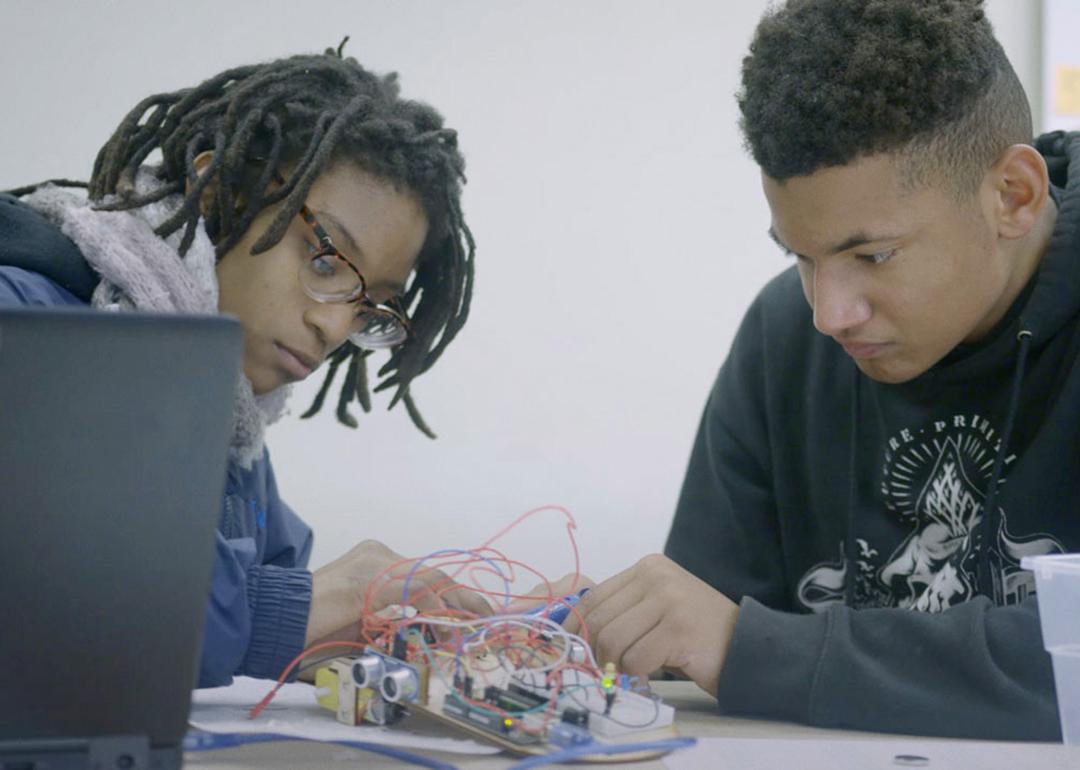
XQ wants states to encourage schools to follow the lead of or the in Grand Rapids, Michigan, where students learn academics and interpersonal skills through projects, not lectures. Another standout: , where every 10th grader follows an adult through a work day to learn about the job, 11th graders have month-long internships and older adults can choose to do a longer one.
The new report takes a different approach from XQ’s previous work, which has centered on schools.
“States have more responsibility and authority over their schools than certainly in recent memory, if not in my lifetime,” Ali said. “They must be the locus of change.”
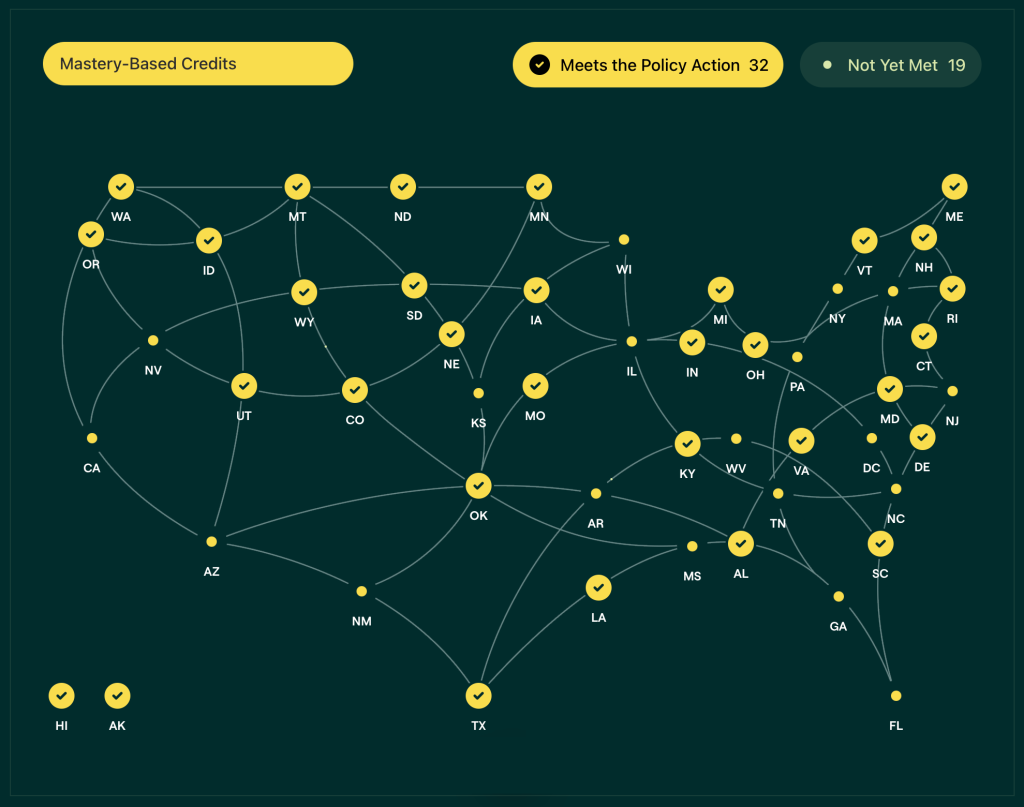
States are mixed, however, XQ reports in the new study, on how they are succeeding in meeting 10 goals XQ considers key to school innovation. XQ met with school leaders across the country to create the goals — and then researched how much progress each state and Washington D.C. has made toward them:
- 46 states have met the goal of offering work experience, such as internships, as credit toward high school diplomas.
- 38 states give every student a chance to earn college credit before graduating, by taking Advanced Placement, International Baccalaureate or college classes.
- 32 states give schools the ability to award students class credit under a , showing they know the material, instead of just attending a class.
- 32 states have identified key skills students need to learn for the future, including nonacademic skills XQ has made a major part of its work, such as teamwork, critical thinking and problem solving. States often created a “Portrait of a Graduate” spelling these out.
- Just 10 states — Indiana, Michigan, Minnesota, North Dakota, Oklahoma, Rhode Island, Utah and Washington — met six of the goals; and no state met all 10, though 31 met at least four. Two states — Alaska and Florida — met only two of the goals.
- Two of XQ’s goals — finding ways to measure how well students have learned interpersonal and thinking skills, then showing those on report cards — haven’t been realized by any state.
XQ plans to track changes and update the report every two years for the next decade.
“I think of these as a start, definitely not a finish line,” Ali said.
To highlight the 10 policy goals and encourage states to adopt them, XQ is planning to visit schools and policymakers in 25 communities, likely over the next two years. Details of that tour, which starts March 4 in Indianapolis and stops in Columbus, Ohio, the week after, are still being developed.
XQ, a nonprofit and affiliate of investing and philanthropic firm Emerson Collective, was cofounded by Ali and Laurene Powell Jobs. Powell Jobs is Emerson’s founder and president, and wife of the late Apple founder Steve Jobs.
XQ has been refining its vision for redesigning high schools since launching in 2015 with a to identify and support innovative “Super Schools” across the country. It gave a total of $102 million in 2016 to 18 schools — including the schools mentioned above — before expanding its work to 28 states.
XQ’s vision has its , who say it and who are to prepare students. But school districts and several states, including Indiana, Rhode Island and Utah, agree with the approach and are open in their support.
Utah’s state superintendent, Molly Hart, said the state rarely adopts any national approach, but there is great overlap in what XQ promotes and the state’s push to redesign high schools, including the support of mastery teaching approaches and requiring students to earn a meaningful professional credential before graduating.
”We align closely when you look at some of the goals and policy actions that XQ does,” she said. “We have a lot of similarities in what we’re looking at.”
The report, and shorter reports XQ released for individual states, also highlight policy changes and efforts already in place that XQ considers “beacons” for change. Among them:
- Indiana: For giving schools increasing flexibility in giving students class credit for showing proficiency in a subject, rather than just sitting through a class all semester or year.
- Rhode Island: For changing diploma requirements so that all students, beginning in 2028, must take the courses in math, foreign language and even art that qualify them to attend college.
“Our kids were not even taking the classes to be able to apply to those schools,” said state education commissioner Angelica Infante-Green. “Once they got there, they were in remedial courses because we weren’t preparing them for college-level achievement.” - Texas: For allowing students to earn 12 hours of college credit in high school, either through college, AP or International Baccalaureate classes.
- Colorado: For encouraging the growth of CareerWise high school apprenticeships, the largest youth apprenticeship program in the country. Colorado also broke career preparation into three categories — Learning ABOUT Work, Learning THROUGH Work, and Learning AT Work.
- Utah: For giving schools grants to train teachers how to educate students using a mastery/competency approach and how to rate student progress. Utah also backed some schools in trying out vastly different report cards — keeping the traditional A-F grade scale, but also giving students a
Ali said XQ also wanted to highlight two goals that haven’t been met yet, but that she considers vital — developing tests to measure how well students have learned key nonacademic skills and then changing student report cards to rate students on those skills.
Ali said the standardized tests states use to measure student skills in math, English and science offer some sense of what students know, but are outdated. There’s no clear way yet to assess how well students have mastered durable skills to prove to colleges or employers that they have those skills. And Ali said that schools tend to prioritize learning the state measures and judges them on, so schools won’t teach them vigorously until they are part of report cards and school ratings.
But XQ recognized 12 states for trying to develop those tests and report cards, six of them for participating in a pilot project with the Educational Testing Service, the Carnegie Foundation for the Advancement of Teaching and the Mastery Transcript Consortium (now part of ETS). The , starting with three: collaboration, communication and critical thinking.
XQ is not part of this effort but partners with Carnegie on some related work and says it enthusiastically backs it.
The Skills for the Future team, which includes Indiana, Missouri, North Carolina, Nevada, Rhode Island and Wisconsin, is still working on creating new tests but recently broke down each of those three skills into smaller skills as one step toward creating tests.
Communication, for example, is broken down into segments — presentation skills, making messages more clear, adapting messages for different audiences or comprehending the communication of others — that are then broken down further into sub-skills.
Infante-Green said measuring these skills will be a “game changer.”
“I think it will give employers things that they have been looking for, as well as change how we teach, what we teach, and how we incorporate (those skills) into the academic field,” she said. “It’s important. It won’t be one or the other, it’ll be both.”
Ali also stressed that just passing policy changes won’t be enough. Schools, teachers and parents need to also be on board.
“It’s not a checklist,” Ali said. “It has to be implemented in a way that is sustained and empowering and supportive of what needs to happen in the classroom.”
Disclosure: XQ provides financial support to .
was produced by and reviewed and distributed by ±¬ÁÏTV.