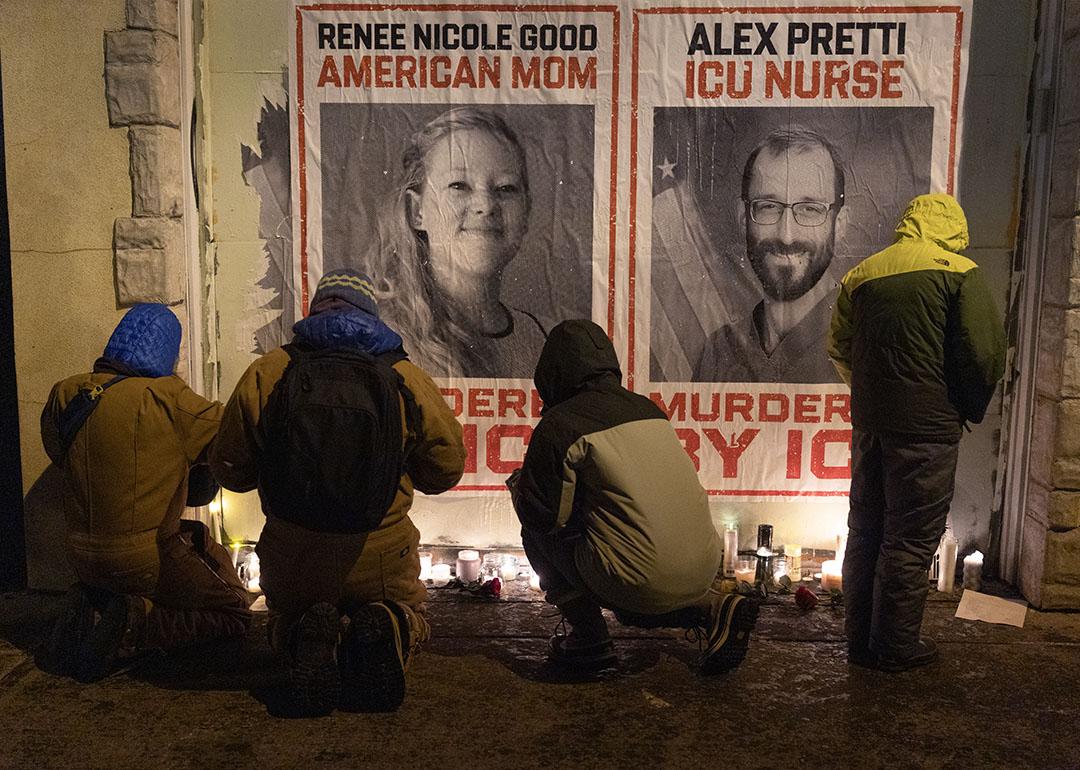
There’s a process for investigating killings by federal officers. Minneapolis is a ‘complete aberration’
There’s a process for investigating killings by federal officers. Minneapolis is a ‘complete aberration’
For weeks after an ICE officer’s killing of Renee Good in Minneapolis, and again in the aftermath of the fatal shooting of Alex Pretti, the Trump administration moved aggressively to and the investigative process. High-level officials , while insisting that and to key evidence. Minnesota Bureau of Criminal Apprehension superintendent Drew Evans told local reporters that in his more than 20 years of experience, he had never been denied access to a crime scene. But after the administration received a barrage of criticism, including , the dam began to break.
In the days since, Trump officials have , floated the idea of , and President Donald Trump personally told Minnesota Gov. Tim Walz that he would direct the Department of Homeland Security to allow Minnesota .
That access matters, but it can't rewind the first minutes and hours after a shooting when ballistic evidence must be collected and witnesses and participants need to be interviewed. Kevin Flynn, a former assistant U.S. attorney for the Department of Justice in Washington D.C., served under seven presidents and investigated scores of shootings. He told that if these processes are done poorly or not at all, the investigation is “fatally flawed.â€
“What we have right now are multiple videotapes, which are extremely compelling. And I personally think that they make   all by themselves a case for a murder prosecution,†Flynn said. But he warned that how the public sees such videos is much different than being a juror or a judge evaluating a case that is also missing essential evidence.
He described the way the federal government tried to shut out state investigators as a “complete aberration.â€
Typically, when a shooting takes place, investigators first establish a perimeter around the scene, canvas for bullet fragments and shell casings, and then photograph this evidence. Firearms — whether they’re fired by an officer or alleged to have been possessed by a suspect — are central evidence in almost any shooting because they anchor later ballistics work and help investigators reconstruct what happened.
Writing for Just Security, Julia Gegenheimer, a former DOJ prosecutor, speculated about who handled Pretti’s shooting. She referred to a photo of the gun the 37-year-old was alleged to be carrying, taken on the seat of a car, later . “Even if its precise location and condition on the scene had been documented earlier, by the time of the photograph, the gun had not been placed in an evidence bag, labeled, or stored securely,†Gegenheimer wrote. “Without additional documentation, the photo raises serious questions about the reliability of any later ballistics or forensic testing on that item.â€
According to Eliot Prescott, the inspector general for the state of Connecticut, the entity that secures a scene matters as much as the fact that it is secured. The Connecticut legislature to conduct of police use of deadly force in the state following the George Floyd protests in 2020.
Speaking about investigations in Connecticut, Prescott said that outside of rendering aid or other urgent matters, the protocol for officers involved is to not touch anything and wait for investigators to arrive. He said his office also puts a premium on avoiding conflicts of interest and assigning investigators from other regions to probe a shooting. “We can’t have officers investigating the very officers they work with day in and day out,†he said.
In Minneapolis, by contrast, some critics of the administration’s approach are concerned that members of Homeland Security Investigations, who work hand in glove with ICE and Border Patrol agents, . The FBI would typically take the lead, according to The Wall Street Journal. On Friday, DHS announced that the , in another apparent concession by the administration.
Likewise, two former officials at the Border Patrol’s Office of Professional Responsibility, which typically investigates shootings alongside the FBI, , writing that Homeland Security Investigations “does not have the mandate or expertise to conduct civil rights use-of-force investigations.â€
Investigators with Minnesota’s Bureau of Criminal Apprehension do have that expertise but were kept away from the scenes of both Good and Pretti’s shootings. To ensure that evidence would be preserved in the Pretti shooting, the BCA filed a lawsuit, resulting in a from destroying evidence. On Friday, the Department of Justice announced that into Pretti’s killing. Earlier this month, the department declined to open a similar investigation of Good’s killing.
Prescott said his office has investigated shootings involving federal agents before, and while some things are different in those cases, historically, the expectation of collaboration made that manageable. In one case, prior to his tenure, Prescott recalled that the federal officer’s handgun was sent to an FBI lab for testing, rather than a state lab. But even though the state did not have direct access to the gun, Prescott said the FBI provided the forensic reports back to the Office of the Inspector General.
“Before this federal administration started, there was a sense that these investigations would be done cooperatively,†Prescott said regarding Trump’s second term. “Do I have confidence that cooperation would extend into these days? No.â€
Prescott said his office is gaming out the legal possibilities of a battle over jurisdiction in his own state based on what he’s seeing in Minnesota — and he isn’t the only state-level official thinking about sovereignty in the face of federal threats. In a , California Attorney General Rob Bonta concluded that despite a long history of working with the feds in these kinds of cases, “cooperation in the conduct of such investigations can no longer be expected from the federal government.†He declared that “California stands ready to take all necessary steps to investigate potentially unlawful conduct by federal agents that occurs on our soil,†citing recent events in Minneapolis.
To be sure, neither the presence of local investigators nor any federal agency can guarantee that officers will face criminal accountability in fatal shootings. , and convictions are even rarer.
Douglas Kelley, a former assistant U.S. attorney for Minnesota, firmly believes in the process of investigating uses of force in his state. “There are times when the [Minnesota Bureau of Criminal Apprehension] and the FBI come up with unpopular conclusions, but I believe they’ve been the right conclusions,†he said, adding that the two agencies working together “produce results that you can trust.â€
Kelley’s fear now is that this cooperation has been irreparably damaged: “If the local FBI was able to do its job without influence from above, I would have all the confidence in the world that they would be objective and come up with the correct answer, but the authority that’s being exercised against them from Washington is terribly concerning.â€
For Kelley, it’s not solely these investigations that are at stake. He worries that the Trump administration’s response to the killings of Good and Pretti sent a dangerous message to agents, essentially saying: “We don’t want you to be charged. But if you did get charged, you’d probably get a pardon if it was in the federal system.’ And to me, that says, ‘Go at it. You’re out in Minnesota, you’re authorized to do rough things.’â€
was produced by and reviewed and distributed by ±ŹÁÏTV.