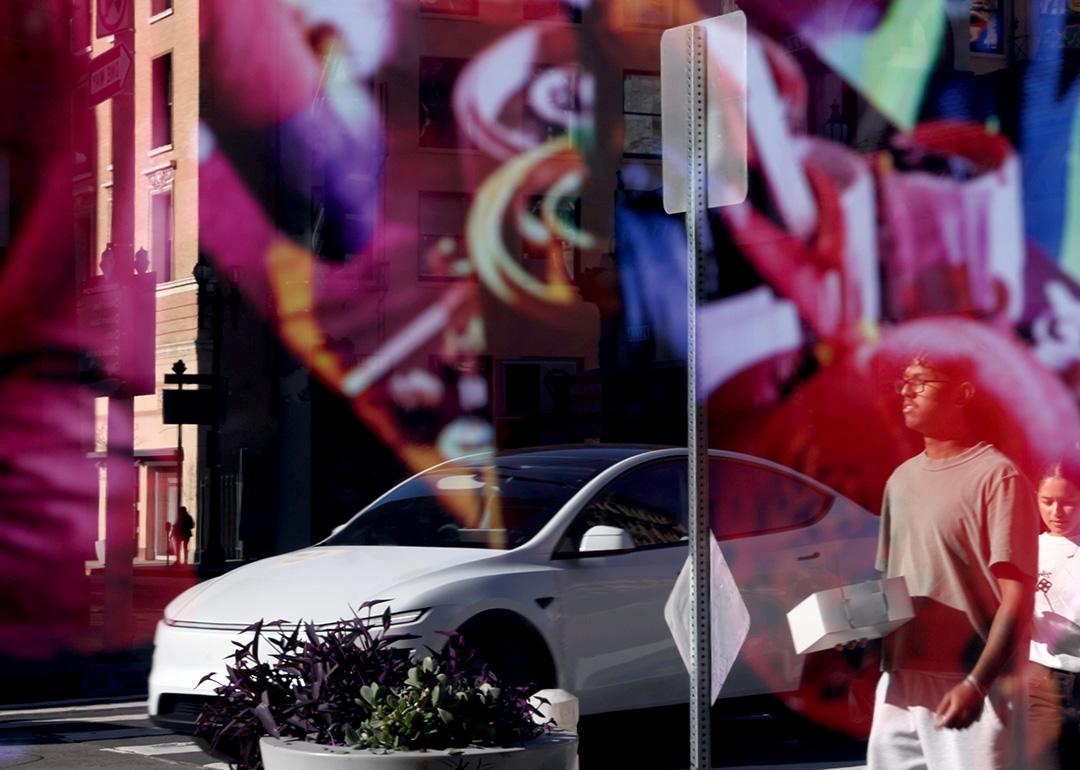
EVs are already making your air cleaner
EVs are already making your air cleaner
The logic behind electric vehicles benefiting public health has long been solid: More EVs mean fewer internal combustion engines on the road and a reduction in harmful tailpipe emissions. But now researchers have confirmed, to the greatest extent yet, that this is indeed what鈥檚 actually happening on the ground. What鈥檚 more, they found that even relatively small upticks in EV adoption can have a measurably positive impact on a community.
Whereas previous work , a in the journal Lancet Planetary Health used satellites to measure actual emissions. The study, conducted between 2019 and 2023, focused on California, which has among the highest rates of EV use in the country, and nitrogen dioxide, one of the gases released during combustion, including when fossil fuels are burned. Exposure to the pollutant can contribute to heart and lung issues, or even premature death. Across nearly 1,700 ZIP codes, the analysis showed that, for every increase of 200 electric vehicles, nitrogen dioxide emissions decreased by 1.1 percent.
鈥淎 pretty small addition of cars at the ZIP code level led to a decline in air pollution,鈥� Sandrah Eckel, a public health professor at the University of Southern California鈥檚 Keck School of Medicine and lead author of the study, told . 鈥淚t鈥檚 remarkable.鈥�
The group had tried to establish this link using Environmental Protection Agency air monitors before, but because there are only about 100 of them in California, . The data also were from 2013 through 2019, when there were fewer electric vehicles on the road. Although the satellite instrument they ultimately used only detected nitrogen dioxide, it did allow researchers to gather data for virtually the entire state, and this time the findings were clear.
鈥淚t鈥檚 making a real difference in our neighborhoods,鈥� said Eckel, who said a methodology like theirs could be used anywhere in the world. The advent of such powerful satellites allows scientists to look at other sources of emissions, such as factories or homes too. 鈥淚t鈥檚 a revolutionary approach.鈥�
Mary Johnson, who researches environmental health at Harvard University鈥檚 T.H. Chan School of Public Health and was not involved in the study, said she鈥檚 not aware of a similar study of this size, or one that uses satellite data so extensively. 鈥淭heir analysis seems sound,鈥� she said, noting that the authors controlled for variables such as the COVID-19 pandemic and shifts toward working from home.
The results, Johnson added, 鈥渢otally make sense鈥� and align with other research in this area. When London implemented congestion pricing in 2003, for example, . That is the direction this latest research could go too. 鈥淭hey didn鈥檛 take the next step and look at health data,鈥� she said, 鈥渨hich I think would be interesting.鈥�
Daniel Horton, who leads Northwestern University鈥檚 climate change research group, also sees value in this latest work. 鈥淭he results help to confirm the sort of predictions that numerical air quality modelers have been making for the past decade,鈥� he said, adding that it could also lay the foundation for similar research. 鈥淭his proof of concept paper is a great start and augurs good things to come.鈥�
Eckel hopes that, eventually, advances in satellite technology will allow for more widespread detection of other types of emissions, too, such as fine particulate matter. That could even help account for some of the potential downsides of EVs, which are heavier and could therefore kick up more tire or brake dust than their gasoline counterparts. On the whole, though, she believes the picture overwhelmingly illustrates how driving an electric car is better not just for the planet but for people.
Research like this, she says, underscores the importance of continued EV adoption, the sales of which , and the need to . Although lower-income neighborhoods have historically borne the brunt of pollution from highways and traffic, they can鈥檛 always afford the relatively high cost of EVs. Eckel hopes that research like this can help guide policymakers.
鈥淭here are concerns that some of the communities that really stand to benefit the most from reductions in air pollution are also some of the communities that are really at risk of being left behind in the transition,鈥� she said. Previous research has shown that EVs could in children, and detailed data like this latest study can help highlight both where more work needs to be done and what鈥檚 working.
鈥淚t鈥檚 really exciting that we were able to show that there were these measurable improvements in the air that we鈥檙e all breathing,鈥� she said. Another arguably hopeful finding was that the median increase in electric vehicle usage during the study was 272 per ZIP code.
That, Eckel says, means there is plenty of opportunity to make our air even cleaner.
was produced by and reviewed and distributed by 爆料TV.