S. Richard Cervera // INRAE
1 / 1Beekeepers and scientists defend the honey bees
It's unclear exactly who developed the initial idea for electric harps, but the earliest mention of it online is by a French beekeeper, published in 2015 鈥� several years before Costa first discovered them. The concept remained relatively unknown for a while, but as scientists have produced more research that supports claims of their efficacy, more European beekeepers have adopted them. According to of beekeepers across southwest Europe, 16 percent now use them.
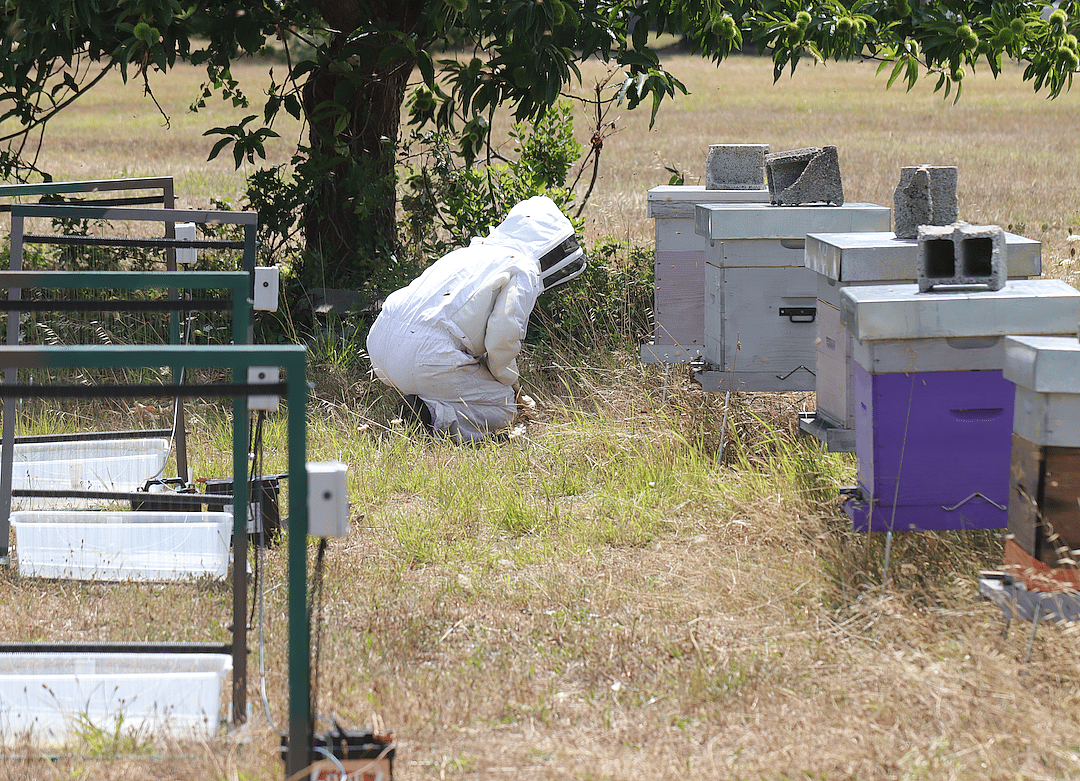
Although the harps take different forms, each one is made of some sort of large frame, which is then "strung" with conductive metal wires. These are then connected to a source of electricity, often solar panels, so that the wires conduct simultaneously positive and negative charges. When a hornet flies through, its wings touch the wires on either side, completing a circuit, and thereby delivering a fatal current of electricity. Beekeepers then place the harps around their hives in positions along the hornets' frequent flight paths.
Thi茅ry and other scientists have found that hives protected by harps fare better than those without. Honey bees need to be able to collect enough food throughout summers to survive the subsequent winters. Any hives in areas where hornets are present suffer as their workers neglect foraging duties out of fear. "This is terrible for the hives," Thi茅ry says. has shown that the harps can reduce predation pressure by 89 percent 鈥� enough to give hives the chance to replenish their stores. In only 56 percent of unprotected hives survived through winter, while 78 percent of those protected by harps did.
One crucial benefit is the harps' specificity in targeting Asian hornets. Their metal wires are spaced about two centimeters apart, which is wide enough for a bee to fly through unharmed 鈥� but not a hornet. Because of these selective dimensions, the harps offer a means of killing hornets that is better for biodiversity than other methods. by a group of Spanish scientists found that 91 percent of the insects that the harps killed were Asian hornets. Only one percent were domesticated honey bees.
Harps are also cheaper than other methods for beekeepers to install and operate. Beekeepers can buy them in complete kits that cost from commercial suppliers online, as Costa did. When combined with solar panels, maintenance costs are minimal. This is important for any defensive measures because beekeepers, depending on the country they live in, receive no or limited central government funding to protect their hives (although Thi茅ry hopes that this will change in France in the near future).聽
Thi茅ry and Costa, who have become close friends in the face of a mutual enemy, are now trying to teach other beekeepers how to construct their own harps with cheap, accessible materials. Thi茅ry describes this as an easy process, as little as $160. The two enthusiasts hosted a workshop for 10 other beekeepers from their region earlier this year. They shared blueprints for a "DIY" model that they designed themselves and recommended suppliers for the materials.
While the electric harps offer a promising new weapon, Thi茅ry admits that no existing tool can end the war. After seeing the hornets' rapid rate of spread across Europe, he believes that it's now impossible to eradicate them (not all of his peers agree with this). But in combination with "search and destroy" programs targeting hornet nests, beekeepers can use ensembles of electric harps to protect their bees from the worst harm. "It is the solution," Costa says.