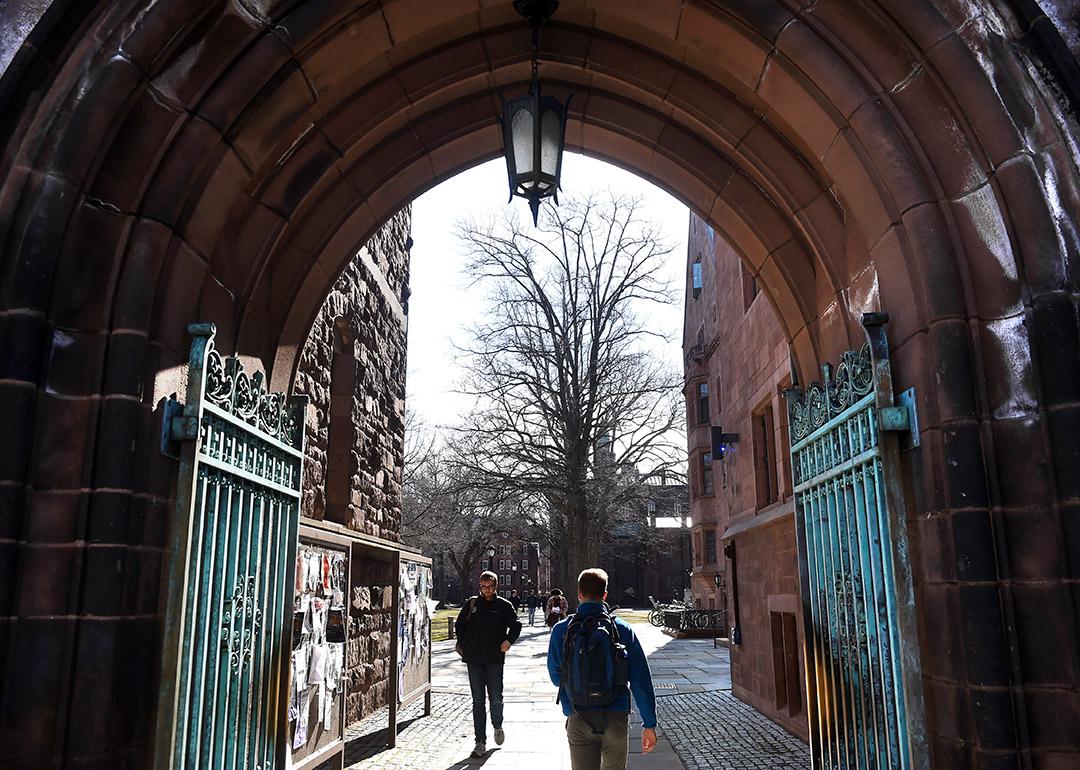
Behind ideological attacks on higher ed, surprising bipartisan reforms are happening
Behind ideological attacks on higher ed, surprising bipartisan reforms are happening
It’s rare in an era of partisan division to hear a veteran of the Clinton and Obama presidencies agreeing with a right-leaning economist who worked for George W. Bush.
Yet these prominent voices from opposite ends of the political spectrum teamed up to mostly praise a law passed by the Republican Congress and signed by President Donald Trump.
The purpose of the law: to protect college students from borrowing federal money to enroll in programs that give them little or no financial payoff when they graduate.
This new rule is “the greatest step forward in increased accountability” for colleges since the creation more than a decade ago of the federal , which discloses graduates’ earnings by institution. That was of Bob Shireman, a senior fellow at the progressive Century Foundation, and Beth Akers, who holds the same title at the conservative American Enterprise Institute, or AEI.
The new accountability rule is among a series of measures that the left-leaning advocacy group EdTrust calls the to higher education policy in nearly two decades. Many were part of the , or OBBBA, and will become effective this year. And several could improve protections and lower costs for families and students.
It may seem a surprise to hear bipartisan acclaim for laws affecting higher education passed by this White House and its congressional allies. After all, such reforms come of bans on diversity policies, restrictions on international students, cuts to research funding, huge fines on elite universities, and Trump’s relentless on “radical,” “woke” campuses.
But “there are definitely some positive steps that have been taken,” too, said Catherine Brown, senior director for policy and advocacy at the National College Attainment Network, or NCAN, who particularly likes an “earnings indicator” added to the FAFSA, or Free Application for Federal Student Aid. That tool that graduates from a particular school with the majors they’re considering have historically earned no more than those with only a high school diploma.
“A lot of times the big headlines — like, ‘We want to cut funding for higher education’ — create a culture where it’s not easy to see improvements that are being made,” Brown said.
Other changes include the overhaul of an accreditation system that has long failed to improve poor graduation rates at many colleges and universities; limits on borrowing for graduate school, which experts say could help drive down the price; and the expansion of federal Pell Grant eligibility — previously available only to degree-seeking college students — to shorter-term job training, including in the trades.
Many of the same steps were proposed by earlier presidents and lawmakers from both parties, but largely resisted by universities and colleges themselves.
“Policymakers from both sides of the aisle and of all political stripes have wanted some of these things for a long time now,” said Ed Venit, managing director at the higher education consulting firm EAB.
Even some of the more controversial moves have the potential for positive change, some analysts and advocates argue. While taxing college and university endowments is contentious, for example, they say it could drive top institutions to extend the benefits they offer to more students.
To be sure, the Trump administration appears to have supported some of these reforms for ideological and even punitive purposes, rather than the reasons earlier administrations tried to get them passed.
Taxing endowments, for example, mostly hurts the wealthy, selective universities and colleges that the administration has targeted for having diversity policies. And transforming accreditation — the de facto quality-control system that governs whether colleges and universities can be paid with federal grants and loans — also appears designed to punish accreditors that push diversity and sanction the teaching of subjects conservatives oppose, according to the president himself.
Accreditation is “our secret weapon,” Trump , to get rid of what he called “Marxist maniacs and lunatics” at American universities. His administration the process of adding new accreditors that he said will promote “the American tradition and western civilization.”
That worries academics and others concerned with new and prospective restrictions on classroom and campus speech.
But it is also true that existing accreditation agencies have continued to accredit colleges and universities or have abysmal graduation rates. Nearly 4 in 10 accredited institutions while being allowed to collect billions of dollars in federal taxpayer money, research shows.
“These are supposed to be the watchdogs of higher education, and some of them have not been doing a very good job,” said Preston Cooper, a senior fellow at AEI.
and administrations have tried for decades to make the accreditation system more accountable for poor outcomes.
Even advocates who like some of the fast-moving changes underway are raising concerns about the fine print.
While Shireman and Akers generally welcomed that new rule blocking federal student loans from being used for majors and programs with low financial returns, for instance, it’s called AHEAD, for Accountability in Higher Education and Access Through Demand-driven Workforce Pell — they noted that the calculation will be based on and not how much they paid for their degrees. That means students will still have access to loans to pay for majors whose graduates make what look like good wages, but not enough to cover what they borrowed.
Still, it’s a step toward accountability that policymakers have been seeking since the Obama administration, which tried to end eligibility for federal financial aid for university and college programs whose graduates’ student loan debt exceeded a given percentage of their earnings — the so-called gainful employment rule.
“One of the things everybody agrees on is we should raise individual economic mobility for students,” EAB’s Venit said. “They should come out better than they went in, and certainly no worse. This is something everybody wants.”
AHEAD, which is scheduled to take effect in July, will affect programs enrolling , the Department of Education estimates, most of them at for-profit colleges and universities. That’s about that would have failed the most recent gainful employment regulation pushed by the Biden administration, according to an analysis by the center-left advocacy organization Third Way.
“Maybe neither side gets everything they want. But we’ve landed on something that can make the accountability advocates on both sides content,” said Cooper, who served that finalized the rule.
Americans from both parties, , support cutting off tax dollars to programs with poor financial payoffs, a survey by the left-leaning New America Foundation found.
Two-thirds, in a separate survey by the student loan provider Sallie Mae, said they were also of limits on student borrowing.
Undergraduate student loans are already capped. But limits were removed for graduate students by an earlier Republican-controlled Congress in 2006. Graduate schools took advantage of this larger pool of money by by $1 for every dollar students borrowed, according to researchers at the universities of Texas and Chicago. Graduate student debt exploded.
Advocates on both the left and right have called since at least 2023 for caps on graduate borrowing , which the current Congress has now ordered. Beginning in July, most graduate students to a maximum of $20,500 a year in federal loans, for a total of $100,000; the top amount for professional programs such as medicine and law will be $50,000, or a total of $200,000.
The change will affect of graduate students and half of students in professional schools who currently borrow more than that, according to the Federal Reserve Bank of Philadelphia, which predicts that many will be forced to turn to private lenders to make up the difference. This set off a national firestorm as nursing and other professions were denied professional status.
But there are indications that the caps may force graduate programs to slow tuition increases and shut down high-priced programs. The Santa Clara University School of Law in California $16,000 scholarships to entering students to “offset the impact” of these new loan limits and bring its $63,280 annual tuition into line with them.
“This has been the most controversial plank of the reforms, but it’s a major step forward to cost control and trimming government subsidies to programs that cost too much and may not be delivering value,” Cooper said.
There’s also been bipartisan support for pushing selective institutions to accept more students and spend more of their wealth on financial aid. Taxing endowments at the wealthiest schools could drive them to expand, some analysts have argued.
Because the tax is based on enrollment — affecting only universities that have the equivalent of $500,000 in holdings per student — some could avoid it by letting in more applicants, Cooper and others say.
“For institutions that are very close to the cap, increasing your enrollments might not be a bad idea,” he said. “A lot of elite universities are relying on exclusivity to try and show value, and by expanding their enrollment a bit, that might give more students access to whatever the benefits are of going to those schools.”
Brown University, for instance, by taking about 250 more students per class, a 10% increase, an analysis by Cooper found.
Not all of the changes proposed by Republicans in Congress have passed, and courts have held up others that were the subject of executive orders.
A Trump administration attempt to limit reimbursements for expenses related to the federal research universities conduct, for example — the cost of labs, utilities, supplies, and manpower — has by a federal appeals court, which agreed with a lower court that it was “arbitrary and capricious” and in violation of the required legal process.
Lawmakers on the left and right have called for containing these costs. After some universities were discovered — at Stanford University, for example, on an antique commode and depreciation on a yacht — President Bill Clinton federal reimbursements as a proportion of the value of research grants, though not as severe as the Trump administration is attempting to impose.
A proposal dropped from the OBBBA would have made colleges when their students default on federal loans. Another would have tried to improve completion rates by requiring students receiving federal Pell Grants, which help lower-income families pay for college, to complete at least — the minimum typically needed to graduate on time with a degree. That’s up from the current 24 credits.
Getting federal financial aid in the first place was itself sped up for many students when the Trump administration rolled out the form required to do it, the FAFSA, , as in past years. The number of submissions in the fall more than doubled over the previous fall, helped also by earlier work by both parties to make the form simpler.
“They’re not the sexiest changes, but some of the FAFSA technical changes have been hugely consequential,” said Brown, at NCAN. “Some of these small things can make a big difference in terms of students ultimately going to college.”
Other long-sought proposals are now gaining traction, including one that would make it easier for students and families to understand what college and compare prices — something institutions now make to do. Half of colleges and universities tell prospective students , and more than 40% don’t disclose the cost at all, a Government Accountability Office study found.
Bills to change this have been , with broad bipartisan support, including from Democratic Senator Elizabeth Warren and Republican Senator Bill Cassidy, who are among the new bill’s sponsors.
“For as much attention as there always is on how much partisanship exists in Washington D.C., it’s often overlooked how much bipartisan agreement there is on things like price transparency,” said Justin Draeger, senior vice president for affordability at the Strada Education Foundation. (Strada is among the many funders of The Hechinger Report, which produced this story.)
“As the cost burden has shifted more to students and families, they’re asking questions about what is the payoff going to be,” Draeger said. “And colleges and universities have to be able to answer that for them.”
The new attempt to push this through is part of now under consideration, including one that would require of graduates from various majors, along with their average loan debt. Postgraduate placement rates and incomes provided by colleges and universities today .
about the value of degrees, more than politics, may, in the end, be what’s accounting for this flurry of new rules, said Cooper, of AEI.
“The thread running through a lot of these changes,” he said, “is a lack of trust in universities to always do the right thing.”
This story also appeared in .
was produced by , a nonprofit, independent news organization focused on inequality and innovation in education, and reviewed and distributed by ±¬ÁÏTV.