How the unprecedented redistricting war is affecting election officials, politicians, and voters
The redrawing of states鈥� congressional districts typically , following the release of new Census data. But the U.S. is now up to six states that have enacted new congressional maps for the 2026 midterms; that鈥檚 more than in any election cycle not immediately following a census since 1983-84, reports. to before voters head to the polls next year. Ultimately, more than a third of districts nationwide could be redrawn, threatening to confuse and disenfranchise voters.
The truly unusual thing, though, is that four of those states passed new maps totally voluntarily. Texas, Missouri, and North Carolina all redrew their districts after President Donald Trump urged them to create more safe seats for Republicans to help the GOP maintain control of the House of Representatives next year, and California did so in order to push back against Trump and create more safe seats for Democrats. (The other two states redrew for more anodyne reasons: Utah鈥檚 old map was thrown out in court, and Ohio鈥檚 was always set to expire after the 2024 election.) To put that in perspective, only two states in total in the 52 years from 1973 to 2024, according to the Pew Research Center.
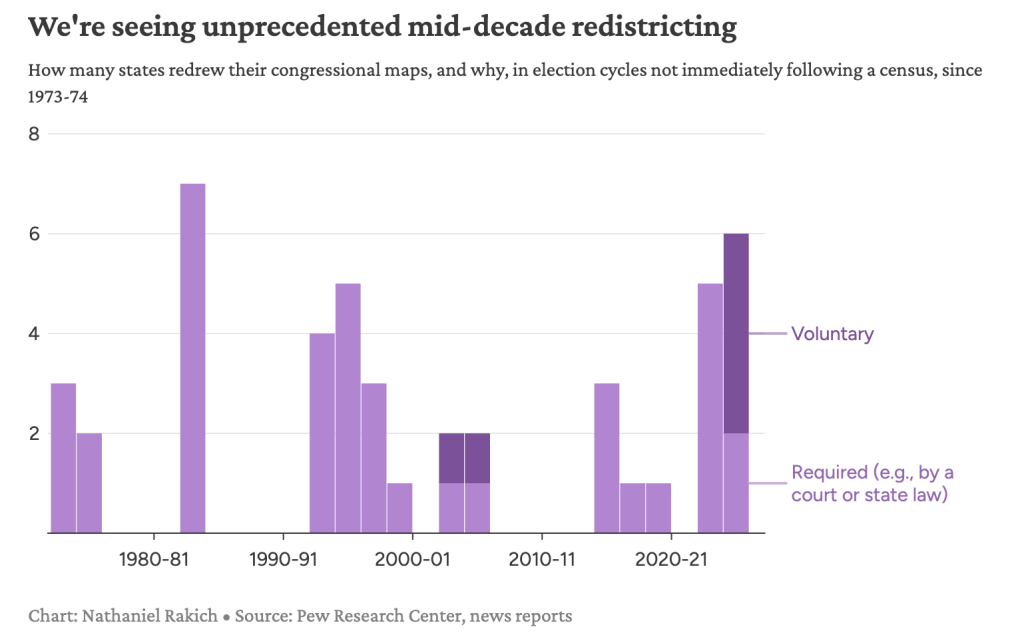
So the current 鈥渞edistricting wars鈥� are truly unprecedented in modern politics 鈥� and that鈥檚 had some chaotic consequences. In Texas, for instance, voter advocacy groups sued over the new map, arguing that it discriminated against Black and Latino voters. They scored a temporary win on Nov. 18 when a panel of federal judges and reinstated the old one. That ruling, though, came less than three weeks before Texas鈥檚 Dec. 8 filing deadline, sending to readjust their plans.
But that wasn鈥檛 even the end of the story: The state appealed the ruling to the Supreme Court, which, for two weeks, left Texans hanging about which map would be in force. Finally, on Thursday 鈥� four days before the filing deadline 鈥� a majority of the justices , putting the 2025 map back in place for the midterms.
Meanwhile, in Indiana, lawmakers considered whether to pass their own new map under the less-than-ideal conditions of threats to their physical safety. A proposal to eliminate the state鈥檚 two Democratic-held seats , but there was genuine suspense over whether the plan could pass the state Senate, where at least 14 Republicans are against mid-decade redistricting. It .
The pressure on these GOP holdouts was intense, with several of them by name on social media and threatening to . But in the last few weeks of the debate, things got much darker: 11 state senators 鈥� most of them redistricting opponents or fence-sitters 鈥� were the . Although it鈥檚 not confirmed that the threats were motivated by redistricting, many of the lawmakers receiving them decried them as intimidation tactics meant to make them toe the line.
Finally, of course, the push to draw more congressional districts scrupulously engineered to vote a certain way threatens to make Congress less representative of the electorate.
On the day before Thanksgiving, a panel of federal judges against North Carolina鈥檚 new congressional map, clearing the way for its use in the 2026 election. Although the judges did not find sufficient evidence that the Legislature had drawn the map with the intent to racially discriminate, they did that the map would have a 鈥渄isparate impact on black voters.鈥�
That鈥檚 because the map鈥檚 goal is to flip the 1st District from the Democratic to the Republican column, and since race and partisanship are so closely correlated in the South, that meant watering down its Black population. Since 1992, the northeastern North Carolina-based 1st District has been configured to enable Black voters to elect the candidate of their choice, but the new map decreases the district鈥檚 Black share of the voting-age population from 40% to 32%. As a result, there are no longer enough Black voters in the district to reliably pull their candidates over the finish line. A political scientist attested in the case that Black voters鈥� preferred candidate would have carried the new 1st District only seven times in 63 recent statewide elections.
None of this, though, may run afoul of the law. Federal courts have set a very high bar for proving racial gerrymandering claims 鈥� and in 2019, to stop trying to umpire partisan gerrymandering altogether. That, as much as anything else, has opened the door to the rash of mid-decade redistricting we鈥檙e currently experiencing. Virtually that have so far have with that make less responsive to the will of voters. For an unprecedented arms race that has caused no shortage of angst, that could be the most indelible impact.
was produced by and reviewed and distributed by 爆料TV.