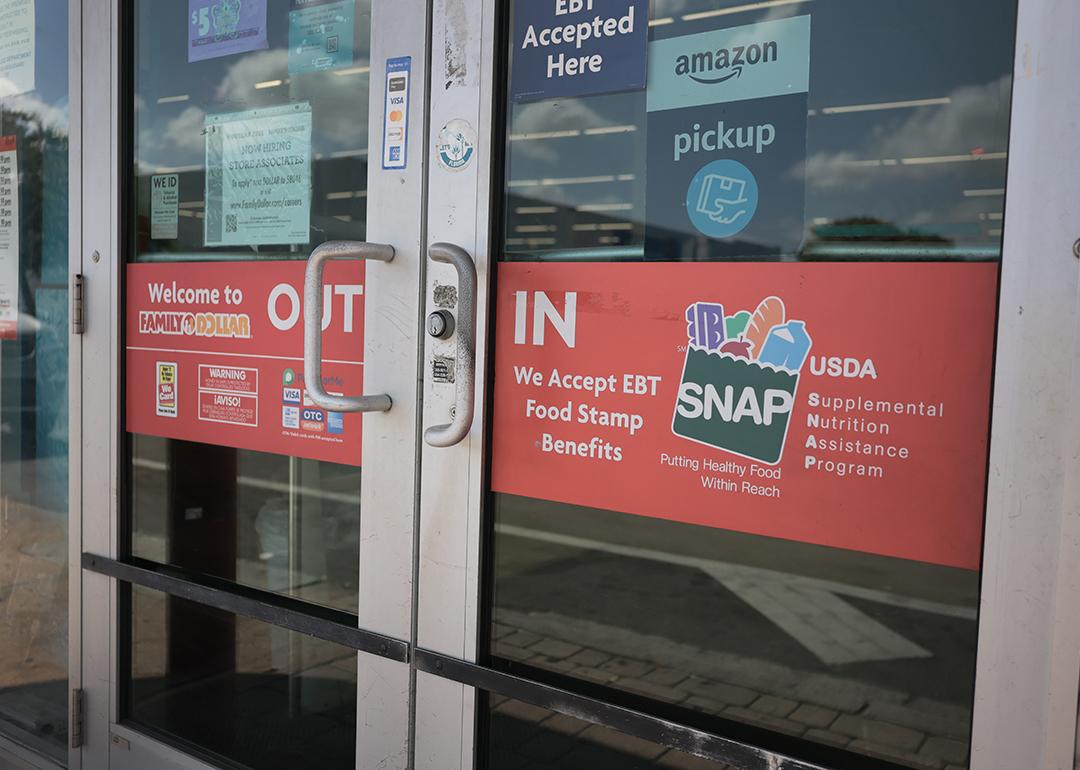
SNAP is how millions of Americans afford food. Cuts to the program have thrown it into chaos.
SNAP is how millions of Americans afford food. Cuts to the program have thrown it into chaos.
A missing zero put Sarah’s grocery money in jeopardy. Every month, Sarah receives $219 in Supplemental Nutrition Assistance Program benefits for her and her 9-year-old. Sarah works two jobs in food service, one at a senior center and one at a banquet hall, and has relied on SNAP for support ever since her husband died unexpectedly about six years ago. But last year during her annual benefits renewal, one of her employers messed up a number on the required paperwork.
It was around Christmas, and Sarah and her daughter were about to take a long-awaited trip from Michigan to Texas to see Sarah’s mother for the holiday. That’s when the letter came. (This article refers to SNAP recipients by their first names only to protect their privacy.) It stated that Sarah would lose her benefits if she didn’t re-complete the paperwork. Before, she had been able to call a caseworker assigned to her who could answer questions. Now, paperwork simply disappeared into a portal. She debated canceling their trip—would it be better to save the travel money to put toward food just in case? She crossed her fingers and headed to Texas anyway, and while there, contacted her job to have them correct the error. She resubmitted with a week to spare. But it was tough to get into the spirit of holiday fun when she was hiding how stressed she was from both her daughter and her mother.
It makes you on edge, she told and , not knowing if you can protect your kid, if you can feed her, all because of something outside your control. She called it a low-grade terror: “You know how that feels, right? Where you’re worried all the time, and it’s like a low burn in your chest, queasiness in the belly.”
She was right to worry: After she returned home, a second letter arrived, telling Sarah she’d lost her benefits.
SNAP helps people in the United States afford food, and under Donald Trump, it’s been thrown into chaos. It’s “completely unprecedented as to what we’re dealing with,” said Gina Plata-Nino, director of SNAP policy and advocacy at the . In July 2025, when the Trump administration’s One Big Beautiful Bill Act, or H.R. 1, was signed into law, it included the to SNAP in history. With that came new work requirements, costs of the program , and other that could lead to more than losing access within the next few years. Then, in November, the program for the, when the Trump administration to fund benefits during the government shutdown, which left many for , a decision that had . People were forced to go hungry, choosing between , or not eating to . Meanwhile, the U.S. Department of Agriculture approved waivers that allow 18 states to restrict some foods from being purchased with SNAP, creating confusion for retailers and recipients, according to . All this is unfolding amid an with for medical care, housing, and, of course, food.
“The government has shown us what they think is important in terms of keeping people fed and healthy and able to participate in our economy, and they don’t care,” said Lindsay Allen, health economist and policy researcher at Northwestern University, adding that health care and food have been used as political pawns.
Even when benefits do end up coming through, the endless chaos, changes to the program, and fear around access to food are taking a toll. After receiving the second notice, Sarah fought to get her benefits back. It turns out that a communal caseworker never got to the resubmitted paperwork. After over an hour on the phone, her SNAP benefits were reinstated—but somehow she got less by about a fourth. “If you want to talk about mental health strain, that kind of thing can happen at any time, and does,” she said. She’s still figuring out how to make up for the fact that her monthly benefits are lower.
Food insecurity, as the economic and social condition of having limited or uncertain access to adequate food, affects . Changes to SNAP could deepen existing food insecurity—and food insecurity itself is anxiety, depression, and psychiatric disorders. There is nothing that being hungry does not worsen. Hunger and mental health issues feed off each other, said Mariana Chilton, a professor in the department of nutrition at the University of Massachusetts Amherst. She’s done extensive showing that food insecurity is strongly associated with major maternal depressive symptoms; she points to focused on the between food insecurity and suicidal ideation and attempts in teenagers. Children are profoundly impacted by hunger, with for mental health and development, among other things, extending far .
Some experts have long called for , or for other changes to make the program more accessible . A found that SNAP benefits weren’t keeping up with rising food costs in 99 percent of counties. Current cuts are making everything worse.
SNAP participation has historically by 30 percent. Research led by Anna Austin, an associate professor of anesthesiology at the University of North Carolina, found that policies that increase the number of households eligible to receive SNAP benefits . She noted that when people gain access to SNAP, they show improvements in symptoms of depression and anxiety. Removing the cognitive strain of where food will come from also can reduce stigma and feelings of shame.
There’s also a general sense of unease around changes to SNAP. Some described it as fear: fear around where a next meal will come from. Fear over how someone will pay for a child’s birthday cake. Fear that the program—without warning or reason—may become impossible to access.
What’s more, changes to SNAP are happening alongside . It leads to what Allen calls a “terrible synergistic effect” of people’s food being taken away and people getting sick because of it while health care is stripped away.
People who are considered “able-bodied adults without dependents” have to work for at least 80 hours a month to receive SNAP benefits, according to KFF, a health policy organization focused on research, policy analysis, polling, and journalism, which broke down Medicaid and SNAP work requirements. H.R. 1 expanded work requirements to include adults ages 55 to 64 and adults with dependents over 14 years old. It also removed exemptions for veterans, young adults who aged out of foster care, and people experiencing homelessness. Lack of access to SNAP disproportionately harms children, seniors, veterans, people with disabilities, immigrant households, and rural communities, and can racial and ethnic health inequities, Austin said. Meanwhile, studies show that most people receiving SNAP so, and work requirements aren’t effective at improving employment outcomes, since they don’t economic conditions, scheduling practices, or other barriers to work. Getting a job, even if you really want one, .
A March 2026 detailed the deadly consequences of these cuts, estimating that work requirement expansions could lead to almost 70,000 deaths by 2040. In the meantime, they are tormenting people. In 2022, Allen published that found that SNAP work requirements worsened anxiety and depression, with visits to health care providers for depression and anxiety increasing faster for women than they did for men. SNAP and Medicaid are safety-net programs, she said, “and there’s nothing below the safety net but concrete.”
The first time Nieves Aragon testified at a Colorado Board of Human Services meeting about the restriction on using SNAP benefits to , she held up a juice box. The second time, in early March, she held up a can of Coca-Cola. She wanted to show that what they are attempting to take away from SNAP recipients are lifesavers to her as a Type 1 diabetic. If she’s with her 5-year-old son and her sugar goes low, the first thing she thinks of is a Gatorade or soda, which wouldn’t be covered. Now, she worries about whether she can afford the $3 out of pocket to grab a Coke, or if she’ll have to compromise on what her child needs in order to grab what she needs for her sugar. Aragon has attention deficit/hyperactivity disorder, and said that maintaining a specific diet is crucial to both her diabetes and ensuring her ADHD medication is working properly. “I try not to think about it too much, because I feel like then you spiral down to that depressive ‘What are we going to do?’ kind of state,” explained Aragon of the restrictions. In March 2026, SNAP recipients in multiple states, including Colorado, over food-restriction waivers, stating in the complaint that they “destabilize food access.” The restrictions are .
Over in Tennessee, where restrictions on “” will take effect in July, Brittany, a single mom, says the cost of food is so high, she struggles even with the support of SNAP. Restrictions on what can be purchased will only make it harder, because out-of-pocket costs take away from other necessities, like gas. There are going to be parents who can’t afford a birthday cake for their kid thanks to restrictions, which isn’t fair to that child, she pointed out. “I feel like you can never get ahead,” she said. She already works full-time as a medical assistant. She can’t get a second job; if she did, she would then make too much to live in government housing—but still wouldn’t be able to afford to live elsewhere. She’s always worried about the next thing. “I try not to cry in front of my kids or let them know that I’m worried at all about anything, because that just puts more stress on them,” she said.
The strain of uncertainty sits at an intersection of turmoil in the United States, all overlapping, all exhausting. There’s the cost of food, and the cost of health care. Jobs feel impossible to find, and don’t meet the cost of living. Even attempting to keep track of changes is like “drinking from the firehose,” said Austin, the researcher who found that expanded SNAP access improved mental health. “I think the constant uncertainty, particularly when it’s something as important as ‘How am I going to feed my family? Where am I going to get my next meal?’ is just so much strain and stress and really negatively impacting mental health,” she said.
Recently, Krysten, who lives in Pennsylvania, was dropped from SNAP because she technically makes too much money. Krysten makes $13 an hour as a home health aide, but doesn’t have paid leave or benefits, so when she’s sick, she makes nothing. Because she lives in the same household as her mother, what her mom receives in Social Security counts as income. That’s left her household receiving only $72 a month in SNAP benefits. She thinks elected officials who are making decisions to cut or restrict SNAP should visit food pantries to see how many people are coming in—last time Krysten went, the food pantry was so low on items that they weren’t able to really help. Krysten does meet the requirements to stay on Medicaid, which she’s thankful for.
Recently, when she went to the doctor, she said they asked if she wanted medication for depression. But she didn’t feel like there was anything amiss that could be solved with medicine. She is depressed because she doesn’t have enough food in the house, she explained to the doctor. “That does make you stressed. It does make you depressed.”
For many, SNAP is a direct mental health support. That’s the case for Annika Verma, a college student who moved out of her family’s home shortly before she turned 18. Verma was struggling with depression and an eating disorder, and working as a barista while enrolled in community college. She didn’t know she could access resources like SNAP. “Starving, to me, started to feel like an economic choice that just became congruent with those aesthetic and obsessive choices around food,” she explained. By summer 2024, SNAP benefits made it possible for her to work with her nutritionist and clinical team to eat consistently, and to build new, nutritious foods, as well as fun foods, back into her diet.
But the threat of that support going away was constant. While she recently has become financially stable and stopped using SNAP, she recalled worrying that one mistake on a form would mean not eating. The fear would keep her up at night catastrophizing; the calculator on her phone was always being used for either calorie counting or counting SNAP dollars. It stays with you, she said. Now, she added, it feels like the Trump administration is telling people “that they are not allowed to be a human in need.”
Co-published by and .
was produced by and , and reviewed and distributed by ±¬ÁÏTV.