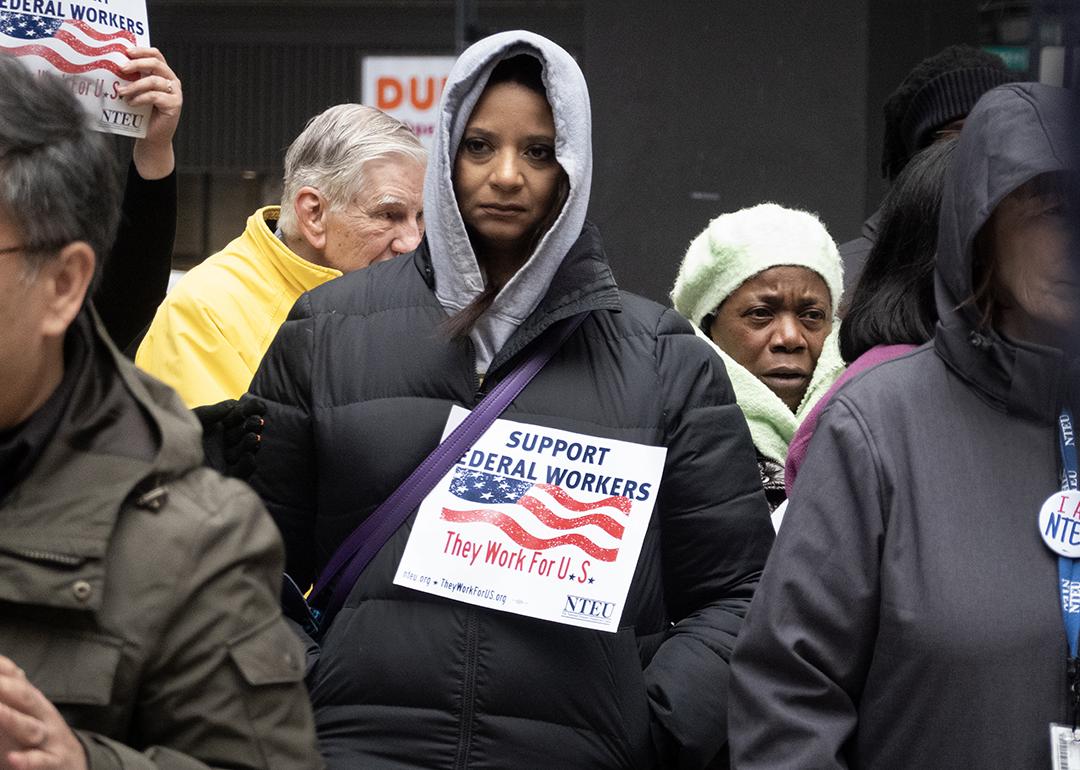
What happened to the Black women Trump purged from the federal workforce?
What happened to the Black women Trump purged from the federal workforce?
For 24 years, Constance Franklin worked at the U.S. Centers for Disease Control and Prevention in Atlanta. As a CDC analyst, she traveled to Botswana during President George W. Bush’s administration to evaluate PEPFAR, an AIDS relief program. She spent time at African American churches in metropolitan Atlanta setting up tables to encourage flu vaccinations. She even volunteered to lead tours at the CDC Museum, where she explained the history of the polio vaccine and guided visitors through the exhibits.
Some of her work at the CDC’s National Institute for Occupational Safety and Health focused on overlooked Black populations. That could mean exposing Morehouse College students to her division’s work, educating workers who are at heightened risk of injury or illnesses because of their race or ethnic background, or making more people aware of the overdose-reversing drug naloxone.
“I loved my job. Absolutely loved my job,” Franklin told and . “Never woke up and said, ‘Ugh, I gotta go to work.’”
Until the White House created the so-called Department of Government Efficiency, or DOGE. The new initiative gave Elon Musk broad authority to take a chainsaw to some federal agencies.
After Trump’s 2025 inauguration, Franklin and her colleagues weathered rumors of mass firings or transfers to a new group. On April Fools’ Day, a notice arrived in her email at 5:30 a.m. informing her of a reduction in force, known as RIF in federal government parlance. When the cuts hit, employees across the country quickly received anonymous emails from DOGE that resembled anti-phishing training, but the missives weren’t spam. They were real. Franklin, 49 at the time, broke down in tears, her plans to retire in 20 years now foiled.
“There [are] so many other Black women who I know, and I’m friends with, that have been targeted, lost their jobs,” Franklin said.
Most weekdays, Franklin blocks out the morning to write cover letters for job applications. Moving from the federal to the private sector is hard because the work doesn’t often translate. In a sea of unemployment, the competition is stiff, and compensation is not as high as her former annual salary of $144,000.
A recently divorced mother of three teenage girls, Franklin said losing a job has been crushing and is especially devastating for Black women. “Financially, it is awful because a lot of times we are already the breadwinners or everything is on our shoulders already,” she added.
When her daughters ask for the takeout they’re accustomed to, Franklin reminds them there are packs of chicken in the freezer.
Black women have been fired from the federal workforce since Musk’s actions more than any other group, said Katica Roy, a gender economist who crunched the numbers. They comprise 6% of the overall U.S. labor force and 12% of the federal labor force. But of the almost 300,000 federal jobs slashed in 2025, Black women were a stunning 33% of those cuts.
An analysis by the National Women’s Law Center found that made up a majority of employees hit by the Trump administration’s aggressive job cuts. Among the hardest-hit agencies are housing, veterans affairs, education, and health and human services. “We know who’s being targeted, and it’s Black workers and women, and the intersection of those is Black women,” said Jasmine Tucker, NWLC’s vice president of research.
Black women are also heavily represented among federal employees whose work was related to diversity, equity, and inclusion (DEI) efforts. On Trump’s first day of his second term, he signed an that rolled back DEI, deeming it “immoral” and “illegal,” putting federal workers on notice that any preexisting commitment the government had to pursue these goals was no more.
Four Black women described the humiliation of their jobs being devalued and slashed. They are still unemployed and emotionally distraught from the chaos of the past year. Savings accounts are depleted, student loans languish, and their sense of self-worth crumbles.
Jenniqual Johnson got her first taste of community organizing while a first-generation college student at Harris-Stowe State University, an HBCU in St. Louis. Eighteen-year-old Michael Brown was killed by a white police officer in Ferguson, Missouri, just minutes away from the suburb where she grew up. Johnson, chief of staff for the student government, coordinated meetings, housing, and protests as a growing Black Lives Matter movement focused the nation’s attention on the horror of Brown’s death.
Right after the killing, Johnson said, “I wanted to do higher education administration or workforce development for first-generation college students like myself, who were adults, who had that nontraditional path to higher education. … That was supposed to be the American dream, which was: You go to college, you get a good job, you will live a good life.” She had been in the army and attended culinary school before enrolling at Harris-Stowe.
Johnson’s grandparents had migrated from Mississippi to St. Louis. Her mechanic grandfather and homemaker grandmother were the first Black family on the block where they purchased a home. Racist neighbors egged their house, and one by one, the white families planted “For Sale” signs in their yards. Johnson’s parents — her father was a nurse, and her mother worked in hospital finance — drilled a message into her: Get a good government job, stay there, and retire. She said the message was: “You go to work, you pay your bills, you get your house together, you have a stable life.”
So Johnson parlayed her community organizing experience into that good government job. She joined the U.S. Department of Agriculture Forest Service, underresourced populations in cities in Illinois and Missouri to nature in surrounding areas — yes, Black and brown folks, but also anyone else who lived in the city. She doled out funding for local groups. A partnership with Kappa Alpha Psi Fraternity, Inc., introduced Black boys to horseback riding and archery. Job Corps trained youths in sawyer skills for tree maintenance. Young people got out of their comfort zones and experienced the outdoors in new, imaginative ways. Johnson also helped high school students matriculate into land-grant HBCUs as a way to help build a pipeline into agricultural jobs.
“It’s unheard-of for folks who work in community organizing or community engagement to make good salaries,” said Johnson, 43, who earned $100,000. “I had a great career, knowing that I had a workplace that was flexible and that fit into my life, and knowing that I was directly able to connect local community organizations with federal funding that they may not have been able to access before.” She had found what she thought was a lasting career — and realized she was helping communities harmed by policies such as redlining, which happens to overlap with communities lacking as many trees as white neighborhoods. She relished her public service.
“The whole point of my role was diversity and equity — giving equitable access to our national forests,” Johnson said.
In January 2025, the bosses signaled that she and her colleagues needed to stop their work entirely. At first, they pushed to get organizations already granted a commitment for funding quickly reimbursed. Union reps instructed employees not to send emails to the DOGE staff asking for rundowns of their workdays. Then, in February, supervisors announced no new partnerships, followed by a return-to-office mandate. Johnson worked in the field and lived in Chicago but was told she needed to report to Columbia, Missouri — a nonstarter for her.
“I took that deferred resignation program because I’m like, what else are we going to do? It was too much uncertainty,” Johnson recalled.
She stayed on payroll until September, even though she stopped working because the bulk of her role had been eliminated. Her search for full-time work hasn’t been successful; she’s tried to make ends meet with side gigs, such as helping small businesses with HR. “It’s not nearly the income that I would have been making working full time,” she said. “Then, of course, there’s the insurance, the health coverage, the other benefits that are also still missing, too.”
Johnson’s partner also lost her job due to cuts to DEI jobs in the private sector. U.S. employers eliminated more than 2,600 jobs with “diversity” or “DEI” in the title between 2023 and 2025, according to an . Last fall, the couple moved to Mexico to cut expenses and escape how unsafe they increasingly felt as Black people living in the U.S., Johnson said.
Her parents’ advice about working hard, saving, and retiring isn’t accessible anymore, she said. The move to Mexico and the money needed to start her HR business drained Johnson’s retirement account. She has two master’s degrees and six-figure student loans to pay off. Thirty years from now, Johnson thinks she’ll still be working — not a traditional job but cobbling together gigs on top of her business.
Johnson was asked if she’d ever return to the U.S.
“As things stand as they are, no,” she replied with not a hint of hesitation.
In Mexico, life feels a bit easier, she said. But she adds, “I hate that Black women have been forced into resiliency. We’ve been forced into being strong. We’ve been forced into being waymakers. We are not afforded that same soft landing” white people enjoy.
Black people were first able to access government employment during Reconstruction. White-collar federal jobs across the country, especially in Washington D.C., paid strong salaries and benefited from Republican political patronage. But when Southern Democrat Woodrow Wilson assumed the presidency in 1913, he oversaw the demotion and firing of thousands of Black civil servants. His purge of those well-paying jobs .
White administrators resented Black ambition and now had permission from the top to get rid of the competition. Demotions, promotion ceilings, and forced resignations derailed careers. Sounds familiar.
Similarities exist between the patronage purge of the early 20th century and DOGE, said the historian Eric Yellin, author of ”.” Then, as now, white supremacists vowed to clean up the swamp. What’s different is the importance of federal workers pledging blind loyalty to Trump. “This is about whether you share not just his ideology but share his vision that he, as the unitary executive and the most important member of the government, gets to call the shots all the way down,” said Yellin. “And so those who are purged are people who cannot get in line with that, the people who will get in the way of that more personalistic rule.” Black women are among those who got in the way.
Across the decades, Black people have had to fight to access the protections offered by the federal government. The 1935 Social Security Act purposely left out agricultural and domestic workers, which diminished benefits for Mexican and Black workers. During the height of the Civil Rights Movement, historic mandated affirmative action in federal contracts and outlawed wage discrimination, at least in theory. Today, the right frames DEI as something newfangled and unnecessary, but it’s merely the latest iteration in a long history of expanding protections for employees. As the explains, DEI builds on the Civil Rights Act of 1964 and federal anti-discrimination laws “to increase access to education, employment, and public contracting opportunities” in the public and private sectors.
A recent filed in federal court alleges that the administration unlawfully fired government employees involved in DEI work. “The majority of people who have contacted us are women of color, and particularly Black women,” said plaintiffs’ lawyer Jessica Moldovan of Lieff Cabraser Heimann & Bernstein, a firm that specializes in class and group actions. She said no list of people affected by Trump’s anti-DEI order has been made available; the attorneys are asking the government for that list of names in discovery. Moldovan said she feels confident that there are records of who was let go pursuant to the executive orders.
Moldovan said the Trump administration fired a broad swath of federal workers, including some who were no longer or had never been in a DEI role and others who had enforced laws through Equal Employment Opportunity Commission positions. “The government went out of its way to bulldoze through all of these people, and in our view, targeted not just DEI positions but targeted people,” she said. The complaint she filed argues the firings violated both the First Amendment and the Civil Rights Act and inflicted a disparate impact based on race and gender. Plaintiffs are asking to be reinstated and receive back pay and damages. The court has yet to certify the class.
The civil service is nonpartisan, and staffers remain through Democratic and Republican presidencies. But by targeting federal workers, the Trump administration is disregarding this reality, accusing some employees of having political beliefs that make them disloyal to the current president. “The Trump administration has made clear that it views DEI as essentially code for pro-Biden, pro-Democrats, or further — they use terms like Marxist,” Moldovan said. “They are targeting those employees because of their perceived political beliefs.”
La’Nita Johnson’s position at the U.S. Agency for International Development (USAID) had nothing to do with DEI, but her diplomatic career nonetheless ended when Trump returned to the White House a year ago. As DOGE began shuttering agencies and eliminating departments, USAID was among the first to go. As an officer there, Johnson, 33, earned $116,000 a year plus benefits and guaranteed salary increases.
Now she’s a visiting professor in communications at her alma mater, Pepperdine University, earning $46,000. “I don’t know how I’m gonna catch up. I’ve slid so far back in pay, it is unfathomable,” Johnson said. Consulting gigs keep her afloat. She does workshops and training focusing on leadership development, intercultural communications, and youth workforce preparation. Her routine has become very simple: She goes to campus and comes home. Spending is limited to groceries. Johnson said the Trump effect takes a toll on mental health, and she’s thankful that her therapist didn’t cut her off when the income stopped.
“I don’t even recognize my current life anymore,” Johnson said. “I’m sad even talking about it.”
Johnson grew up solidly middle-class in Powder Springs, an Atlanta suburb, taking classes in Spanish, French, and Mandarin. She didn’t envision a diplomatic career using those skills until she . In 2016, Johnson worked for GE and traveled to Burkina Faso on a mission to help build a school. While at a cafe, a group entered and started firing shots and throwing bombs. Johnson hid in the bathroom. Two people on her mission were killed.
“That experience really shifted my career goals: I want to work abroad. The private sector isn’t suiting me. Clearly, life is very short, and there are real risks when youth don’t have access to education and workforce opportunities,” Johnson said.
She earned a master’s degree and then started a fellowship to work for USAID. Johnson moved to Guatemala to work with a program called Puentes (“bridges” in Spanish), which provided education and workforce development for youth who are vulnerable to recruitment by gangs such as MS-13 and Barrio 18. Her work with a different USAID program helped youth transition from fifth to sixth grade, when the dropout rate increases. Another project focused on water, sanitation, and hygiene by building latrines at rural schools so that girls did not have to miss instruction because of their periods.
Johnson returned to the U.S. for a domestic tour and then took an unpaid leave to start her consulting business. By January 2025, she was eager for her second international tour and prepared to rank her country choices. Trump and Musk had other plans. Johnson remembers how shocked and confused she and her colleagues were by the emails they received. They wondered whether AI was spying on chats and if DOGE was monitoring social media. The RIF letters Johnson received were riddled with errors about her work history.
Congress did not approve the White House’s elimination of USAID, and a federal judge last spring that the administration probably violated the Constitution in dismantling it. Still, the agency remains shut down. Johnson said the impact of the agency’s closing has been immediate. Within the first several months, the shuttering of USAID health programming had led to hundreds of thousands of deaths from malnutrition and infectious disease, according to one . The impact of the closing of education programs will take longer to measure, but she predicts that literacy will decline and crime will spike in the coming decades. “We might see democratic backsliding in countries that we’ve become allies to because of our own democratic backsliding,” Johnson said. “I don’t think we’ll recover from this for a century. We’ve broken trust across the world.”
After her visiting professorship ends, Johnson hopes to move to Mexico, the same choice Jenniqual Johnson and her partner made. “I would never work for the State Department after what’s happened. I don’t believe in our message, and I won’t propagate this message.”
After the initial cuts last year, has the overall picture for Black women improved in 2026? Katica Roy said the picture is bleak.
“Black women are the only cohort to have lost jobs since February 2025,” Roy said. The January 2026 jobs report, which covered December, showed that “every other cohort, including Black men, gained jobs.” White men alone have gained 362,000 jobs.
Roy said the layoffs will ripple for generations. Black women are breadwinners in 52% of households with children under the age of 18, she said, adding, “We know that the most important factor that determines a child’s future economic standing is the economic standing of their parents.”
It’s not just the federal government laying off Black women. An analysis by the found that the steepest declines in labor-force participation since January 2025 are among Black mothers. Black women are overrepresented as heads of households, and so challenge the right’s mid-20th-century nostalgia for an American dream that can be restored with (ostensibly white) two-parent heterosexual families. A report from the conservative Heritage Foundation about argues that achieving higher marriage and birth rates is the only way the country will survive. As has long been the case, the right is promoting strict gender roles that these communities reject. Jasmine Tucker of the NWLC said the right wing’s pro-natalist vision is an affront and destabilizing to Black families.
Black women are the “primary and co-breadwinners for almost every single family. They can’t afford to not work, and so robbing them of all of this money is devastating for Black families, for Black communities,” Tucker said. “If we look at the whole picture, it’s devastating for our economy.” Recent job cuts mean Black women have less money to buy homes, spend on their children’s education, and contribute to the economy. “We’re just robbing ourselves,” said Tucker.
This is what Rachael Gold-Brown, a 41-year-old former government employee, faces. She worked in the Department of Homeland Security’s Office of Civil Rights and Civil Liberties, which handled discrimination and harassment cases. and fired its staff because, the agency said, “Rather than supporting law enforcement efforts, they often function as internal adversaries that slow down operations.”
Gold-Brown said she worked with the office’s statistician on workforce data, which showed that “DEI wasn’t just for people of color, which is a shame that that’s how it’s being treated.” As she explained, “Everybody benefited.” Staff learned from workforce data who was being hired and in what roles in the agency, including breakdowns by gender and disability.
While a Peace Corps volunteer during the Obama administration, Gold-Brown helped start a girls’ leadership program in Rwanda. She then served as a special assistant at USAID, analyzing programs for women overseas. She had enjoyed her federal career until emails labeled “Fork in the Road” popped up in her inbox last year.
“It was a very nasty transition, because of the way in which we were being terrorized every week by DOGE. Every week, we are getting a message being told to explain what we did today,” she said. “We were being harassed, and then we were told that we were being doxxed, our information was out. I was paranoid.” She didn’t answer the emails.
By March, word came down that the office would be abolished. She said, “I had a panic attack. I was emotionally distraught.” By September, the paychecks stopped. (The Trump administration that the DHS civil rights office is still functioning, though reportedly it now operates with a skeleton crew, most of whom are contractors.)
“I did not have a backup plan. I’m still not working, and I’m in the middle of packing and moving,” Gold-Brown said, the frustration rising in her voice. The single mother of two daughters, ages 6 and 13, was packing when The Economic Hardship Reporting Project and Hammer and Hope talked to her in late December. Gold-Brown needed to move in with a friend because she has no income. Unemployment doesn’t cover living expenses, student loans, or car payments. “The most important thing for me has been trying to maintain my mental health and my peace living in this country right now, in this current state of affairs,” she said. “I’ll continue to apply for jobs in the local government and the counties. I had some interviews coming up, but what else can I do? I can continue to apply to the federal government, although I have to change my résumé and tailor things appropriately. But during this administration, I don’t think I’m going to have much luck because they don’t really want people like me there — that’s pretty obvious.”
Back in Atlanta, the picture is not as bleak for Constance Franklin. She is part of the American Federation of Government Employees union, which has against the Trump administration to challenge the reduction in force, but is among those who haven’t had to wait for the courts to decide. In January 2026, HHS in the occupational safety division where she worked. Franklin returned to the same salary in mid-January but now has a new boss and new red tape.
Morehouse College, with which she has enjoyed a close working relationship, asked her to do a lecture on global pandemics and the workplace. She must now fill out a form before accepting a routine invitation to justify how the talk relates to Trump’s agenda. “I have to jump through all of these hoops to get approval to even do it, and that never would have happened before,” Franklin said. “I’ve spent half the time Googling the White House page and the HHS [Health and Human Services] page trying to figure out what his agenda is so that I can try to tie this lecture into his agenda, and I can never find it.”
She’s writing up a defense of her previous job role in the hope of returning to it. In the meantime, she’s reviewing other CDC employees to see if they qualify for internal agency awards — hardly the impact she imagined for her work.
“I don’t want to sound ungrateful,” Franklin said. But so far, the job isn’t offering the same level of fulfillment as it did before DOGE, and it still feels precarious. “I’m just trying to hold on to my faith.”
Co-published by and .
was produced by and , and reviewed and distributed by ±¬ÁÏTV.