
What is heart rate variability (HRV)?
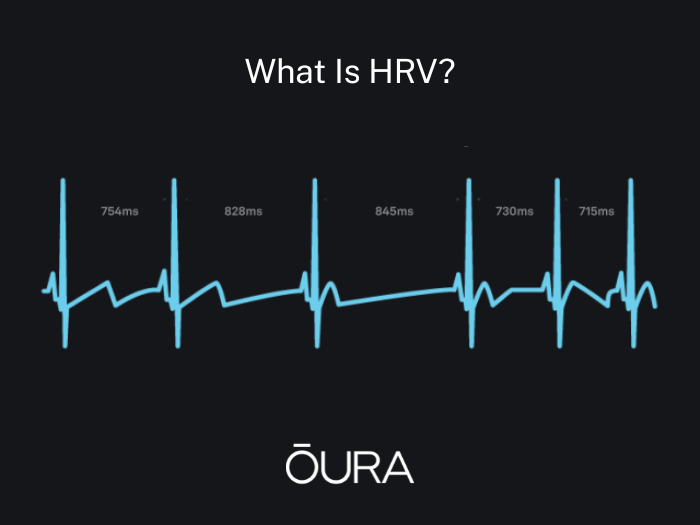
As popular as the metaphor may be, a healthy heart doesn鈥檛 beat as regularly as a metronome. In fact, it changes its rhythm with each beat. Heart rate variability, or HRV, is a measure of the constant variation in milliseconds between your heartbeats.
Some situations increase variation, leading to a higher HRV, while others cause the time intervals between beats to stay more consistent, leading to a lower HRV.
While subtle, these variations reflect your heart鈥檚 ability to respond to different situations. HRV can react to stress and/or illness before your , which makes it one of your body鈥檚 most powerful signals鈥攑roviding useful insights into your stress levels, recovery status, and general well-being.
Here, examines what HRV is and why it matters for your health.
HRV and Your Nervous System
HRV is linked to your 鈥攕pecifically, the balance between the parasympathetic nervous system (PNS), also known as the rest-and-digest branch, and the sympathetic nervous system (SNS), known as the fight-or-flight branch.
By balancing the two forces, your ANS helps you respond to daily stressors and regulate some of your body鈥檚 most important systems, including heart rate, respiration, and digestion.
Independently, your heart beats to its own rhythm thanks to a built-in pacemaker called the sinoatrial (SA) node. Your SA keeps your heart firing at around 100 beats per minute.
However, your ANS greatly influences how your heart beats. Think of it this way: All the cells within your heart鈥檚 pacemaker have direct phone lines from both sides of your ANS. They give input, beat to beat, on a cellular level to your heart.
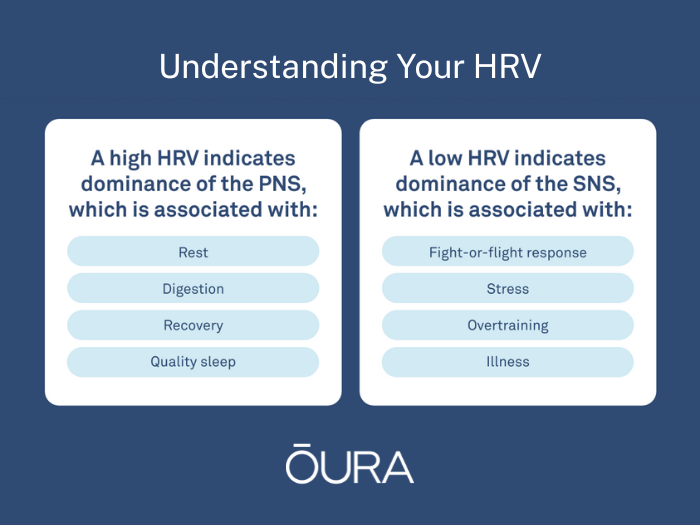
- The PNS, or rest-and-digest system, tells your heart to slow down, making room for variability between beats (higher HRV).
- The SNS, or fight-or-flight system, tells your heart to speed up, limiting space for variability (lower HRV).
These two systems can be silent, active, or shouting over each other at any given time. That鈥檚 a lot of conversation, and it leads to a lot of variation.
What Does Higher or Lower HRV Mean?
As a rule of thumb:
- Higher HRV is associated with rest-and-digest, general fitness, and good recovery
- Lower HRV is associated with fight-or-flight responses, stress, illness, or overtraining
However, keep in mind that your HRV is highly unique to you. 鈥淗igh鈥� and 鈥渓ow鈥� HRV is relative for each person鈥攊t鈥檚 a very sensitive metric. Some individuals have steady HRV scores, while others fluctuate considerably.
It鈥檚 normal to see daily and in your HRV.
Can You Improve Your HRV?
Yes, by focusing on healthy lifestyle habits. However, there are certain factors outside your control, such as age or genetics.
Factors You Can鈥檛 Control
- Genetic factors: Your plays a significant role in determining your baseline HRV. Variations in genes mean you have a unique ANS, which leads to individual differences in HRV patterns. As a result, you may naturally have higher or lower HRV. While you can鈥檛 change your genetic predispositions, it can help you to understand your HRV baseline.
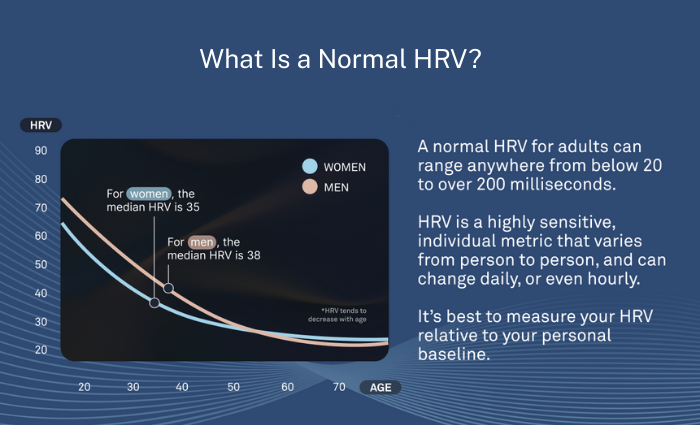
- Age: HRV changes with age. Generally, HRV as you get older. This decline is attributed to various age-related changes in the ANS and heart function. Nonetheless, even within specific age groups, individual differences in HRV exist.
- Hormone cycles: Hormone cycles, , can influence HRV. Menstrual cycles and fluctuations in sex hormones, such as estrogen and progesterone, can affect the ANS and, consequently, HRV. Changes in HRV during are not uncommon.
- Mental health and emotion: Positive emotions and relaxation to increase HRV, indicating a more flexible and adaptive ANS. Conversely, anxiety and stress can lower HRV, indicating a less resilient autonomic response.
- Illness: Certain illnesses and health problems, like , diabetes, high blood pressure, or , can impact HRV. During illness, HRV may decrease due to the body鈥檚 response to physiological stress.
Factors You Can Control
- Sleep routine: Your internal biological rhythms, such as the circadian rhythm and sleep-wake cycle, can affect HRV. For example, a sleep-wake cycle that promotes adequate, restful sleep can result in better HRV, whereas sleep disturbances and sleep deprivation can lead to decreased HRV. The good news is that you can with your body鈥檚 natural rhythm to enhance your sleep routine and, in turn, HRV.
- Environmental factors: Environmental factors, such as air quality, , and , can influence HRV.
- Medications and substances: Various medications and substances can influence the ANS and, consequently, HRV. For instance, , or certain drugs may increase sympathetic activity and reduce HRV.
- Lifestyle: Your lifestyle choices, including your physical activity, sleep quality, , as well as hydration, and dietary habits, all contribute to your distinct HRV patterns. This means that you have some control over your HRV balance.
What Is a Normal HRV?
A normal HRV for adults can range anywhere from below 20 to over 200 milliseconds.* The best way to determine your HRV normal range is to use a wearable that measures your HRV in a controlled setting, like sleep, and establishes a baseline over a few weeks.
Is It Normal For Your HRV to Fluctuate?
Yes, HRV is a highly responsive metric.
While some explanations of HRV oversimplify it by asserting that a high number is always good and a low one is always bad, it鈥檚 far more complex.
In fact, there are situations where low HRV is necessary and even desirable. For example, during strenuous exercise, low HRV is a reflection of your fight-or-flight system appropriately dominating to get your heart rate up for activity. Your HRV will rebound afterward, as your rest-and-digest system takes over to help you recover.
These fluctuations occur throughout the day, as different daily stressors continuously challenge your system. Simply being excited or moving from the couch to the bathroom can change your HRV at any given moment.
By measuring your HRV during the day, you鈥檙e capturing your body鈥檚 response to these fleeting changes. If you want to understand your chronic physiological state, the best time to measure HRV is while you sleep.
At night, your body is in a consistent state, without any confounding variables (e.g., food, social interactions, changing environment). Some wearables take the apples-to-apples approach when it comes to your measurements. They fail to caveat that daytime measurements might mask your underlying ANS balance.
Monitoring your HRV can help you reach peak productivity, manage stress, and fine-tune your training regimen.
A single nightly HRV reading can provide insights, like:
- A higher HRV score that reflects a rest day, cool bedroom, or 鈥渕indful鈥� low/moderate intensity activities such as hiking or yoga
- A lower HRV score that results from dehydration, alcohol, a late meal or exercise, illness, a high-intensity workout, acute stress, or a hot bedroom
You may notice that your HRV varies greatly from day to day. If you鈥檙e looking for patterns, what matters is your HRV trend.
HRV: Frequently Asked Questions
What is HRV?
HRV refers to the natural, millisecond-by-millisecond variation in the time between your heartbeats. It鈥檚 a key indicator of your nervous system鈥檚 balance, showing how well your body adapts to stress and recovers.
What is HRV ms?
HRV ms is simply the measurement of your heart rate variability and the number you see is expressed in milliseconds (ms). It reflects the tiny, healthy differences in time between each of your heartbeats.
What鈥檚 a good HRV?
There鈥檚 no single 鈥済ood鈥� HRV score since it鈥檚 highly personal. Healthy HRV levels can range widely from person to person. The most important thing is to track your own average over time. But if you鈥檙e wondering what HRV is good or what a healthy HRV is, know that generally speaking, a higher HRV indicates a state of rest and recovery, while a lower HRV can signal stress, illness, or fatigue.
What factors affect my HRV?
Many factors influence your HRV, including those you can鈥檛 control, like genetics, age, and hormone cycles. However, you can positively impact your HRV through healthy habits. Getting enough quality sleep, managing stress, exercising regularly, and staying hydrated all contribute to a healthier HRV.
Why does my HRV fluctuate?
It鈥檚 completely normal for your HRV to fluctuate throughout the day and from one day to the next. These changes are a reflection of your body鈥檚 natural response to different activities and stressors. For example, your HRV will drop during intense exercise and then rebound as your body recovers.
*This HRV range is based on data that includes independent academic studies, as well as . Academic studies are typically restricted to smaller or less diverse populations and, therefore, may not be representative of the general population in isolation. Oura鈥檚 goal in providing this broader range is to reflect the largest and most representative dataset possible. While it may be more common for HRV averages to cluster around certain numbers (e.g., 50 ms), there are individuals whose averages may not appear as frequently in the population but still represent their personal normal (e.g., 18 ms). The most effective way to analyze HRV is to compare your values to your personal baseline.
was produced by and reviewed and distributed by 爆料TV.