Are America鈥檚 top colleges letting in more students from low-income backgrounds?
It鈥檚 hardly news that America鈥檚 elite universities are by students from America鈥檚 wealthiest families.
Yet in recent years, this has drawn increasing alarm. has documented just how large the admissions advantage is for well-off students. Bloomberg Philanthropies has pumped tens of millions of dollars to get talented lower-income students into better colleges. The College Board, which administers the SAT, in this effort. For some, the 2023 Supreme Court ruling added more urgency to the task. In the wake of the ruling, a number of schools pledged to step up recruitment and end legacy admissions.
Have these efforts paid off? A look at university press releases might suggest so, reports. A number of schools 鈥� including , , , , , and 鈥� have recently touted a who receive Pell grants, education stipends that go to students from low- and middle-income families.
Most press releases did not mention a salient fact, however: The Pell qualification rules have changed in recent years, skewing comparisons over time. A careful parsing of the data suggests that America鈥檚 top colleges are still filled largely by students from advantaged backgrounds. Individual universities have seen some progress, but the aggregate changes appear to have been modest.
鈥淭here are benefits to enrolling more rich kids 鈥� untold benefits 鈥� for these selective institutions,鈥� says Paul Tough, efforts to improve college access. 鈥淎nd there are very few benefits to enrolling more low-income students, except that it鈥檚 the right thing to do.鈥�
This matters because enrollment at top universities to higher graduation rates and higher incomes post-college. Selective schools typically provide a better-funded education, while offering more generous financial aid. They also often to i and influence.
It鈥檚 important to be clear about how incremental progress in increasing economic diversity has been. If schools can get positive attention for addressing this without making substantial changes, they may feel even less pressure to undertake further reforms.
Researchers have often counted students as lower-income based on whether they receive a federal Pell grant. But since eligibility in 2024, Pell numbers across the country have spiked. 鈥淢y suspicion is that much of the uptick in Pell representation at these selective colleges and universities is a measurement issue,鈥� says Sarah Turner, a University of Virginia professor who studies higher education.
Some universities acknowledge the changing Pell definition but say that their economic diversity has genuinely increased. To figure out whether this is the case, data from the National Student Clearinghouse, which tracks university enrollment and is broken down by the income level of students鈥� neighborhoods, was examined.
Total enrollment at 鈥渉ighly selective鈥� colleges has been going up in recent years, but the economic background of the student body has barely budged. The share of students from the two groups of lower-income neighborhoods has shifted from 13.2% in 2019 to 13.4% in 2025. In raw numbers, that鈥檚 an uptick of about 20,000 students, which is far less than the 95,000 student increase from the two highest-income neighborhoods.
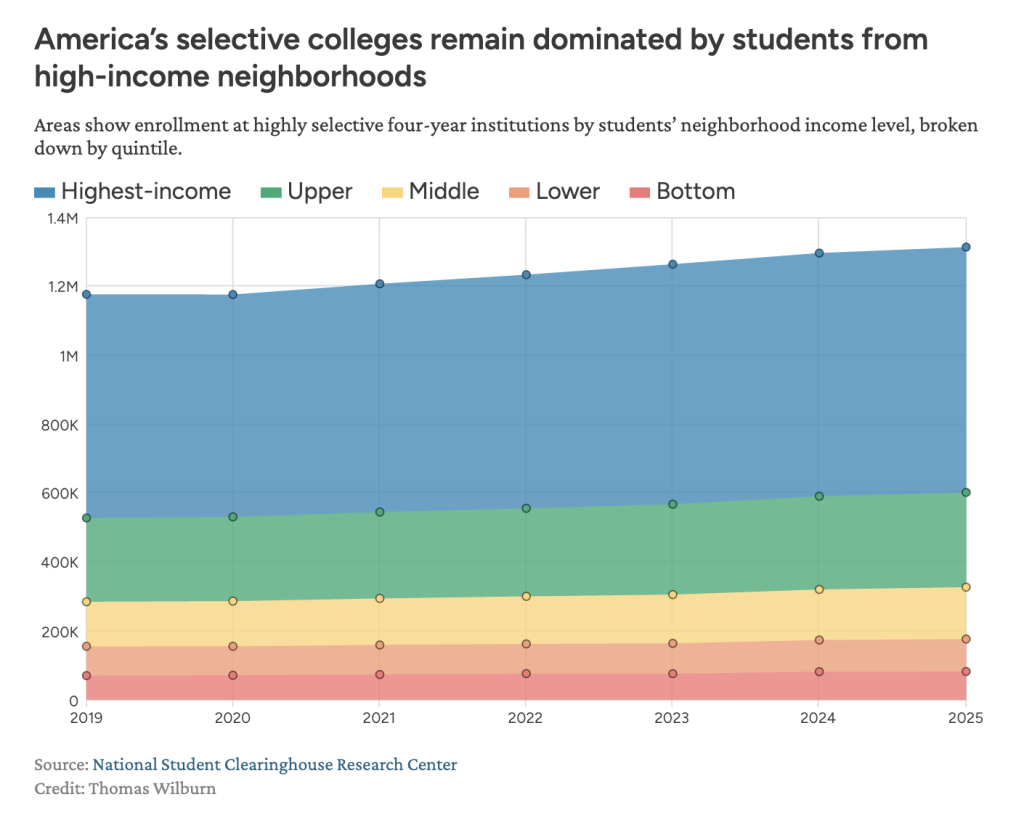
Three-quarters of students at these selective schools come from those affluent areas. This is just 1 percentage point lower compared to six years earlier.
Another , recently published by the College Board, looked at the year after affirmative action was banned. At very elite colleges, the share of first-year students from low- and middle-income neighborhoods rose by only a 鈥渕inimal鈥� amount, researchers found.
The clearinghouse income data only goes back to 2019. Would a longer time horizon change the picture? Not much. A recent by James Murphy, a higher education analyst at the nonprofit Class Action, found that between 2013 and 2023, first-year Pell enrollment at highly selective private colleges increased from 16% to 18%. This uptick was a bit higher at Ivy League and elite liberal arts schools. Still, at selective public colleges, Pell shares fell by 2 points. (This was when the Pell definition was broadly consistent.)
The data described is imperfect. The clearinghouse measures students鈥� neighborhoods, rather than their individual economic circumstances. Those are highly correlated but are not the same. The clearinghouse also includes a variety of colleges, nearly 200, under the banner of 鈥渉ighly selective,鈥� not just the very elite schools. Turner of the University of Virginia says more detailed data is needed to fully understand the trends here.
None of the universities touting their record Pell numbers responded with any data beyond that showing that more low-income students were enrolled.
The challenge of making substantial change is epitomized by the American Talent Initiative, an organization supported by Bloomberg Philanthropies (which is also a of Chalkbeat). In 2016, ATI set a goal of adding 50,000 low- and middle-income students to 350 or so colleges with high graduation rates. Many of those schools joined ATI as members, but even more did not participate in the initiative. Initial reports from the group showed that its members were making progress, but non-participating schools were actually enrolling fewer and fewer lower-income students.
Tania LaViolet, an ATI leader, says the original hope was to influence the broader ecosystem of top colleges by sharing best practices across institutions. 鈥淭hat hypothesis didn鈥檛 pan out as we had anticipated,鈥� she says.
In 2024, ATI to focus just on colleges that opted to participate in the work. Its latest , released last month, touts an increase in lower-income students among ATI members, though the authors acknowledge it鈥檚 challenging to compare trends over time because of the changing Pell definition. The organization no longer tracks data for non-members.
ATI officials note that even if the share of low-income students in selective schools hasn鈥檛 changed much, their raw numbers have increased, as overall enrollment has grown. 鈥淭his increased number means thousands of lives changed for the better,鈥� says LaViolet.
was produced by and reviewed and distributed by 爆料TV.