Public universities face escalating involvement from state lawmakers
Public universities face escalating involvement from state lawmakers
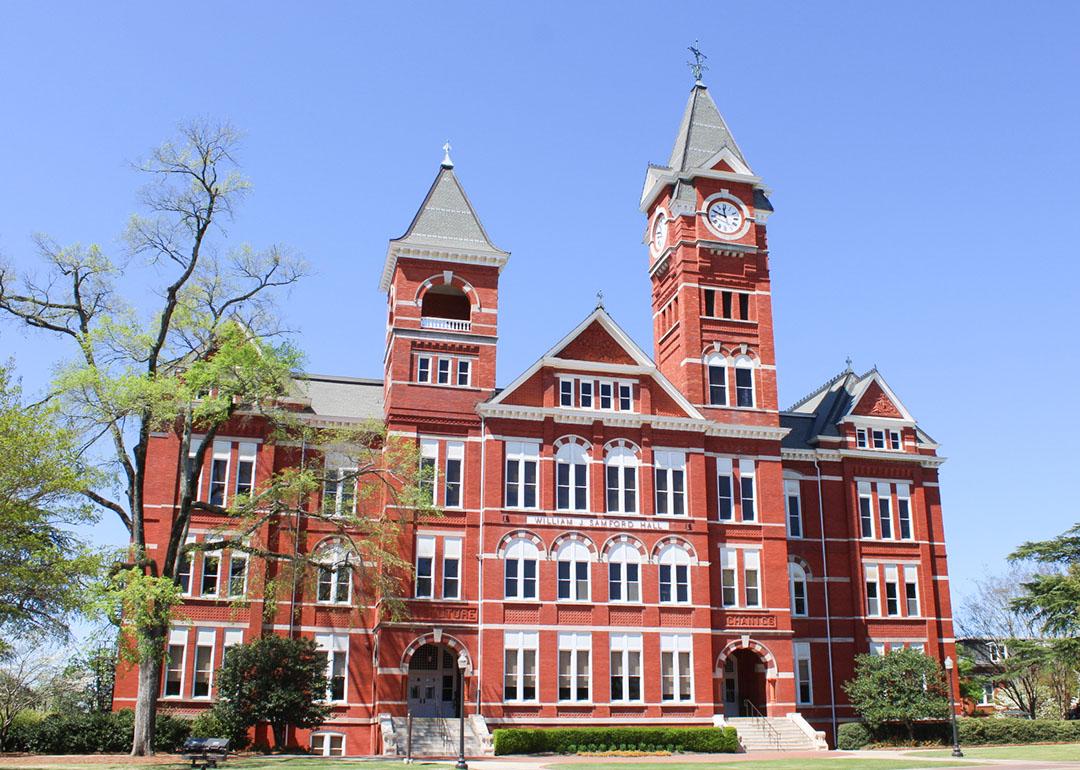
Jennifer Brooks, a history professor at Auburn University, had barely unpacked from a trip out of town in early June when the messages started blowing up her phone.
Texts from colleagues and rumors on social media delivered the unsettling news: The Auburn Board of Trustees had voted to and give itself ultimate authority over academic decisions, including curriculum.
“What was really surprising … is the lack of knowledge that most of our faculty leaders had about the decision,” Brooks, who’s been teaching at Auburn since 2006, told .
Faculty leaders across departments at Auburn — one of two flagship public universities in Alabama — said they learned of the proposal a day before the vote. The board approved the changes unanimously and without public discussion.
“To have that (decision) be the sole product of the Board of Trustees, with no input from faculty, is really unusual,” Brooks said.
The move at Auburn came two months after Alabama’s Republican-dominated state legislature at the state’s public colleges and universities. That law , because their governing structures are enshrined in the state constitution. Some faculty felt Auburn’s eagerness to follow it anyway signals the board’s willingness to bend to political pressure.
The Auburn trustees did not respond to a request for comment, though that its new policy is “intended to advance academic quality, transparency, consistency and institutional alignment while preserving meaningful faculty participation.”
Alabama isn’t alone. Since last year, states like , , and have enacted similar laws that give greater power to politically appointed boards and administrators while weakening tenure protections and faculty sway over curriculum and university leadership. In Indiana, the new state budget Republican Gov. Mike Braun full authority to appoint members of Indiana University’s Board of Trustees.
Supporters of such measures frame them as efforts to hold taxpayer-funded public colleges and universities accountable at a time when many Americans are questioning the value of increasingly expensive college degrees. Many conservative lawmakers also say they are taking aim at liberal bias on university campuses.
have found that professors tend to be liberal, though it’s less clear whether they are pushing their views in the classroom. In by the Higher Education Research Institute at UCLA, nearly 56% of faculty described themselves as liberal or far left, compared with about 13% who said they were conservative or far right and roughly 32% who described themselves as “middle of the road.”
“I think our institutions do need to be run, at a minimum, fiscally, as a business, so that we make sure that the money our taxpayers are pouring into … our universities is used and utilized in the correct way,” Kentucky Republican state Sen. Lindsey Tichenor said earlier this year before voting for a measure to allow the state’s public colleges and universities to, such as low enrollment in a particular program or department or a budget shortfall.
Opponents said the measure was a way for legislators to get around higher education tenure protections. Democratic Gov. Andy Beshear .
Faculty advocates, free speech groups and unions warn the new wave of laws will chill academic freedom and make universities more susceptible to political influence.
“Students, faculty and staff in almost every state have less say in how colleges and universities are run than they did a generation ago, and I don’t know if that resonates with members of the public,” said Barrett Taylor, a professor at the University of North Texas whose research focuses on higher education policy, finance and governance.
“I do think most people probably don’t want to send their kids to a college where they feel like the politicians are in charge,” he said.
Unprecedented power
One of the most far-reaching of the new measures is a Texas law enacted last year that grants political appointees unprecedented power over the state’s public colleges and universities.
University boards, which are appointed by the Texas governor, now have authority over hiring decisions of college administrators and more control over university curricula. The new law, passed by the Republican-majority state legislature, also the power of faculty senates and councils, shifting them to advisory-only roles.
Texas Republican state Rep. Matt Shaheen, the bill’s sponsor, told his colleagues on the House floor last year that its goal is “to ensure degrees earned in Texas are of value and prepare our students for success, both in life and in the workforce.”
The Senate sponsor of Texas’ new law was then-state Sen. Brandon Creighton, a Republican who became chancellor at Texas Tech University a few months after the bill passed. Using his authority under the new law, Creighton in April the school to cancel academic programs centered on sexual orientation and gender identity, and directed faculty to recognize only “two human sexes.”
In a by the Texas Tech University Faculty Senate, about half of the faculty who responded said they chose to alter their teaching content in response to memos from Creighton and another chancellor laying out new guidelines and restrictions on course content. More than half said they were considering jobs at other universities.
Since the law was enacted, several professors at other Texas public universities have been fired: A Texas State professor was after speaking about political organization at a socialist conference; a Texas A&M professor after a video of her discussing gender identity with a student went viral; and a professor at the University of Texas, Austin, was from his senior vice provost role for “ideological differences.”
Texas Republican Gov. Greg Abbott, in response to the vice provost’s ouster, that “Texas is targeting professors who are more focused on pushing leftist ideologies rather than preparing students to lead our nation.”
Model legislation
Texas’ new law closely tracks shared in February by the Manhattan Institute, a conservative think tank. On its website, the institute argues that university board members “can act as a counterweight to the excesses of university faculty and administrators,” and that too much faculty autonomy has made campuses “insular and sclerotic.”
State involvement is necessary, the institute argues, to hold universities accountable to the public. It says that required general education courses should be reviewed and approved annually by administrative boards to make sure they’re relevant and worthy of public investment.
Distrust in higher education has become an election issue, John Sailer, the Manhattan Institute’s director of higher education policy, wrote in an email.
“Legislation is a blunt-force instrument but it isn’t sufficient,” Sailer said. He emphasized that changes have to happen at the institutional level. “Concretely, this looks like giving boards a say in matters that reflect the university’s overarching mission, like the core curriculum.”
But critics argue that everyone benefits from colleges and universities that aren’t subject to partisan politicization. They say the move toward top-down governance at universities will erode academic freedom and pressure faculty to align their research and teaching with ideological interests rather than independent inquiry.
And university boards are increasingly chosen for political loyalty and wealth, rather than for commitment to the institution, said Hank Reichman, professor emeritus at California State University, East Bay, and former chair of an academic freedom committee at the American Association of University Professors.
“I think people are naive if they think that (lawmakers’) political agenda will be limited to just getting rid of DEI and gender studies programs,” he said, adding that he’s seen interference in medicine and other sciences. “It’s really an attack on independent learning.”
Action in multiple states
In Indiana last year, lawmakers over Indiana University’s board of trustees by slipping the language into a must-pass budget bill in the final hours of the legislative session. It also limited faculty boards to advisory-only roles.
“The state has an interest in being sure that it (the university) is operated in the best way,” Indiana Republican state Rep. Jeff Thompson told his colleagues on the House floor last April. “And by the way, the governor would be the one that has to answer to the people.”
Braun later by removing three members of the university’s board who’d been elected by school alumni under the previous system. Braun’s replacements included two conservatives: an attorney who previously worked on his campaign and a conservative commentator and former sports reporter who was for statements about Barack Obama’s father and her company’s COVID-19 vaccine requirements.
In April of this year, also enacted a law increasing top-down governance by barring university leadership from taking faculty recommendations on disciplinary decisions. Under higher education’s tradition of shared governance, such decisions would usually involve input from a tenured faculty member’s peers.
Lawmakers in other states also are exerting control over academic programs and degree requirements.
Iowa Republican lawmakers inserted a requirement into a budget bill approved last month that undergraduate students at the state’s three public universities take both an American history course and one on American government in order to graduate. State lawmakers mandated that those courses at the University of Iowa must come through the Center for Intellectual Freedom, which they created last year to what they viewed as liberal bias in education.
Utah passed a law this year that diminishes faculty control over exams and assignments, allowing students to based on “sincerely held” beliefs, as well as a that restructures university oversight.
Ohio lawmakers this year tried to to institutions’ compliance with a law they passed last year banning DEI efforts, but the bill died in committee.
And in Kansas, the GOP-controlled legislature overrode Democratic Gov. Laura Kelly’s veto of a bill named for Charlie Kirk, the late conservative activist, that that limit where students can protest or advocate for causes.
The legislature also tucked a provision into its that bans public colleges from requiring students to take courses on “DEI-CRT,” the acronyms for diversity, equity and inclusion, and critical race theory, respectively.
Suspicious of higher ed
Republican lawmakers have been pushing some of the most visible changes, but both political parties are interested in exerting more control over higher education, said Taylor, the University of North Texas professor.
“We’re not arguing that the two parties’ agendas for higher ed are commensurate or equally likely to have the same consequences,” Taylor said, “but we do think that both parties are suspicious of higher education and are seeking to exert more control over it, though in very different ways.”
As a historian, Auburn professor Brooks said she and some of her department colleagues were not surprised to see political battles spill onto campus. The changes have been more jarring, she said, for faculty members in disciplines that are further removed from the culture wars, such as forestry or engineering.
“There seems to be a sense from the (university) administration that the only faculty that are disturbed, unsettled, distressed about the situation are a small group of malcontents,” she said. “I think that’s a complete misconception. It’s widespread.”
was produced by and reviewed and distributed by ±¬ÁÏTV.