
Furlough vs. layoff vs. termination: What's the difference?
If you're worried about losing your job, you're not alone. Today's economy is tricky. Costs are still rising because of tariffs, and many people are worried that companies will reduce their headcounts to reduce costs or as they transition to AI.
The loss of a job, no matter how it comes about, could make it difficult to keep up with your bills, resulting in debt and necessitating debt relief. But the way you lose a job could have an impact on the benefits you're entitled to afterward. That's why it's important to understand the difference between furlough, layoff, and termination.
In a nutshell, the difference between furlough, layoff, and termination is as follows:
- Furlough is a temporary, unpaid leave from work.
- Layoff is a permanent loss of a job, not due to an employee鈥檚 actions.
- Termination is a permanent end to a job, often (though not always) for a specific reason.
It鈥檚 important to know what rights you have if any of these things happen to you, so took a closer look at each one.
Key Takeaways:
- Employers sometimes cut labor costs with furloughs, layoffs, or terminations.
- A furlough is an unpaid, temporary interruption in work, but you keep your job and benefits.
- Layoffs and terminations are permanent. Layoffs are usually no-fault, and terminations (firings) are typically for a reason.
Understanding the Legal and Financial Implications of Losing Your Job
Furlough, layoff, and termination all result in the loss of your paycheck. But the difference between layoff and termination, for example, could influence whether you're entitled to collect unemployment benefits.
Generally speaking, if you're furloughed or laid off from your job, you're entitled to unemployment benefits. If you're terminated for cause, you can't collect unemployment. Your state will ask you why you're no longer working.
What makes things tricky is that there's such a thing as a 鈥渘o-fault鈥� termination. From an unemployment standpoint, a layoff and a no-fault termination are virtually the same, in that you should be able to collect benefits as long as you meet your state's requirements.
There's also a difference between voluntary and involuntary termination. Voluntary termination is when you decide to leave your job, whether it鈥檚 to take a new one, to retire, or for another reason. Involuntary termination is when your employer decides to eliminate your job.
With a voluntary termination, you're not entitled to unemployment benefits. With involuntary termination, you may be eligible for unemployment benefits if it's considered a no-fault termination.
Most U.S. companies operate on an at-will employment basis. This means your employer can terminate your job at any time, as long as it鈥檚 for a legal reason. (It鈥檚 illegal for an employer to terminate your job based on race, religion, sexual orientation, age, or gender, for example.)
The difference between layoff and termination could also be a factor when you鈥檙e looking for a new job. A layoff may not make it harder to find work again, as you can simply explain in interviews that your job was eliminated through no fault of your own.
Being terminated for cause, on the other hand, could make it harder to get hired again. If you're terminated for cause, be prepared to explain what steps you're taking to avoid ending up in a repeat situation.
What You Need to Know About a Furlough
A furlough, or mandatory suspension from work without pay, is as brief or as long as your employer needs it to be, provided they follow certain rules. If you鈥檙e furloughed, it鈥檚 generally because your employer doesn't want to lay you off but also can鈥檛 keep paying your wages in the near term. While there鈥檚 no standard time period for a furlough, they鈥檙e usually short.
Here are some things to know about being furloughed.
You shouldn鈥檛 work without pay
As a furloughed employee, you shouldn't do any work for your employer. According to the Department of Labor, if you answer work-related phone calls or emails or engage in any other work-related tasks, your employer must pay you for the time you worked. This holds true whether you鈥檙e a salaried or an hourly employee.
You get to keep your benefits
If your employer gives you benefits in addition to your salary, you typically keep them while you鈥檙e furloughed. So if you depend on your employer for health insurance, retirement accounts, life insurance, or other benefits, you probably won鈥檛 lose them during this time. However, you might still be required to contribute toward things like health insurance premiums, despite not getting a paycheck.
It鈥檚 also common for employers to offer matching contributions to employee retirement plans. You generally won鈥檛 get those matching contributions while you鈥檙e furloughed, though, because you鈥檙e not getting paid, and therefore aren鈥檛 contributing to your retirement plan yourself.
You can seek new employment
If you鈥檝e been furloughed and are technically still someone鈥檚 employee, you can still look for a new job. Many furloughed employees take temporary jobs during their furlough period so they can bring in some income. If your goal is to return to your job, you may want to turn to the gig economy for flexible work in the meantime. Earning at least some money could help you avoid the need for debt solutions.
You can collect unemployment benefits
You can usually collect unemployment benefits as a furloughed employee. The amount you鈥檙e eligible to receive depends on your wages, as well as your state鈥攅ach state has a maximum weekly unemployment benefit. If you return to work, your unemployment benefits end.
In some cases, when you're furloughed, your hours and paycheck are reduced, as opposed to being paused completely. In this situation, you may be eligible for partial unemployment benefits. Most states use a formula to reduce unemployment benefits based on how much money you're earning while furloughed and working part-time.
Your employer should communicate with you regularly
Because a furlough is not permanent, your employer should keep you updated on when you may be able to return to work. When your company is ready for you to come back, you usually receive a formal recall notice with a return date.
At that point, you have the right to not return to work (such as if you've found a new job). But if you don't go back to work, you generally stop being eligible for unemployment benefits, since the situation becomes a voluntary termination.
It鈥檚 important to manage your finances carefully
Although a furlough may only be temporary, you may end up going weeks or months without a paycheck. It鈥檚 important to avoid debt as much as you can during that time.
Aim to reduce your expenses, and if you have an , now鈥檚 the time to tap it before charging expenses on a credit card. Furthermore, if you鈥檝e been furloughed and have an installment loan you鈥檙e paying off, like a mortgage or personal loan, you may want to see if your lender will let you pause your payments temporarily. You may also be eligible for .
What You Need to Know About a Layoff
In a layoff, you鈥檙e let go from your job due to no fault of your own. It could be that your company鈥檚 needs have changed, and they鈥檙e downsizing their staff. Or that money is tight, and your employer needs to cut its headcount. It鈥檚 possible to be rehired after a layoff, but it鈥檚 not something to bank on. Here are some things to know about layoffs.
You should seek unemployment benefits
If you鈥檝e been laid off, file an unemployment claim as soon as possible in the state where you worked. If you receive severance pay from your employer, you might not be eligible for unemployment benefits right away, but it鈥檚 still a good idea to file your claim so it gets processed. In some states, no benefits are paid for the first couple of weeks after you file, so get that waiting period started.
You may need to apply for new health insurance
Typically, when you鈥檙e laid off, you lose your workplace benefits right away, including health insurance. You could , a program that continues your health insurance while you鈥檙e furloughed or laid off. But typically, you have to pay the portion of your insurance that used to be covered by your employer. That could be quite expensive.
You may be better off finding a more affordable alternative through the Affordable Care Act marketplace (healthcare.gov). Medicaid may also be an option if you qualify based on income. Or you may be able to secure health coverage from a spouse鈥檚 job.
You need to understand your severance package
Your employer may offer you a severance package when they lay you off. It may be a one-time payment or several payments spaced out over time. Your severance may be based on the length of your employment.
To get paid, you may also have to sign a severance agreement in which you give up certain rights. It could pay to review that agreement with an employment lawyer before you sign it. Your severance package and agreement may be negotiable, so you could end up with better terms.
Even if you鈥檙e not entitled to severance, it鈥檚 important to get the details of your layoff in writing in case your unemployment claim is denied. It鈥檚 also important to understand what benefits you鈥檙e entitled to (if any) as part of your layoff, such as being paid for accrued vacation or sick days.
You should know what rights you have
Layoffs often come out of the blue. But depending on the size of your company, your employer may be required to give notice of a layoff.
The Worker Adjustment and Retraining Notification (WARN) Act generally requires companies with 100 or more full-time employees to give proper notice (usually 60 days), particularly for mass layoffs. If your company violates this rule, you may want to speak to an employment attorney.
You should try to leave on good terms
It can be difficult not to take a layoff personally, even when it鈥檚 clear that you aren鈥檛 being fired for cause. But one thing you generally don鈥檛 want to do is express anger toward your employer. You never know when your employer鈥檚 situation might change and when a job may open up for you, whether it鈥檚 the one you鈥檙e losing or a new opportunity. So it鈥檚 worthwhile to leave on good terms and maintain a professional relationship with your employer even after you鈥檙e collecting a paycheck. You also might need to ask your employer to be a reference for a future job.
What You Need to Know About Termination
When you鈥檙e terminated from a job, it typically means you鈥檙e being let go for cause. However, that鈥檚 not always the case. Some companies offer voluntary termination, meaning an employee resigns, usually in exchange for some type of payment. And it鈥檚 also possible to have a no-fault termination, which is similar to a layoff.
Keep in mind that even though most U.S. employment is at-will, you may have grounds for wrongful termination if you're let go for an illegal reason. That includes:
- Discrimination based on your race, nationality, gender, religion, or age.
- Retaliation for reporting a safety violation or harassment in the workplace.
- Letting you go because you took leave you were entitled to, or filed a workers鈥� compensation claim.
Here are some additional things to know about termination.
Don鈥檛 expect unemployment benefits
Unemployment benefits are generally available to workers who lose their jobs through no fault of their own. If you鈥檙e terminated for cause, whether because of issues with your performance or for violating your employer鈥檚 rules, you usually can't claim unemployment benefits. If you file a claim, your employer will likely contest it and say that you're not entitled.
However, you may be able to argue that you're eligible for unemployment due to 鈥渃onstructive dismissal.鈥� Constructive dismissal is when an employee feels compelled to leave their job because their workplace environment is intolerable. This concept may apply if your workplace or manager was hostile, if your working conditions were unsafe, or if your office was unsanitary.
You may or may not be entitled to severance
If you鈥檝e been terminated from your job, your employer may still offer you severance benefits. If not, you may be entitled to payment for accrued but unused sick or vacation time. Talk to your human resources representative to learn more.
Whether you're eligible for severance or not, it's important to request documentation detailing the terms of your termination. That includes:
- Your employment end date.
- The status of your final paycheck.
- The reason for your termination in writing.
Prepare to lose your benefits
When you鈥檙e terminated, you typically lose your workplace benefits. As is the case with being laid off, you may need to find a new source of health insurance. However, you may also be eligible to get coverage under COBRA for a period of time (though the cost means it鈥檚 often better to consider other options, such as the Affordable Care Act marketplace).
If you have a workplace retirement plan, it鈥檚 important to understand your options. You may be allowed to keep your money in your existing plan. But even if that鈥檚 the case, rolling it into a new retirement plan could be a better option.
Start your job hunt as soon as possible
If you鈥檝e been terminated, you probably can鈥檛 get unemployment benefits. That could make it difficult to pay your bills and lead to . You might also blow through your emergency savings quickly without a job.
Look for work as soon as possible. Here are a few job search tips that could help you out.
- Network online. Join professional groups on Facebook and LinkedIn, and make it known that you鈥檙e in the market for a job in your industry.
- Bolster your skills. The more skills you learn and develop, the more options you may have. You can also consider free courses and certification programs.
- Prepare for interviews. If you were at your most recent job for a while, your interview skills may, understandably, be rusty. Practice in front of a mirror to boost your confidence, or find a friend or family member to do mock interviews with you so you get more comfortable.
How Employers Handle Furloughs, Layoffs, and Terminations
When you're furloughed, laid off, or terminated, you're often called into a meeting with your manager and a representative from your company's human resources department. If it's a mass layoff, you may simply be notified by email.
Your employer should provide you with information that includes:
- The details of a furlough, such as whether your hours are being reduced versus cut completely.
- The nature of your termination, such as whether you're being let go for cause.
- Your final employment date.
- Your final paycheck date.
- What benefits to expect, if any.
- The terms of your severance agreement.
- How to return company property, such as a laptop or cell phone, you use for your job.
If you鈥檙e being terminated for cause, you may be asked to leave immediately. In that case, you may be escorted by a human resources representative to collect your belongings from your workspace. This may also happen if you鈥檙e being laid off through no fault of your own and your job is ending right away.
Furlough vs Layoff vs Termination: Key Differences at a Glance
There are a number of key differences between a layoff and a termination, and being furloughed. Here鈥檚 a summary for easy reference.
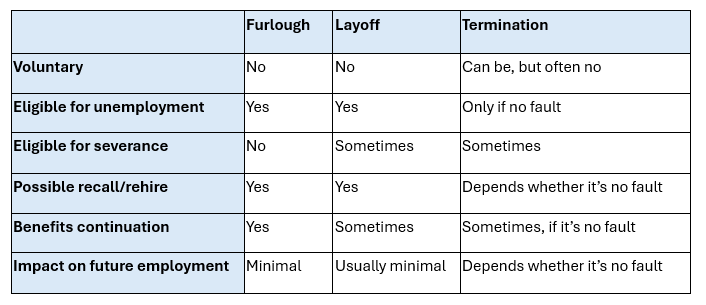
It鈥檚 important to have a clear understanding of the nature of your job loss, as it could impact your eligibility for benefits, among other things.
Protecting Your Finances After Furlough, Layoff, or Termination
Losing your job, no matter how it happens, could impact your personal finances. If you find yourself out of a job, take these steps.
Assess your emergency fund
See how many weeks or months of bills you can pay out of your savings. If your essential bills come to $2,400 a month and you have $6,000 in savings, you could cover 2.5 months of bills without resorting to debt. And that doesn鈥檛 include any money you might get from severance or unemployment benefits.
Review your budget
There may be expenses you can cut back on while your job situation is in flux. Comb through your carefully, and try to pinpoint a few bills to reduce. Make sure to prioritize your essential bills like rent, car payment, and food. Consider canceling extras like streaming services temporarily, then resubscribe once your financial situation improves.
Get relief from your debt
It can be hard to pay a mortgage or make minimum payments on your credit cards when you鈥檙e out of work. Contact your lenders and credit card issuers to see what options you have. You may be able to pause some of your payments or negotiate the terms of a loan to lower your monthly payments. You can also find out how debt relief works if you feel your debts are no longer manageable.
Unfortunately, the loss of a job could lead to more debt, since you may need to rely on credit cards or loans if you're not getting a paycheck. But you may be eligible for debt settlement.
Figure out your most affordable path to health insurance
Losing a job often means losing your health coverage. Going without insurance could result in catastrophic bills if you need surgery or emergency care, so it鈥檚 important to research your options. Depending on your situation, you may be able to join a spouse鈥檚 insurance plan at a cost, or you may qualify for subsidies that make an ACA plan more manageable for a time.
Find out if you qualify for government assistance
Depending on your financial situation, you may qualify for government assistance beyond unemployment benefits. You may be eligible for:
- SNAP, which provides food benefits
- Housing assistance
- Medicaid
- Utility bill assistance
Eligibility for these programs generally varies by state.
Losing a job can be a harsh blow, whether it鈥檚 temporary or permanent, and whether you did something wrong or not. Don鈥檛 hesitate to turn to family and friends for support as you figure out your next steps.
was produced by and reviewed and distributed by 爆料TV.