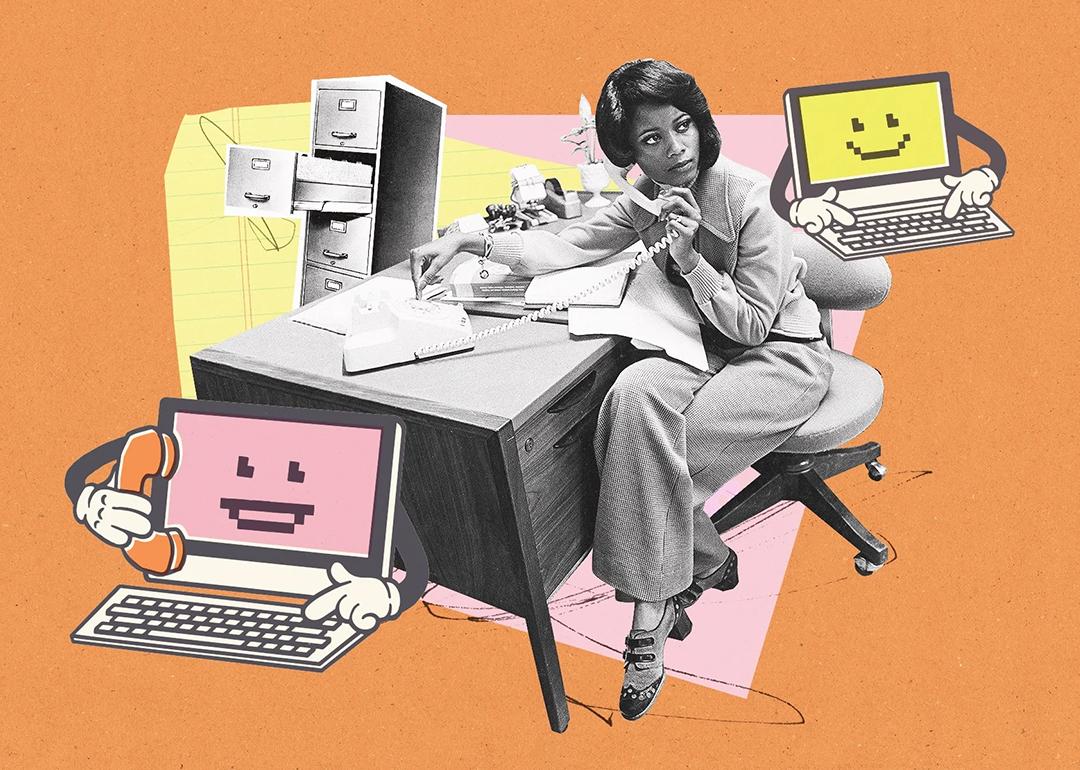
The women who power America’s offices are making themselves AI-proof
The women who power America’s offices are making themselves AI-proof
At the administrative assistants’ conference, everyone wants to talk about AI.
Among the workers who are most likely to have a hard time finding a new job if AI takes theirs, , according to findings from a recent Brookings Institution study. Most of them are admins or clerical staff, with the highest concentration of women workers.
So in the place where administrative assistants gather to talk about their industry and hone their craft, AI offerings abound: There is a class on how to prompt AI as an executive assistant and one on how to better use Microsoft Copilot or Google Gemini. , one session boasts.
Debra Coleman, who teaches the Gemini course at the Administrative Professionals Conference, said the popularity of these classes has taken off in just a few short years. They’re always wall to wall with administrative and clerical workers who, like her, have no trouble reading the tea leaves (or the headlines).
The mentality over the past couple of years has been, “Our jobs are toast,” said Coleman, who has been an administrative professional for 30 years.
explored how administrative assistants are adapting to the use of AI in the workplace and how the technology is impacting this women-dominated field.
The embrace of AI has happened quickly. Just three years ago, AI was met with significant skepticism from admins, a field that has historically been undervalued in part because of its workforce. They were viewed as notetaking secretaries rather than operational strategists in their offices. There was a worry, Coleman said, that incorporating AI would lead others to further devalue that work. As women, would their AI usage be viewed as an asset or a crutch?
“The male administrative support professionals, if you were to put both of us in a room and he stood up and said, ‘I’m incorporating AI into my everyday workflows,’ my sense is that he would be applauded,” Coleman said. “If I stood up and said, ‘I want to incorporate AI into my workflows,’ well, why are you being lazy, why do you want to do that?”
That competency penalty Coleman referenced is real: In one study where people were asked to review two identical code snippets labeled as written with or without AI assistance, women who appeared to use AI were than the men. Women in general have to be skeptical of a technology that has been developed with uses that have become toward women. But faced with real threats to their livelihoods, many admins have chosen to learn to use the tech to work for them, and some managers have learned to seek out workers with those skills.
Those facing the greatest threats of losing their jobs or having their jobs automated are admins whose jobs are very task-based, centering heavily on sending emails or scheduling meetings. Among those who may have a harder time finding a new position are older women who have been in their roles for decades and those in more rural pockets of the country where reemployment opportunities are narrower.
The threats are also higher for women of color, who make up of workers in the 15 most AI-vulnerable jobs. Black women’s unemployment rates as other sectors that offered them long-term stable jobs, like government employment, hemorrhaged positions. It’s “kind of a perfect storm,” said Katherine Gallagher Robbins, a senior fellow at the National Partnership for Women & Families, who has studied the impact of AI displacement on women.
The concern among economists is not just job loss, but the way that it could destabilize entire families and communities, said Michelle Miller, the director of innovation for the Center for Labor and a Just Economy at Harvard Law School, where she researches the impact of AI on working women.
“These women — mostly women — have some of the last remaining decent working-class jobs that might enable them to be the only person in the extended family that has an extra bedroom so if someone else loses their job, they don’t become unhoused, or they have predictable hours so that they can do school pickup, they can take people to doctor’s appointments,” Miller said. “The structure of their lives is not just about that they have this job — it’s sort of an exponential impact.”
Already, admins are adapting. Over the past two years the number of administrative professionals who said they have adopted AI has tripled, from 26% in 2024 to 77% this year, according to the .
Leah Warwick, senior content manager for the American Society of Administrative Professionals, said the push now is to create new roles that incorporate AI but highlight the strategic part of the work. New titles are already cropping up: Goodbye, executive assistant; hello, director of executive operations.
“Complex operations, frankly, is where we see things going with this profession,” Warwick said. “They’re rewriting their roles right now.”
If this story sounds familiar, it’s because it’s happened before. Administrative professionals are no strangers to technology threatening to eliminate or change their jobs.
In 1998, the : “Celebrate Secretaries Day while you can — it may be on the way out. Not only have the tools of a secretary’s trade changed dramatically in the last decade, but the word ‘secretary’ itself is becoming as passe as carbon paper. Yesterday’s IBM Selectric is today’s Microsoft Word or Powerpoint, and yesterday’s secretary is today’s administrative assistant.”
A decade before that, the that “U.S. companies are dropping stenographers, typists and secretaries and replacing them with word processors, high-speed copiers and sophisticated dictaphones.”
Around 1985, when that Washington Post article was written, there were about clerical and secretarial workers across the nation, making up 18% of the entire workforce. Today, the number is about .
Karen Nussbaum, who co-founded the clerical workers union 9to5 in 1973 and later headed the Department of Labor’s Women’s Bureau, told The 19th that there are numerous parallels today with what the union faced 50 years ago.
“The concerns were at two levels: What’s going to happen to me — what will my job be like, will I get trained for the new jobs, will it be paid a living wage; and what would be the new rules for the workforce — the restructuring of clerical jobs to eliminate decision-making, constant computer monitoring, the division of clerical jobs into a small number of administrative assistants and big pools of highly routine work at call centers,” Nussbaum said.
By 1980, Nussbaum said they knew they had about five years to shape what their jobs would be before a new crop of employees were hired with new expectations. The union fought to organize workers to help them collectively bargain as — some 645,000 jobs were lost from 1983 to 1987 alone — and launched a that taught workers to adapt to the changing technology by developing their problem solving and time management skills.
Today, Coleman said workers are trying to upskill to keep up with changing job descriptions and expectations that now require AI proficiency. In the interview process, workers are often asked to explain how they’d use AI to help streamline their work, she said.
What’s not catching up, administrative professionals told The 19th, is the training and resources workers need to make the jump to AI. According to the , only 47% feel confident integrating it into their workflows. It’s part of why AI classes are consistently the most popular at admin conferences.
Miller, who has been conducting lengthy interviews with women in clerical roles, said the message is consistently: “Just figure it out.”
“I’m less concerned about AI’s structural threat inside the workplace than I am for the totally goofy, unplanned mixed messages,” Miller said. “That’s the other thing that makes me wonder if there’s a massive displacement coming — you do have to have a plan for this to work and employers are not making those plans. They’re leaving it to individual workers.”
Mark Muro, one of the authors of the Brookings report, said much of the onus of what comes next will be on employers and how they respond.
“Are they seeking to just automate these jobs away or are they helping some of these women move to some of the more important jobs in the office?” Muro said. “The hope is firms will not just see this as an opportunity to automate and also see it as a chance for women to find a mainstay job in the firm.”
If that’s the way it goes, then there is opportunity in the AI age. Research has found that past technological disruptions have effectively helped college-educated women admin workers secure , though they still only represent of the workforce.
Alison Taffel Rabinowitz, a career coach and founder of the women career training program the Finishing School, said that for many years, administrative roles trapped women in low-pay, low-benefit work that didn’t live up to their full potential.
“That admin role had so much unseen strategy work but the thing that got the most spotlight was: Did the conference room have the right amount of food?” Taffel Rabinowitz said. “Maybe AI forcing that issue is brutal, but maybe it’s a reset. The roles that survive have to be reimagined and the best people to be reimagining them are women.”
That’s the pitch Kathy A. Adams and Rhonda Augustus, two administrative professionals with 50 years of experience between them, have been making for the women who are a part of the network they run called the Black Executive Admin Network, an industry support group.
Augustus, who has been job hunting since the end of last year after she was laid off from a telecommunications firm, said she’s used AI to optimize her resume to stand out in a crowded field, and to prepare her for the interviews themselves. In interviews, prospective employers don’t want to know if she can manage travel and expenses and the calendar. They now want to know what AI she’s using to prioritize tasks and streamline workflows.
“They’re asking me things like: How can you come in and do some type of operational infrastructure?” Augustus said. “They’re wanting to know: What AI can you adopt or put into place to make this workflow more efficient?”
And they’re willing to pay more for that. Jobs that three years ago may have been $70,000 to $80,000 are now six-figure roles, she said, though hiring managers may be looking for one or two admins to do more strategic roles, where before it may have been four or five positions.
In that landscape, there is no choice but to adapt, said Adams, who encourages women to find free or subsidized training opportunities, even when their companies won’t support them. After 30 years in the field, she now considers herself an “AI early adopter” who now can’t imagine doing her work without ChatGPT open on her computer.
Finally, this assistant has an assistant, she said. His name is Chatty.
was produced by and reviewed and distributed by ±¬ÁÏTV.