States with the most remote workers and what that says about regional lifestyles
Remote work is no longer just a COVID-19 pandemic-era experiment. It is a structural shift in how millions of Americans are earning a living and where they choose to live. While headlines often frame remote work as a national trend, the reality is far more uneven. Some states have embraced work-from-home as a defining feature of their labor markets, and others remain anchored in more traditional in-person industries that leave little room for flexibility.
used the Census Bureau鈥檚 American Community Survey data, along with insights from the Pew Research Center and other labor-market analyses, to show where remote work has taken hold and where it hasn鈥檛. This data will demonstrate what those differences mean for state economies, housing markets, and workforce mobility.
The remote work divide: Top and bottom states
Census data confirms a stark geographic divide in remote work adoption across the country. While the national share of people primarily working from home has stabilized since its pandemic peak, certain states are consistently outside the average, as evidenced by the :
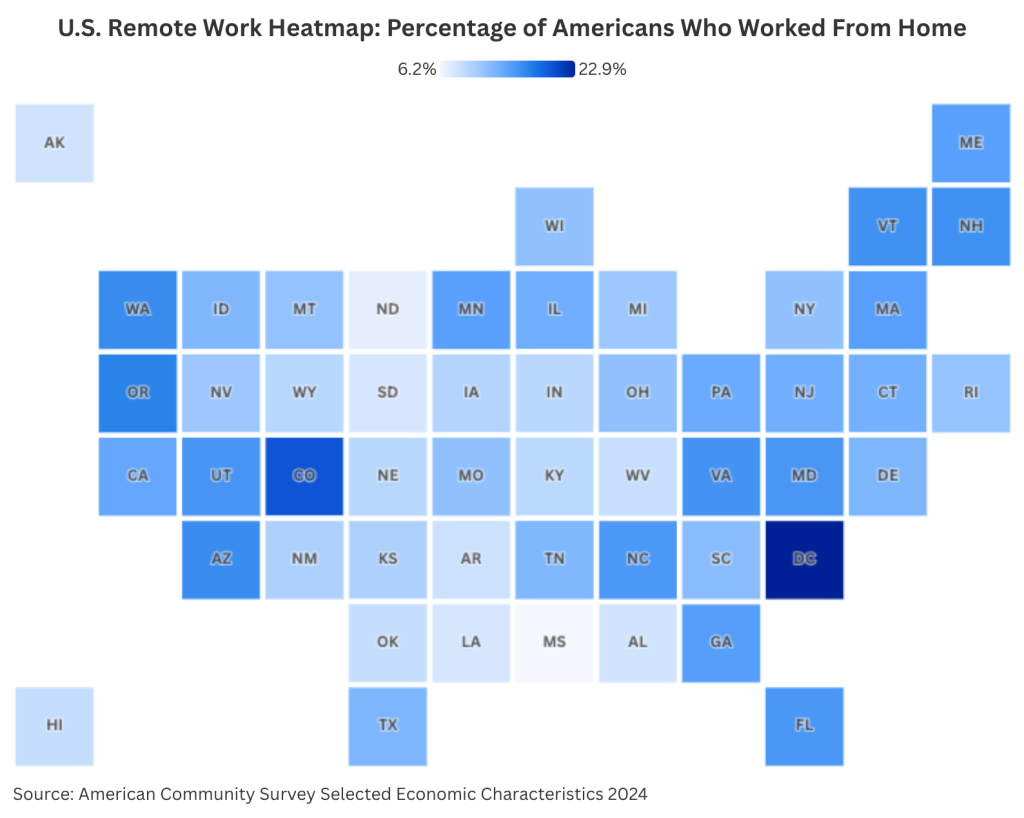
The outer edges of the United States are home to the states with the most remote workers, and the interior of the country shows lower numbers. States with the highest share of remote workers tend to have white-collar job concentration, higher education levels, and urban labor markets that transitioned smoothly over to remote work during the pandemic, but this isn鈥檛 a hard-and-fast observation across the board. Specifically, the top five states with the highest share of remote workers are:
- District of Columbia 鈥� 22.9%
- Colorado 鈥� 19.9%
- Oregon 鈥� 17.10%
- Washington 鈥� 16.40%
- Arizona 鈥� 16.30%
Remote working is no longer fringe in these states, with a significant share of residents working from home full-time. Many more do so in hybrid arrangements. Conversely, the states with the lowest percentages are:
- Mississippi 鈥� 6.20%
- North Dakota -鈥� 7.10%
- Louisiana 鈥� 8.00%
- South Dakota 鈥� 8.00%
- Alabama 鈥� 8.30%
These are states that tend to rely more on manufacturing, retail, logistics, health care support, and service operations that require an in-person presence. Even as remote tools have improved, the nature of available jobs naturally caps adoption.
Driver #1: Industry composition and job type
The strongest predictor of remote work adoption is naturally the type of work that a state鈥檚 residents do. States with high concentrations of technology, finance, professional services, and government roles can support more remote work, as these tasks can be done virtually. , a digital platform connecting students with coding bootcamps, conducted research on "tech exodus鈥� patterns that are beginning to emerge. This data shows that software engineers, product managers, analysts, and digital marketers are disproportionately represented among remote workers.
Conversely, states built around manufacturing, energy extraction, agriculture, or tourism face natural barriers to entry for remote roles. No amount of investment can make a factory floor or hospital remote.
Driver #2: Education levels create access barriers
Another gatekeeper of remote work is education. Data from the , the American think tank on economic and social issues, found that workers with a bachelor鈥檚 degree or higher are several times more likely to work remotely. States with higher educational attainment, therefore, enjoy a much broader remote-eligible workforce.
Meanwhile, states with lower college completion rates face an uphill battle, even when workers are eager for flexibility. This creates a remote work access gap that mirrors broader income and opportunity divides.
Driver #3: Migration reshapes regional economics
Remote work hasn鈥檛 just changed how people work but also where they live. The published a study in January 2026, noting that work-from-home trends have driven increased demand for smaller, less-populated regions that offer attractive amenities. As workers untether from the confines of an office, they can begin to prioritize housing affordability, lifestyle amenities, and tax structures.
This has ripple effects, though, including rising home prices in previously affordable markets, population growth without proportional office demand, and shifts in local tax bases. Suburban and exurban real estate markets have seen particular gains, similar to the seen following the COVID-19 pandemic, as outlined by the National Bureau of Economic Research. States that attract remote workers benefit from income flows but also face infrastructure and housing supply challenges.
Stabilization with regional divergence in the future
While the explosive growth of remote work has cooled following the pandemic, the long-term outlook points to stability rather than a reversal. In a panel of just over 5,000 respondents in early 2025, 46% indicated they would be likely to leave their current job if forced to return to the office. With such high numbers of workers enjoying the luxury of remote work, it鈥檚 clear that employers can鈥檛 afford to completely get rid of it.
The outlook isn鈥檛 the same everywhere, though. Instead of national cohesion, regional divergence is more likely. Our prediction? Remote-heavy states will deepen their advantage, in-person economies will remain essential (albeit flexible), and hybrid models will dominate wherever possible.
The continued development of remote work
Remote work has redrawn the American labor map, but not evenly. States with the right mix of industries, education levels, and policy environments are pulling ahead by attracting mobile workers and reshaping local economies. Others remain constrained by job type and access barriers that technology can鈥檛 solve on its own. As remote work enters its next phase, whatever it looks like, the question won鈥檛 be whether it will last, but which states are best positioned to benefit from a workforce that can choose both where it lives and where it works.
was produced by and reviewed and distributed by 爆料TV.