
What to do when parents have different care needs
When your elderly parents develop different care needs and it’s time to find a care arrangement where they can live together or near each other while receiving the care they need, you have several options. These include hiring in-home care for the parent who needs extra care or both parents moving to a senior care residence that allows them to each receive the appropriate level of care. shares what to know to choose the best fit for your option.
Key Takeaways
- When parents develop different needs as they age, there are many options for keeping them together while they receive care.
- Couples may be able to remain living together if one needs more care with the help of in-home care.
- Senior living communities can accommodate parents with different care needs by providing additional care to the one who needs it.
- Some senior living communities provide different levels of care so that parents can live on the same campus and receive the care they need.
Start by asking: Can they safely live together?
When a couple’s care needs diverge, it can affect both people’s safety and well-being. For instance, one person may need help with mobility, while the other has become too weak to help.
Signs that a couple with different health challenges may not be able to live safely together include:
- One senior’s needs affect their spouse’s health. “If one person is falling and their spouse has to call paramedics or family members to come and help, that’s the time when families need to step in,” says Niki Gewirtz, a senior living expert with A Place for Mom. “This is usually when families say we can’t let Mom do this anymore or we can’t let Dad do this anymore. It’s getting to be too much.”
- One parent needs consistent help. A parent may start needing daily help with , or they may need medical or cognitive support.
- One parent consistently acts as caregiver for the other. “This can be a really hard thing for some seniors to let go of because they take seriously that vow of ‘in sickness and in health,’ and believe it’s their job to take care of their loved one,” says Gewirtz, “but they’re not realizing the toll it’s taking on them.”
- One parent requires supervision to stay safe. If a parent is experiencing cognitive decline and is at risk of leaving the house or wandering, this is a sign that help is needed. Gewirtz offered the example of her 94-year-old grandfather, who started waking at 2 a.m. thinking he had to go to work, and waking her grandmother, who was losing sleep as a result.
Recognizing any of these signs means it’s time to choose one of the following options to be sure your parents are safe and cared for. In fact, families often discover that the goal isn’t necessarily to keep both parents in the same place at all costs, but to help them remain safe, connected, and supported.
What usually determines the best option?
Once your family has decided that it’s time to transition your parents to a new living arrangement, the challenge is determining which options can meet their needs. Here are some factors that can help you choose:
- Your parents’ individual care needs. If one parent needs help with ADLs or managing medication, then hiring or moving to might be the best choice. But if one person is experiencing cognitive decline, then a move to might be appropriate.
- Safety concerns. If safety is an issue, for instance, if one parent is experiencing , or has cognitive decline, which can lead to getting lost outside of the home, then they may benefit from memory care while the other remains at home or in an assisted living residence on the same campus.
- Your own family’s needs. A move to senior living can also help adult children, says Gewirtz. Adult children may miss work or time with their own kids to take a parent to doctor’s appointments, or to stay overnight with a parent who can’t be left alone. “It’s important to talk about how a community can not only help your parents, but help you,” says Gewirtz. And remember the benefits for your parents. “They’re going to be getting that 24/7 oversight, getting their and to doctor’s appointments, or the community may have medical professionals who come to them.”
- Cost. Most residential care communities require an entrance or community fee along with a monthly fee, and this can help determine whether one or both parents can take this step. However, says Gewirtz, “Some communities will make financial concessions. For instance, if you’ve got a couple who want to move into separate apartments, maybe they’ll just charge one community fee instead of two. Or maybe they’ll make a rent concession for the person who’s more independent.” If affordability is a concern, talk to the senior community about such financial options.
- Preference to stay together. If both parents wish to continue living together, then you’ll need to consider whether hiring in-home care for one parent is a possibility, or whether moving to a senior care residence where they can each get the care they need is a better solution.
Care options can help parents stay together
“There are a lot of choices,” says Gewirtz. Below are options that support senior couples with differing care needs staying together.
Home care
“As a starting point, one option is to bring in home care to help ease the caretaking burden,” says Gewirtz. “A home health caregiver can give one senior a shower or help with light housekeeping.” This works best when the care needed is minimal. For instance, a home health care provider could help with short-term care of a parent who’s recovering from surgery with services such as physical therapy, medication administration, or wound dressing.
This arrangement relieves the healthier or more active spouse from having to do those tasks, and allows them to get out of the house, reducing the and . “Many times, though, seniors are reluctant to have a stranger in their home,” says Gewirtz. “So in-home care doesn’t tend to be a long-term solution.”
Independent living with added care
Another option for couples is to move into an community where the person who needs care can receive in-home care services. Many independent living communities allow home care services for one spouse in a couple.
“On-site home care can be very flexible and helpful to alleviate the stress of the primary caregiver,” says Christy Neal, a Senior Living Advisor at A Place for Mom. “Staff and neighbors are usually aware that the couple has slightly different needs, and [they] lend a watchful eye and helpful hand when needed.”
If the independent living community doesn’t offer easy access to a home care provider or it isn’t feasible to pay for this added service, there are other options.
Assisted living for couples with different needs
For but have different care needs, moving into an assisted living community may be an appropriate choice because caregivers are available 24/7 in case a resident needs some kind of assistance, such as help with ADLs.
“A lot of times couples will go into assisted living where they can be in the same apartment together,” says Gewirtz. “If one person needs a lot of help, say with incontinence care, or taking a shower, or mobility assistance, they’ll have 24/7 care staff there to help with that while they can still remain in the same apartment together.”
However, assisted living communities provide different services, so it’s important to find one that offers the specific services each person needs.
A two-bedroom unit in assisted living is another option, Gewirtz says. This can ensure each spouse gets the sleep they need if, for instance, one person is a light sleeper and the other tosses and turns.
Some communities also provide tailored short-term nursing services for residents with more advanced needs.
Continuing Care Retirement Communities (CCRCs)
A longer-term option for couples is a (CCRC) that includes independent living, assisted living, and on a single campus. This type of senior living can work well for couples who have different care needs, says Gewirtz. In this setting, the couple can interact regularly, have meals and do activities together, and family members can visit both parents easily because they live on the same campus.
Neal says it’s common for senior couples who have different care needs to move into the same community but live in different buildings.
“Each spouse can have all their physical and cognitive needs met in a safe setting, amongst their peers, and they can still be together as often as they’d like,” she says.
When living together may no longer be the safest option
Situations in which it is no longer safe for a couple to live together include:
- One person has and is at risk of wandering or getting lost, or isn’t safe at home alone
- One person has complex or intensive medical needs and requires emergency care
- The caregiving spouse or partner experiences
In these situations, couples can benefit by living in separate apartments in the same senior living community or in separate buildings that offer different levels of care.
Gewirtz recalls meeting a couple in a senior living community who both had dementia and often argued with each other. The solution was to move them into apartments across the hall from each other. “They could be separate during the day if they wanted, or sit in each other’s apartment,” she says. “But if they started bickering or getting on each other’s nerves, they could go to their own private space. And that worked out great.”
How to support parents who live apart
When it’s not feasible for parents to continue living together because their care needs differ significantly, then living in separate spaces may be the best for their health and well-being. If one parent stays at home while the other moves into a residential care community, you can manage the arrangement by:
- Planning for transportation. “Use an Eldercare Locator to find your local Area Agency on Aging and access senior transportation services,” suggests Sharon Daily, LCSW-C, a social worker at University of Maryland Upper Chesapeake Health. This way, the burden of driving one parent to visit the other doesn’t always fall on a family member.
- Making a visiting schedule. Since you can’t be in two places at once, schedule family and friends to visit on different days. Not only will this lighten your load, it will also relieve some burden for the more independent parent who’s still at home.
- Managing guilt. Rather than blaming yourself or others for your parents’ senior living separation, focus on the fact that you and your family are doing the best you can in a complicated situation. “Be gentle and kind to yourself and your family members when managing the stressors of having parents in two different care environments,” Daily says.
Comparing care options for parents with different needs
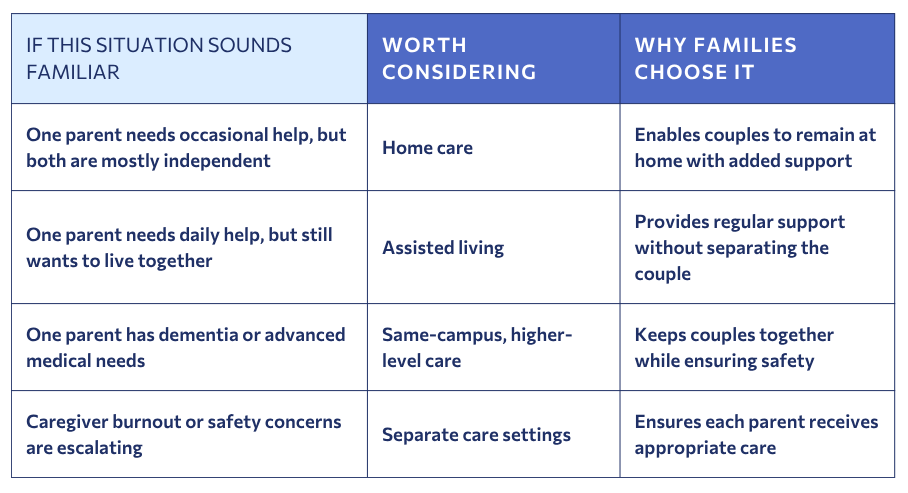
If one parent is developing significant health needs, is presenting safety concerns, or a caregiving parent is experiencing stress and burnout, then it’s time to talk with an expert who can help you find an appropriate living situation for both parents.
was produced by and reviewed and distributed by ±¬ÁÏTV.