Inside the largest US measles outbreak in decades: Records reveal spread in vaccine-hesitant community
The first case in what would become the largest U.S. measles outbreak in decades was a parent in South Carolina’s Upstate region near Spartanburg.
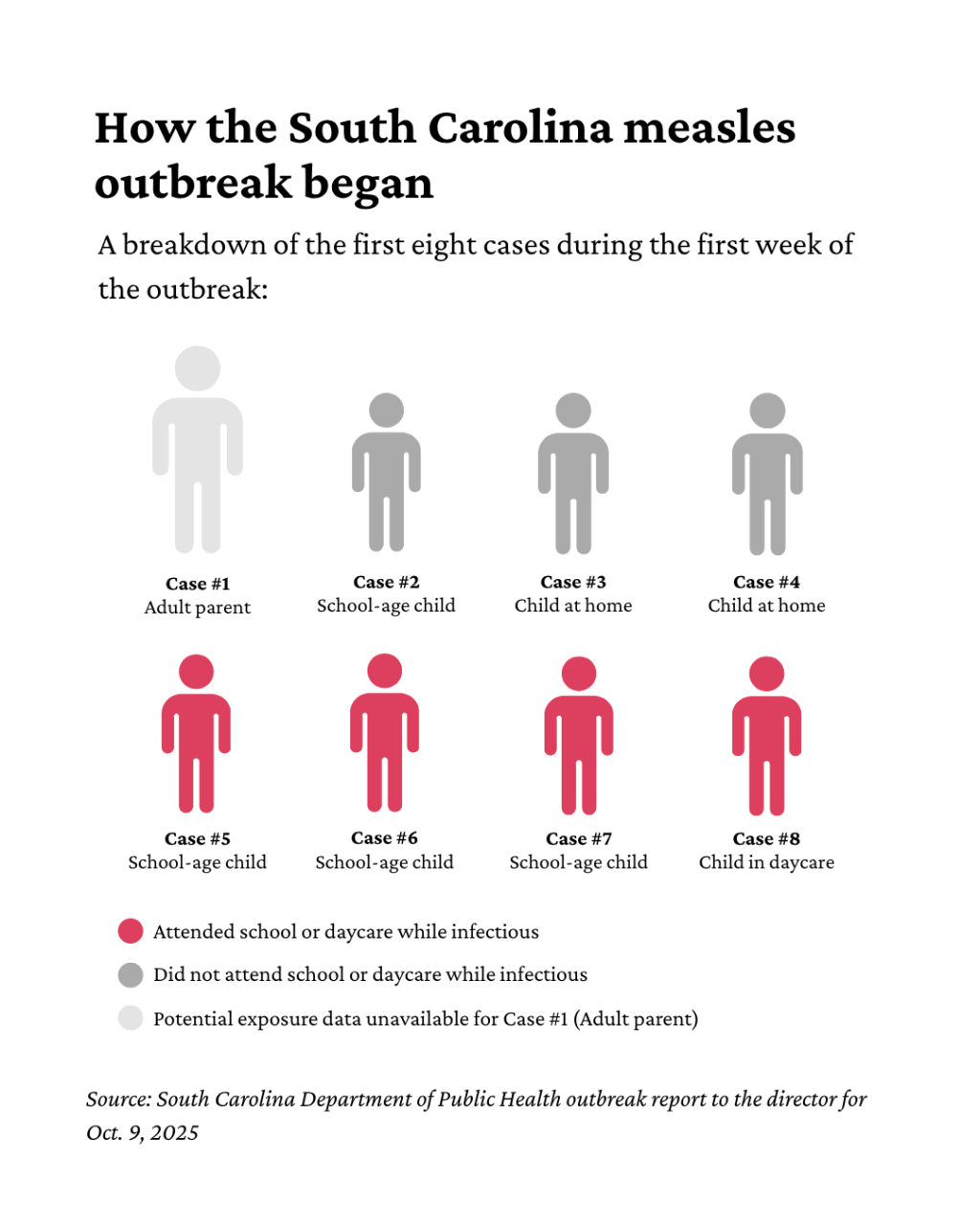
The next seven people to fall ill were all children. Three of them were being cared for at home — limiting their ability to spread the highly contagious measles virus to others.
But the children who became Cases 5, 6, 7, and 8 were infectious while they mingled with other children at school and in daycare, according to internal records obtained by Healthbeat from the South Carolina Department of Public Health.
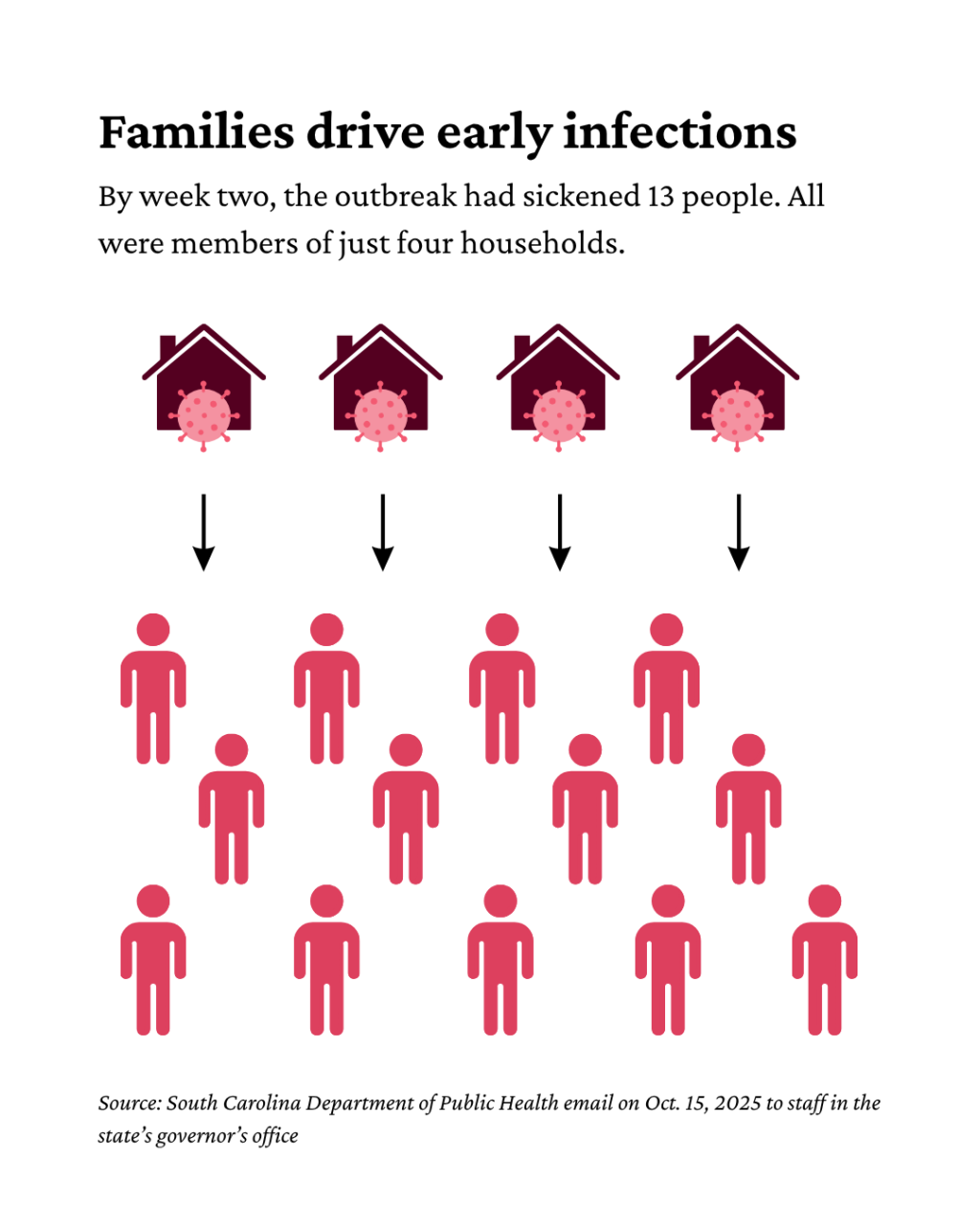
By the second week of the outbreak, the number of known infections had grown to 12. The internal records, obtained under the state’s public records law, reveal all of them lived in just four households.
At the center of the nearly seven-month South Carolina measles outbreak — from beginning to end — was a close-knit, vaccine-hesitant Ukrainian- and Russian-speaking community in and around Spartanburg County, according to South Carolina state health officials.
By the time the outbreak was on April 27, the handful of cases that were first identified among a couple of families in October 2025 had resulted in 997 documented measles infections.
detailed the events of the 2025-26 measles outbreak in South Carolina and explained how such a disease can spread through close-knit, low-vaccination communities.
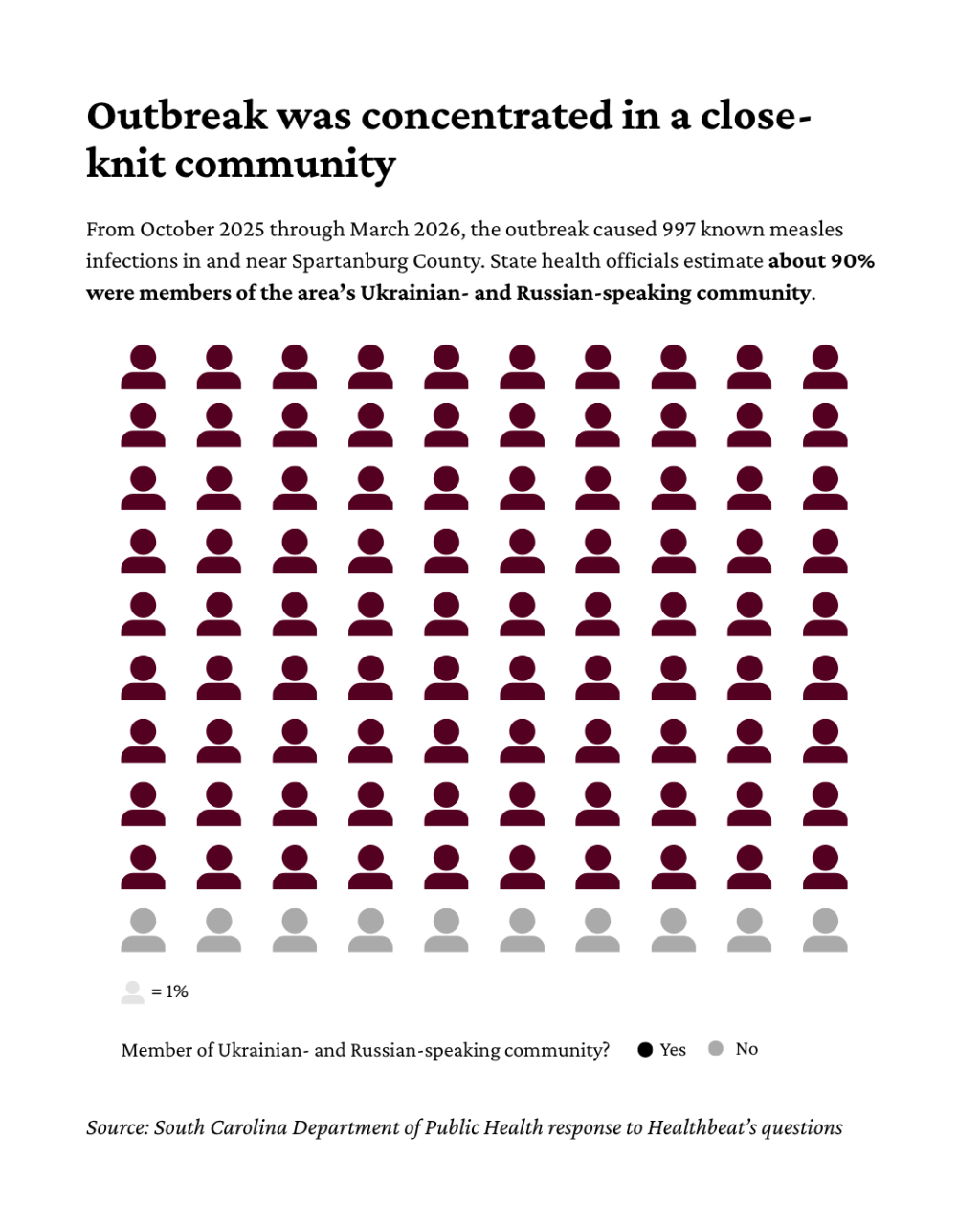
South Carolina DPH estimates about 90% of these outbreak cases were among members of the area’s Ukrainian- and Russian-speaking community, which has around 15,000 people in Spartanburg County, the department said in emailed responses to Healthbeat’s questions.
“This community was at the center of the outbreak for its whole course,” said the department, which did not grant an interview.
The South Carolina outbreak is the latest example of a trend the Centers for Disease Control and Prevention has documented for decades: Nearly all large U.S. measles outbreaks since 2000 — when the country attained measles-free status — have involved various types of close-knit groups with low vaccination rates.
As measles makes a major comeback across the country, a Healthbeat examination of the challenges encountered controlling the South Carolina outbreak highlights the need for public health officials to understand the specific and sometimes differing reasons for vaccine hesitancy within individual groups.
It also illustrates the importance of identifying at-risk pockets of unvaccinated people and building trusted relationships before outbreaks happen. All are complex tasks made more difficult amid heightened public distrust in the wake of the COVID-19 pandemic and during a time of cuts to public health staffing and funding.
“Waiting for infectious disease to start spreading is too late. It is significantly more effective to prevent an outbreak than to contain it,” said Dr. Eliza Varadi, a Russian-speaking pediatrician in Charleston, South Carolina.
“Even in a state where most people are vaccinated, those small pockets, that’s where diseases will spread,” said Varadi, the immunization representative for the South Carolina chapter of the American Academy of Pediatrics, who worked with DPH officials during the outbreak and provided advice on culturally sensitive outreach and education.
Close-knit groups have fueled U.S. measles outbreaks since 2000
South Carolina’s outbreak is a case study in how years of declining immunization rates — especially among children obtaining religious and nonmedical — is making localized communities of various types across the country vulnerable to the spread of infectious diseases, according to Varadi and other health experts.
Dr. Satish Pillai, the CDC’s incident manager for the 2025-26 national measles response, noted the role of close-knit groups in “nearly all” measles outbreaks with more than 50 cases since 2000 during a earlier this month.
These outbreaks include those that have occurred in largely in an Orthodox Jewish community; in Washington state in 2019 among a Ukrainian- and Russian-speaking community; in primarily among children of Somali descent; in within a shelter for migrants who were mostly from Venezuela; in where a Somali community was disproportionately impacted; and in in 2025 among a rural Mennonite community.
In recent months, Pillai noted, the types of close-knit groups driving measles outbreaks have been evolving. Large outbreaks this year have occurred in Florida and at in Texas.
“Having large college outbreaks and large detention facility outbreaks at these levels are unprecedented since 2000,” Pillai said.
Meanwhile, lower vaccination rates throughout communities have begun allowing outbreaks that begin in close-knit communities to start spreading widely across populations, as has happened in the ongoing , he said.
Schools, families, churches contributed to virus spread in South Carolina
South Carolina DPH officials told Healthbeat they do not know the infection source that led to the initial cases in the state’s measles outbreak. They said this indicates unrecognized spread of the virus was already occurring by the time cases started being reported to public health.
Measles poses a significant outbreak threat for unvaccinated, socially and geographically connected people because it is so contagious and spreads through the air, where it can linger for in enclosed spaces.
To prevent ongoing transmission of measles within communities, need to be fully vaccinated against the disease, according to the CDC.
Some of the earliest cases in the South Carolina outbreak last October involved Global Academy of South Carolina. The Spartanburg County public charter school was founded by whose “passion to help families of immigrants” have prompted them to open tuition-free schools in California, Florida, and , according to the schools’ websites.
When the outbreak started, Global Academy’s student body had one of South Carolina’s lowest levels of vaccination coverage: Only 21% of its students were up-to-date on their school vaccinations during the 2025-26 school year, . Even fewer of the school’s students — — were fully vaccinated during the previous school year.
Officials with Global Academy of South Carolina, its board of directors, and founders have either declined to be interviewed, did not respond to interview requests, or could not be reached during and after the outbreak.
As the measles cases continued to spread within households, some of those infected were unvaccinated children and teens who unknowingly brought measles into other schools — exposing scores more students who also weren’t vaccinated.
“We know that some schools with a high percentage of children from Ukrainian- or Russian-speaking families have been impacted and a number of public exposures have been reported in churches attended by these community members,” DPH said in response to Healthbeat’s questions.
In low-vaccination communities, one person can expose dozens
Because the initial symptoms of measles — such as a cough, runny nose, red eyes, and fever — can appear like those of a common cold or the flu, people can spread the disease before they know they have it. They are contagious beginning four days before the telltale measles rash appears on their face and body.
Further complicating public health efforts to control the virus’ spread is that there can be a significant lag time from when someone is exposed to the virus and when they start feeling ill. Symptoms often develop seven to 14 days after exposure, but it can sometimes take .
Internal South Carolina state health department records obtained by Healthbeat provide a window into how a single contagious person can expose dozens.
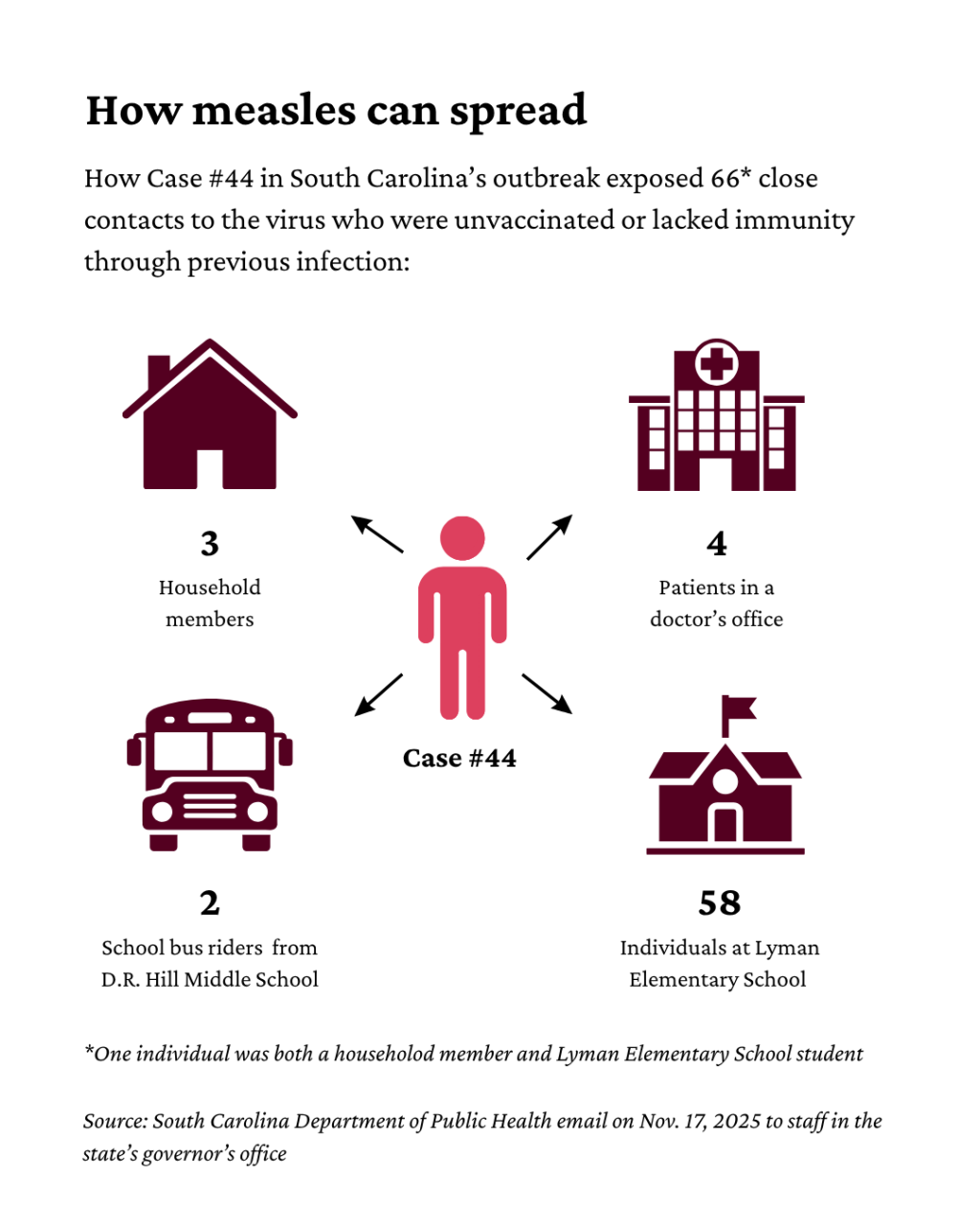
Outbreak Case No. 44, identified by state health officials in mid-November, exposed 66 close contacts to measles who were unvaccinated or lacked immunity to the virus through previous infection. They included three household members, four patients at a doctor’s office, 58 individuals at Lyman Elementary School (including one of the household members), and two school bus riders from D.R. Hill Middle School, according to an email update from DPH to the South Carolina governor’s office on Nov. 17.
As state public health officials investigated outbreak Case No. 45, they identified an initial 61 close contacts who had been exposed and weren’t protected against measles. They included four household members and 57 individuals from Boiling Springs Middle School. The person, while infectious, also attended a church with about 250 people in its congregation, according to DPH emails to the governor’s office on Nov. 19 and 20 that do not name the church, but say notification letters in multiple languages were provided for distribution.
As the outbreak continued, infected people participated in services and other activities at several Slavic churches, where services are held in the Russian or Ukrainian languages, including Slavic evangelical and Pentecostal churches.
At one of these churches, the Way of Truth Church in Inman, South Carolina, a person who was infectious attended on the , exposing others who weren’t vaccinated. Over the weeks that followed, at least 30 infections were linked to the church.
Of the 14 newly identified measles cases announced on Dec. 2 by state health officials, . Over the next week, fell ill with measles from exposures at the church. linked to the church were announced on Dec. 16, on Dec. 19.
During late December and into January, state health investigators tracing the movements of people recently diagnosed with measles identified additional exposures that had occurred at , including Tabernacle of Salvation Church, Ark of Salvation Church, and Slavic Pentecostal Church of Spartanburg. Church leaders could not be reached or did not respond to Healthbeat’s interview requests during and after the outbreak.
Slavic churches unwilling to host vaccination events during outbreak
Varadi, the state American Academy of Pediatrics representative who worked with South Carolina DPH during the outbreak, told Healthbeat that vaccine hesitancy within the membership of some Spartanburg-area churches was a key challenge in stopping the outbreak.
“The center of the outbreak was not the entire Russian-speaking or Ukrainian-speaking community. It was a small subset that may have been related to specific churches,” Varadi told Healthbeat.
“It’s not that the church leadership was discouraging vaccinations, they just were not encouraging,” Varadi said. “We wish that there would have been a better partnership to work together to encourage vaccination.”
DPH officials, who told Healthbeat that Varadi provided them with “valuable insights and assistance,” acknowledged that no church from within the area’s Ukrainian- or Russian-speaking community agreed to host a vaccination event during the outbreak.
“As is often the case, church leaders made decisions about whether to interact with DPH based largely on the wishes and feelings of their congregations,” the department said in its written responses to Healthbeat’s questions. “While some were willing to discuss outreach and education opportunities, others were not. Importantly, none were forced to meet with DPH to discuss any of these topics.”
One of the close-knit community’s “prominent churches” did voluntarily agree to meet with DPH leadership during the outbreak, the department said, “and that conversation was informative.” DPH declined to name the church.
From the beginning of the outbreak, DPH officials in press briefings emphasized the importance of vaccination in stopping the outbreak. They separately made information about measles available in the and languages on the DPH website and to churches and other groups.
Two doses of the measles-mumps-rubella (MMR) vaccine are 97% effective in protecting against measles, and even one dose is 93% effective, .
While the Ukrainian- and Russian-speaking community remained a vaccination challenge, — the department started seeing wider increases in measles vaccination across Spartanburg County and the state. This increase, combined with the large number of people who became immune to measles through illness, helped end the outbreak, they said.
Dr. Brannon Traxler, the South Carolina DPH’s deputy director and chief medical officer, in response to Healthbeat’s questions during the department’s last media briefing on the outbreak on April 27, said it is important to understand the community’s history and reasons for being hesitant about vaccines.
“We recognize and appreciate there is history there that didn’t occur in South Carolina, often even before they came to the United States, that has led to very legitimate fears of government and of government health,” said Traxler, who the department’s acting director in May. “They have a reason to have the doubts that they do.”
Traxler did not elaborate. DPH, in response to Healthbeat’s questions, declined to discuss the reasons public health workers have been given by community members for not vaccinating their families against measles.
“Those reasons are theirs to communicate, not ours,” DPH said by email. “Our role in every communication was to provide the best factual information possible with which families could make informed decisions.”
Vaccination programs and government trust have a complicated history in Ukraine and Russia.
The more distant history includes the former Soviet Union’s and and concerns about vaccine safety.
There also was a history in former Soviet republics of some measles vaccines having in preventing outbreaks that has been attributed to poor manufacturing quality control and improper vaccine storage and handling practices.
While the Russian Federation is estimated by the World Health Organization and UNICEF to have for many years, that has not been the case in Ukraine.
In Ukraine, the country’s vaccination coverage dropped dramatically after the of a Ukrainian teenager, an event later determined to be against measles as part of a large immunization campaign.
According to the , 95% of children in Ukraine in 2008 were fully vaccinated against measles. But by 2016, were protected with one dose of measles vaccine and . And during 2017-19, the country experienced a measles epidemic that resulted in more than .
Since then, vaccination coverage . As of 2024, about 91% of 1-year-old Ukrainian children and about 83% of 6-year-olds were vaccinated against measles, according to information last year.
In South Carolina, DPH officials said members of the Ukrainian- and Russian-speaking community cooperated with the department’s recommendations for isolating and quarantining at home to prevent spreading measles to others.
Quarantines, which could last up to 21 days, had a significant impact on these families’ daily lives, education, and finances, with children having to stay out of school and adults missing work.
DPH said its community health workers, when asked, helped these families identify social service resources, including for food and utility support.
Community members are key to building trust in public health
Public health officials at the Washington State Department of Health found themselves facing similar challenges in 2019, following a among a Ukrainian- and Russian-speaking community.
“We didn’t have a lot of connection with that community or a lot of resources for them in their language,” said Danielle Koenig, the department’s health promotion supervisor.
In the wake of the outbreak, Koenig helped secure a CDC grant that for six years funded a project to better understand the needs of the community, build trust, and provide health resources. The grant ended last summer.
The department found that a cornerstone of building trust is partnering with leaders and organizations from the impacted community, listening and responding to their needs, and hiring members of the community — like Vadim Gaynaliy — to help lead the outreach.
Gaynaliy, a health educator at the department who speaks Ukrainian and Russian and is from a large Ukrainian community in northeast Portland, Oregon, said his background and those of others involved in the project provided insights into the community’s values and how it functions.
“We’re not even talking about a single community here. There’s obvious political tensions between Russian and Ukrainian communities, there’s different religions and denominations. So we try to address them as different communities who will have different needs,” Gaynaliy told Healthbeat.
The project resulted in the creation of the — now an independent nonprofit organization run by and for the Ukrainian- and Russian-speaking community that provides a range of resources and support programs beyond just information about vaccination.
“Trust is the biggest ingredient,” said Tamara Cyhan Cunitz, the board’s co-founder, executive director, and a registered nurse and educator whose relatives came to the United States after escaping the Soviet Union during World War II. “People who are from a cultural community will pay attention and connect better with someone who knows their culture and language.”
South Carolina gets 5 months of funding to launch outreach project
The huge measles outbreak in the Spartanburg area is finally over, but the area remains at risk of future outbreaks because it continues to have large pockets of people who are not vaccinated against the disease — including in the Ukrainian- and Russian-speaking community.
To help address this, DPH told Healthbeat it is beginning a new partnership with two nonprofit public health organizations to hire community health workers to do education and outreach in two or three areas within Spartanburg County that face higher risks from measles and other vaccine-preventable diseases.
The CDC Foundation, a nonprofit organization that supports the CDC and public health, has agreed to provide five months of funding for the project, the groups said.
“The idea is to reach the specific Slavic community, that from a health department perspective, they have had struggles with reaching over the years and to really make inroads around vaccines and vaccine education,” said Scott Thorpe, executive director of the Southern Alliance for Public Health Leadership, which is one of the project’s partners. “Doing this work outside of a crisis is really, really important.”
Terri Jowers, executive director of the South Carolina Community Health Worker Association, the project’s other nonprofit partner, said the project plans to hire three community health workers, with two of them coming from within the Russian- and Ukrainian-speaking community.
Jowers said the project will develop training for this soon-to-be hired team on how to better engage with communities through conversations about why they are hesitant or concerned about vaccines, what they have heard, and ways to work together to find sources they trust to figure out the facts. The training will also be made available to other community health workers in Spartanburg County and across the state, she said.
“The goal is to really start training people by the end of June so that community health workers feel more comfortable having these conversations,” Jowers said.
Five months is not a lot of time to build trust, and Jowers said she is hoping that the project will be able to identify additional funding for a year beyond the initial grant. “You have to build those trusted relationships,” she said.
The CDC Foundation, which told Healthbeat it is providing more than $100,000 for the project, said that trusted messengers are critical. The foundation said the project’s limited time frame is based on funding availability. “If additional funding becomes available, we would consider extending the timing,” it said.
was produced by and reviewed and distributed by ±¬ÁÏTV.