
The affordable daycare that keeps parents close
Saja Khuder was set to return to her job with a pharmaceutical firm after maternity leave. At the last minute, her child care plans fell through.
Chase Mateusiak, a bioinformatician, was using a daycare that was “fine” but expensive — and which left his 18-month-old son “exhausted and unhappy” after a 10-hour day.
And for PhD student Kellsey Launius, paying for daycare wasn’t an option. She tried to work around her daughter’s nap time, but found it almost impossible.
All three parents found the answer in , a coworking space with adjacent child care facilities in Ann Arbor, Michigan. Users say its prices are a fraction of what other daycare centers charge, reports.
For Launius, who had been reluctant to leave her then nine-month-old with strangers, Little Break was “a perfect solution,” allowing her to focus while knowing her daughter was close by. “It immediately felt like a supportive community for working parents, rather than just a place to sit and work,” she says.
While some countries prioritize child care, the U.S. — aside from some states, — is not one of them. Families spend between of their median income on full-day care for just one child, and prices have . And cost is not the only factor. Just over half of America’s children live in — areas where demand exceeds availability. “There are waitlists everywhere,” says Khuder.
“I think in the U.S., we’ve all kind of thrown our hands up in the air, and just [said]: ‘I guess this is how it is,’” says Ariel Wan, founder of Little Break. Parents face tough decisions, and often one of them — usually the mother — ends up working less. The conclusion is that women can’t, after all, have it all.
Wan disagrees: “We can. Let’s just build it.” So she did.
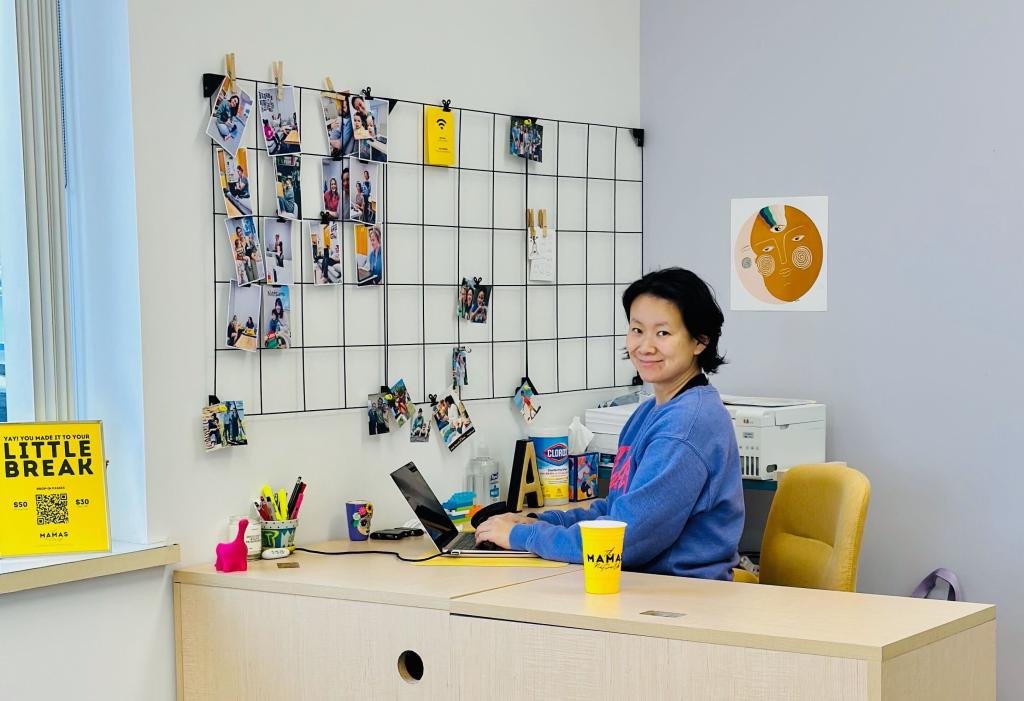
Wan’s own children had attended full-time daycare while she and her husband worked demanding jobs — a stressful, tiring routine. She began looking for dedicated support for parents, but found very little.
“It’s a tale as old as time: When a mother gives birth, they’re like: ‘Where is my village?’” says Wan, who, like many women, moved away from family for her career, and also struggled with postpartum depression. “There’s no one around.”
She made it her mission to change this, quitting her corporate job in 2024 and setting up , a nonprofit support community. As part of this, Little Break opened in April 2025, initially charging $299 per month, then rising to $599 for full membership (use of the space five days a week). In December, it moved into a larger space, with full-time membership priced at $799 per month. In comparison, Mateusiak’s family previously paid around $1,450 for three days a week. Non-members can also use the space on a drop-in basis ($65 per day).
Little Break is a nonprofit rather than a commercial business, and Wan is not yet taking a salary herself. The big difference, however, is that it is not a licensed child care facility, making it much less costly to run. Parents must remain on site, and take care of feeding and diaper changes. Otherwise, they get on with work in an adjoining room, while paid staff — other parents, some of them former nannies or daycare workers — watch the children.
“It’s like that village feeling, where everybody’s sort of helping raise each other’s kids. It’s amazing,” Mateusiak says.
The setup wouldn’t suit everyone. But users point out the upsides. “You can’t leave your child there and go somewhere else. But the benefit of that is you have nothing else to do but to focus on your work,” says Khuder. There are interruptions, but that also means you’re available when issues arise, says Mateusiak, who mentions a recent “biting incident” involving his son, Wolf. More importantly, it’s allowed much more father-son time than he would otherwise enjoy. “I got to see Wolf’s first steps,” he says.
Little Break aims to provide just that — a little respite — whenever needed. While some use the space regularly, others drop in at short notice. One parent needed backup when their usual daycare closed for Halloween; another turned up when a heating malfunction meant the preschool had to shut, says Wan. The relief on their faces was visible.
It’s easy to think other parents are all coping, she says. “Then you realize, no: We’re all drowning.” Little Break provides “flotation devices” at no extra cost, Wan adds, in the form of spare diapers, coffee, even space for a nap. “We’ll pull you out of the water, get you dry, get you cozy.”
That focus on adults’ wellbeing is intentional. “My joke is: I don’t care about your kids. You care about your kids […] If you’re taken care of, you are able to take care of your kids,” says Wan. Little Break has no rules about drop-off times, for instance, the existence of which, she says, helps children and staff but can cause extra stress for parents.
A coworking community can counter the isolation that some experience when working from home. Khuder, who works remotely, says coworking helped her transition from maternity leave to work. Mother and baby both benefited from the sociable surroundings: Khuder made some “great connections” with other professionals, while her baby developed more quickly than her older children did, thanks to much more interaction with other children. She now has an au pair at home, so is no longer a member of Little Break, but, with three children under the age of four, still uses the space when needed.
Many large employers already provide . Family-friendly coworking is also catching on. Alongside Little Break, other providers include in Pennsylvania, in Australia and in the U.K.
Dr. Karen Aronian, a parenting and education expert, sees combining services as “very instinctual.” There are practical and psychological benefits for parents and children, and it helps educators, who can quickly check in with parents when needed. The benefits may go even further. One researcher who looked into this form of suggests it is linked to fairer pay for staff, and stronger neighborhood and civic engagement.
An immediate advantage is reduced travel time. provides coworking, gym and licensed child care services in one place, and customers using all three save 270 hours of driving a year, according to founder Britt Riley — while avoiding the “persistent, cranking stress” of rushing from one place to another.
Haven, which currently operates in three locations in Rhode Island and New Jersey, aims to provide “spectacular” child care, says Riley. Memberships cost between $645 and $2,450 per month, depending on location — similar to the price of a high-quality child care provider, but far cheaper than a nanny, according to Haven.
That makes its model quite different from that of Little Break. But, like Wan, Riley’s personal experience of juggling a career and motherhood prompted her venture. “I just couldn’t stop thinking, ‘there has to be a world where parents can achieve their professional aspirations as well as their parenting aspirations, and feel good about it,’” she says. She spent two years “trying to get to the bottom of what on earth has happened in this country — that we have essentially not progressed in the area of supporting families and child care since women went to work […] half a century ago.”
But she was also determined not to “sit around and wait for the government to get its act together.” Six years ago, Haven opened its doors; it has in investment, and is now looking to rapidly expand through a franchise model. “We’d like to be in at least 150 communities in the next five years,” says Riley.
Wan also hopes Little Break will spread. She has recently opened a smaller, mornings-only version of the model . Expansion isn’t easy, though. As a new nonprofit with no financial backing, potential landlords are likely to be wary, she says. Finding staff in an underpaid, stressful sector is also tough.
For Riley, a key challenge is complex regulations and licensing requirements, which may differ from one state to the next. “It’s certainly not like opening a small clothing store,” she says.
Ultimately, few would argue that models like either Haven or Little Break can solve the child care crisis. But, as Mateusiak says, “The alternative here is what we currently have, which clearly isn’t working. Can it be part of the solution? I think the answer clearly is, obviously, yes. I don’t think it’s the only solution, though.”
Haven offers corporate memberships, and Riley says she is working to convince more companies that they, too, benefit when covering employee costs. Once CEOs are on board, she believes they will “get loud,” pushing governments to act too.
The new wave of family-friendly workspaces could also raise the bar for employers of all kinds, Dr Aronian suggests: “You have to consider how you could compete.”
was produced by and reviewed and distributed by ±¬ÁÏTV.