Why values and early conversations matter when talking about wealth
Wealth without values is a fragile inheritance鈥攕tarting early, honest conversations with kids about money and meaning is the true legacy that lasts across generations.
When it comes to wealth, especially at the ultrahigh-net-worth (UHNW) level, the conversation often starts and ends with portfolios, asset allocation, and tax strategies. But if you ask families who have successfully navigated wealth across generations, they鈥檒l tell you the most critical work happens long before any financial decisions are made. It begins with understanding your relationship with money and, more importantly, the values that guide it.
Insights from dozens of in-depth, confidential interviews with multigenerational families and family office leaders point to a clear conclusion: Wealth without a foundation of self-awareness and shared values is fragile. On the other hand, as explains, wealth grounded in purpose and intentionality stays resilient.
Why Values Come First as Wealth Grows
One self-made entrepreneur who eventually exited put it succinctly: 鈥淚f my motivations were a Ferrari and a bigger house, I would have given up early and failed miserably. The only reason I kept fighting was for my family. That鈥檚 the only motivation that matters.鈥� Clarity of purpose鈥攏ot financial reward鈥攕ustained them through years of uncertainty and eventual success. Without that clarity, wealth can amplify stress, fear, or misalignment. But when your financial journey is anchored in what truly matters, wealth becomes a servant to life, not the driver of it.
For many wealth creators, there is no inherited playbook. As one family office leader explained, 鈥淲hen wealth is liquid and there鈥檚 no legacy business, you don鈥檛 automatically have a story or something bonding family members. You have to be intentional about creating a sense of connection and legacy.鈥� Values such as humility, responsibility, generosity, and stewardship become the compass when there is no road map.
And this compass is essential not just for the current generation but for the next. One first-generation wealth creator shared a common concern: 鈥淚 just don鈥檛 want my kids to think that money makes them better than anyone else. It doesn鈥檛. They still have to show up, they still have to work, and they still have to be good people.鈥� Families who are most confident about their long-term success emphasize communication, education, and deliberately conveying values to the next generation.
Put Values First, Numbers Later
One of the most important lessons to be learned from working with UHNW families is that values must come before numbers. One entrepreneur with five children described their approach: 鈥淲e created our family values together: love, gratitude, respect, discipline. I ask my kids 鈥榃hat are the values you guys lived today at school, or in the sports arena?鈥欌�� This philosophy鈥攖ying money conversations back to values and separating values education from financial disclosure鈥攊s a hallmark of families who feel confident about the next generation鈥檚 outcomes.
Without a values framework, wealth discussions can feel abstract, or worse, transactional. But when values come first, money becomes a tool in service of something bigger, not an identity. This mindset transforms wealth from a potential source of division or anxiety into a source of clarity, connection, and opportunity.
When and How Should We Talk to Our Kids About Our Wealth?
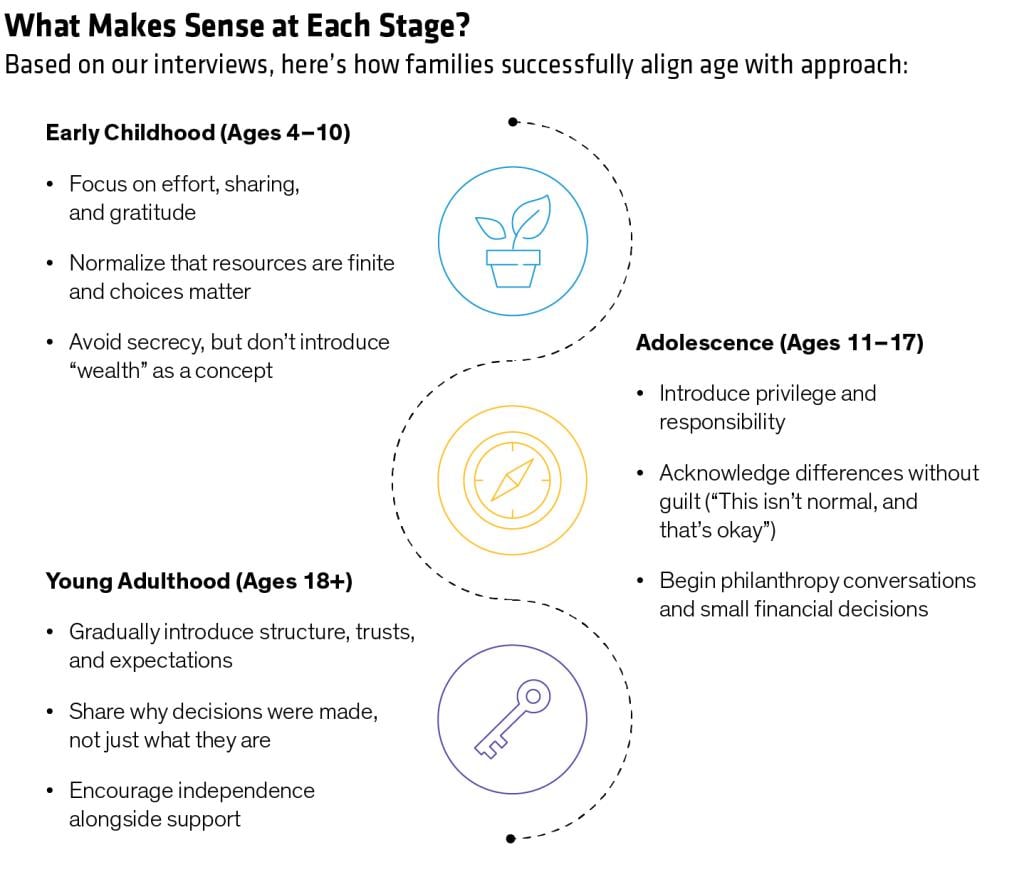
One of the most emotionally charged questions for UHNW families is: When should we talk to our children about our wealth? And what should we say? The short answer is that there is no single 鈥渞ight age.鈥� Instead, it鈥檚 that deepens understanding over time. One parent who experienced a significant liquidity event shared that they didn鈥檛 sit their kids down and say, 鈥淗ere鈥檚 the number.鈥� Rather, what mattered was helping them understand 鈥渢hat this isn鈥檛 normal鈥攂ut they鈥檙e not special,鈥� emphasizing that money doesn鈥檛 buy effort, character, or belonging.
Start Earlier Than You Think
Children start forming beliefs about money as early as elementary school. And silence doesn鈥檛 protect them. Instead, it leaves them to fill in the gaps themselves. One multigenerational family leader explained, 鈥淲e didn鈥檛 grow up with financial education, but we certainly did have conversations. Not about money鈥攁bout expectations. To encourage us to do something meaningful with the freedom we were given.鈥�
Long before wealth is named explicitly, early conversations focus on work ethic, gratitude, and choice. These conversations lay the foundation that makes later disclosures feel logical instead of destabilizing. They don鈥檛 need all the information, but they do need context. Shielding children from wealth often increases anxiety later. You can involve them in age-appropriate advisor conversations and financial decisions without handing over full control. This approach fosters trust and prepares them for future responsibilities.
Three Ways to Build a Values-Driven Wealth Legacy
1. Start with Honest Self-Reflection
Before diving into structures or strategies, take time to reflect on your own relationship with money and values. Ask yourself:
- What does money represent to us? Security, freedom, impact, perhaps something else?
- What beliefs about money did we inherit, and which ones still serve us?
- What life experiences inform how we make decisions about wealth?
- In what ways does wealth simplify our lives, and where does it complicate things?
Action: Set aside dedicated time, alone or with your partner, to write down your answers. This exchange can become the foundation for future financial decisions and family conversations.
2. Make Values Explicit鈥攁nd Share Them
Many families assume their values are 鈥渦nderstood.鈥� In practice, the strongest families name them clearly and revisit them often. Create a short family values list or mission statement. Use family meetings to discuss why decisions are made, not just what decisions are made. Share personal stories that illustrate values in action鈥攅specially moments of failure or challenge. Living those values day-to-day is just as critical, if not more. Put simply, as the family grows, it鈥檚 not enough to hope everyone stays close. As one multigenerational entrepreneurial family member reflected, 鈥淲hen you have so many people involved, communication and preserving the [family values] are the most important things to keep the family together for the next generations to come.鈥�
Action: Draft a family values or mission statement and review it together at least once a year.
3. Connect Money Decisions to Meaning
Financial literacy deepens when wealth is connected to purpose. Involve the next generation in age-appropriate financial decisions. Use philanthropy as a teaching tool, not just a giving vehicle. Encourage exploration of passions alongside an understanding of responsibility. As one family business leader with college-age children noted, 鈥淚鈥檓 going to set up a charity, and I want to use that to get [our kids] to start thinking about how you manage money, how you give money away, how people will be looking at you and treating you. I think it鈥檒l be a good experience for us to learn together, and hopefully use that as a stepping stone for more education on wealth management.鈥�
Action: Home in on one financial decision鈥攊nvesting, giving, or spending鈥攁nd explicitly discuss how it aligns with your family鈥檚 values.
Final Thoughts
For UHNW families, financial literacy is not just about knowing how to manage money鈥攊t鈥檚 about knowing why you have it, what role it plays in your life, and what you want it to stand for. When values come first, wealth becomes a source of clarity, connection, and opportunity across generations. But when they don鈥檛, even the most sophisticated strategies can fall short. As one interviewee summarized, 鈥淪tay humble. Stay true to your values, regardless of your financial situation. I think that鈥檚 the most important.鈥�
was produced by and reviewed and distributed by 爆料TV.