How cities can unlock more housing, one stairway at a time
How cities can unlock more housing, one stairway at a time
Fire officials and pro-density urbanists are often at loggerheads. This is especially evident in notoriously car-centric Los Angeles, where a firefighters’ union spent six figures . The two camps can have different ideas of acceptable risks and priorities.
But Matthew Flaherty, a firefighter who has lived in L.A. his whole life, bridges the two worlds. He’s an advocate for affordable, transit-friendly housing. His struggle to find an apartment in a walkable neighborhood led him to become a member of the Livable Communities Initiative, a nonprofit group advocating for more walkable neighborhoods in L.A.
“Cities shouldn’t be designed around the fire department,” Flaherty argues. “The fire department should be designed to deal with the infrastructure as it is. If you have a plumber design a house, the whole house is going to be a toilet.”
One area of tension for fire safety advocates and density advocates is the requirement that most new apartment buildings have more than one stairway to facilitate resident evacuation and emergency responders’ access. In nearly all American cities, unlike in other parts of the world, developers are required to build double staircases into four- to six-story residential buildings. (Though definitions vary, these are often considered mid-rise buildings.)
This extra staircase takes up about 7% of floor space and drives up costs by 6% to 13%, . That extra cost could be enough to kill a project to build housing, says Stephen Smith, the executive director of the Center for Building in North America, a nonprofit organization focused on building code reform.
Largely due to advocates like Smith and Flaherty, a movement is sweeping across North America, from to Toronto, to relax restrictions on residential stairways. have now considered such measures. As examines in this article, the possibility of relatively , outside the national three-year cycle, is raising urgent conversations about density and safety as cities grapple with housing shortages.
Seattle’s influence
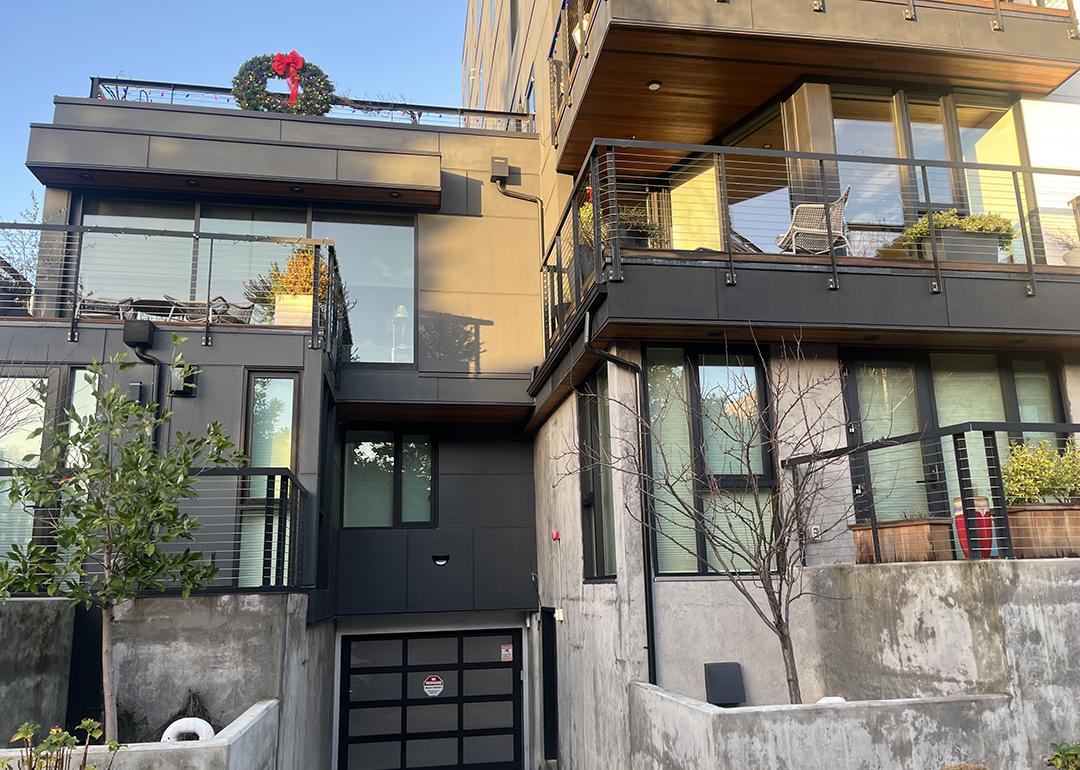
Single-stair apartment buildings (sometimes called point access blocks) are sprinkled throughout Seattle. Rents can start at around $1,500/month for studio apartments in such buildings. Walking around these apartments is a good way to get a feel for Seattle’s distinct neighborhoods.
as well, encompassing luxurious full-floor apartments, shareable student apartments, a striking cohousing complex, and nearly 30 apartments stacked next to another residential building. Some of these homes sit above ground-floor businesses.
Seattle’s history with single stairways illustrates how attitudes toward housing have shifted over the decades. In the 1940s, amid suburbanization and rapid building, a multiple-stairway requirement was imposed on buildings of three stories and up. In the 1970s, a housing crisis led Seattle to allow single stairways in apartment buildings, without a height limit, but with a floor limit of four units per floor. During a backlash to development in the 1980s, the city instituted a limit of six stories to such buildings. Further fire protection requirements followed. In the 2010s, momentum started to build outside of the few American cities, like Seattle, that allowed for single stairways.
New York City’s single-stair permission is older: It was changed in 1938 in recognition of the need for more housing on small lots. But Seattle has been even more influential in galvanizing the current momentum around similar reforms in other U.S. cities. In Smith’s analysis, New York is too much of an exception to the rest of the country to serve as a planning model. With the city’s scarcity of urban space, “we don’t have the room to build these buildings with giant hallways and two stairs,” says Smith, who himself lives in a five-story building in Brooklyn with a single stairway.
Plus, “in the building and fire world, there is a deep distrust and disdain for New York City,” Smith believes. “Seattle, I think, has been more of interest because it’s a more typical American city,” down to the frequency with which wood is used as a building material. More broadly, “the places that have been most interested in [single-stair reform] recently have been the West Coast states with the more severe housing crises.”
Seattle’s version of single-stair permission has been called the showing how much the city has become associated with a particular type of medium-density housing: an apartment building constructed on a small lot, with up to six floors and just one staircase. can have only four units, all of which must stay within 125 feet of the exit.
The Seattle special represents a kind of compromise. It’s not a high-rise that might intimidate locals wedded to single-household homes, but it also allows for more density than a house or duplex. By allowing for infill development on land parcels where it might be difficult to construct other units, it can permit an efficient use of urban space. In Seattle, this includes .
The single stairway is perhaps the ultimate compromise. It offsets the potential safety risk of losing another means of exit with other fire protection requirements like pressurization systems for smoke control (which admittedly can be expensive to maintain). It also seeks to balance that risk with the benefit of gaining more space inside the building.
Mark Chubb, a Seattle-based building-code consultant who previously worked as a fire chief, explains that in various parts of the U.S., land-use reformers were realizing that just having the authority to build denser housing didn’t mean that in practice they could actually do so.
“So that’s when they started looking for solutions and kind of stumbled over the Seattle provision. And they said, ‘Gee, wait a minute, it looks like Seattle solved this problem,’” Chubb summarizes. “We don’t have a lot of buildings that use single exit, but we have some fairly innovative buildings on some fairly small parcels that represent a large assortment of solutions.” Chubb believes the single-stair movement has not been driven by large moneyed interests, but by YIMBYs, activists and architects.
L.A. lawmakers’ attempt to allow single stairways in residential buildings up to six stories appears to have stalled following a city council vote last year; the International Association of Fire Fighters one of the organization’s “key victories” in a “coordinated effort to stop these proposals before they become the new normal.” But within L.A., Culver City has gone further on single-stair reform than any other part of California. In September 2025, after three years of advocacy, it approved its own single-stair ordinance.
“It is the single most impactful thing that I have done in all of my civic engagement,” says Travis Morgan, a cofounder of the Livable Communities Initiative.
This group didn’t set out to become single-stair evangelists, Morgan explains. “It was more of a means to an end, and the end being this walkable, livable, engaged, community.” suggested that without single-stair reform, it would be nearly impossible to build housing on small L.A. lots.
Culver City’s new ordinance bears more than a passing resemblance to Seattle’s building code. That’s because “we modeled the ordinance after the city of Seattle,” Morgan says. In Seattle, “there’s been …and it really is sort of considered the gold standard.” Honolulu has also .
Visualizing the spread of Seattle’s single-stair buildings has also helped influence debate in Denver, whose City Council approved a single-stair ordinance in November 2025.
According to Denver architect Sean Jursnick, who created , it “was helpful when discussing single-stair reforms with officials locally because it illustrates how single-stair projects are integrated into neighborhoods across Seattle and could integrate into the similar urban fabric of Denver.”
Fire safety
The main argument for keeping a double-stair requirement is fire safety. Even nearly 50 years after allowing for single-stair buildings in Seattle, the Seattle Fire Department (SFD) does not support the extension of the Seattle model elsewhere.
According to Karen A. Grove, SFD’s fire protection director, the 1970s code change “was done in part due to the quick response times of SFD and the very good hydrant infrastructure in Seattle.” In other words, cities with fewer resources might find it harder to adapt. It can be difficult to compare these kinds of metrics across American fire departments, due to inconsistencies in data reporting and definitions.
Allowing for just one stairway “puts a larger burden on the Seattle Fire Department, as without the second stair, we become the back up plan if the first stair is blocked or compromised,” Grove states. There is also a burden from regularly testing and repairing the smoke control systems that may become required in lieu of the second stair. SFD cautions fire departments elsewhere to consider extra needs for training and equipment, such as ladder access, if their jurisdictions remove the second-stair requirement.
“It’s a very solvable problem,” Flaherty, the Southern California firefighter, says of the potential changes like updating fire trucks. As for the arguments for keeping a double-stair requirement, he believes that it’s not realistic that a mass of residents will crowd on the single stairway and impede firefighting, or that smoke will collect in a single stairway. Instead, in his experience, “sprinklers are what keep fires from getting out of control.”
The evidence seems to bear this out for the U.S. Between 2017 and 2021, American buildings with automatic sprinkler systems had than buildings without those systems.
Unlike in the rest of the world, new apartment buildings in the U.S. are often already required to have sprinklers. So an important fire protection measure has become widespread since the development of double-stair requirements, yet building standards often haven’t been updated to reflect the spread of sprinklers.
And , “we don’t require sprinklers in single-family homes, and there’s no moral panic over it,” Flaherty points out. For some urbanists, this dissonance suggests that the rules around fire protection are essentially arbitrary.
Detailed fire safety assessments are continuing. Minnesota published one . California’s, which was , discourages lifting double-stair requirements. The National Association of State Fire Marshals has also opposed single stairways, , “Proper exiting, much like smoke alarms and carbon monoxide alarms, is known to have saved thousands of lives and have been and remain the fundamental building blocks to life safety.”
Complicating the situation is that unlike in some other countries, many American firefighters now spend a good chunk of their time not actually responding to fires. Flaherty estimates that 90% of the incidents he attends are medical. Firefighting bodies have argued that double stairways provide flexibility in responding to a variety of emergencies, including . These scenarios aren’t always incorporated into the design of building codes—or their amendments.
What single-stair reform can and can’t do
For Cody Fischer, a bigger impediment than the costs of building a second staircase has been the rigidity. His company, Footprint Development, develops and manages low-carbon multi-household housing in Minneapolis. While working on his very first project, one of the barriers “ended up being this very obscure safety component in the model building code,” which sets standards for health and safety.
Even in sought-after locations that were zoned for six-story buildings, it was tough just to find a site with the dimensions to accommodate a multi-stairway building. And if a site could be located, he would be restricted to one-or two-bedroom apartments, and “gross-feeling hallways” with limited windows. The impact of this single detail was eye-opening to Fischer: “Once you see it…it’s like the only thing you see.”
Like Fischer, a number of single-stair supporters have been radicalized by their experiences of other countries, which don’t require second stairways and yet don’t suffer more from fires. In the case of the influential Seattle architect Michael Eliason, a stint working in Germany, seeing that his colleagues were designing an 11-story building with a single stairway, initially stunned him.
Fire-protection and building-code expert Chubb worked for years in New Zealand, where he commonly saw single-stair apartment buildings. He also served as an expert witness regarding the 2019 Christchurch mosque shootings. While American fire departments are nervous about having single exits in active-shooter situations, he says that mass shootings tend to take place outside of residential buildings.
For Smith of the Center for Building in North America, spending part of his childhood in Romania, where his family hails from, normalized single stairways for him. Smith says he would even feel comfortable in a 30-story single-stair building in Switzerland. “In general, I think the limit should be higher, the higher your incomes are,” Smith reflects, because of the general link between higher GDP and better fire protection.
Of course, a loosened policy won’t automatically lead to more construction. In Culver City, activist Morgan is hoping that newly allowed single-stair buildings will come into being within the next few years. But he acknowledges that this will require education, likely with some demonstration projects to prove that this type of housing can be both profitable for builders and affordable for residents.
In Seattle, a kind of demonstration city, progress after single-city reform was initially sluggish. Chubb estimates that, in general, it could take eight years to actually see the effect of a building-code change. An concluded that following permission to include just one stairwell in 4- to 6-story buildings, an average of about 53 additional units were constructed per year in Seattle. This is a modest addition to the city’s housing.
One reason may be that the structures themselves have to be modest, with no more than four units per floor. This limits the amenities, like gyms, that developers can bundle into large apartment buildings to increase their appeal.
Another lesson is that code changes aren’t enough on their own. It’s only within the last decade or so that “the education component is starting to happen,” Eliason believes. Though a small but vocal group of architects like him has embraced the possibilities of single-stair design, even in architecture school “it’s hammered in our brains” that two modes of exit are needed, Eliason says.
Some proponents have argued that single-stair reform can have a host of benefits even beyond increasing housing options, from fostering community-minded cohousing (by allowing more space for common areas) to encouraging climate adaptation (by allowing more ventilation). There are examples of these in Seattle, but it’s not a given.
“Single-stair is not some silver bullet that’s going to create a utopia,” Flaherty, the L.A. firefighter, notes. But he calls it a necessary reform, on top of others like , to ease the development of affordable housing.
Seattle appears to reflect this. Jursnick, the Seattle-mapping architect, says that there was “an uptick of single-stair projects in areas like Capitol Hill about 10 years ago when parking minimums were lifted for areas near frequent transit.” So single-stair reform was a building block, which other reforms could build upon.
The progress has been piecemeal in other ways as well. In the U.S., it has largely occurred one city or state at a time, through legislative changes that can be more politically complex than the slower but more uniform process of amending the model code set by the International Code Council every three years. (Despite its name, this body sets building standards mainly for the United States.)
For the 2027 version of its International Building Code, which would influence standards nationwide, the council is considering allowing four-story buildings to have single stairways without smoke control systems. This would represent significant, if incremental, progress for the single-stair movement.
Building-code debates can seem arcane. But at the sharp edges of these kinds of decisions are people like Gabbie Metheny, a mother of two renting a cramped apartment in L.A.
“Building regulations that overly restrict how we use space are a huge factor in why folks leave L.A. for the suburbs when they start having families,” Metheny says. She’s unconcerned about fire risks in a single-stair building, and wonders if ditching the second staircase could allow for more affordable family-size apartments.
“If there was a three-bedroom apartment in the city in my price range, I’d jump at the opportunity,” she says. But unfortunately, she says, that doesn’t exist.
Support for this story was provided by The Neal Peirce Foundation, a nonprofit organization dedicated to supporting journalism on ways to make cities and their larger regions work better for all people.
was produced by , a nonprofit newsroom covering solutions for equitable cities, and reviewed and distributed by ±¬ÁÏTV.