The new local authority stack for real estate in AI search
Not long ago, winning in local real estate search meant one thing: Dominate Google Maps and rank for your city plus 鈥渉omes for sale.鈥� A strong website, a steady stream of reviews, and a dialed-in Google Business Profile were enough to stay competitive.
That era is over.
The numbers tell the story plainly. In just 18 months, the share of homebuyers using ChatGPT, Perplexity, Gemini, or Google AI Overviews as their primary agent research tool has rocketed , outpacing the adoption curves of mobile search and Zillow combined. What鈥檚 more, 61% of buyer-side real estate searches now begin in an AI search engine rather than a traditional one. And perhaps most urgently, 91% of U.S. agents are effectively invisible in the AI search engines their buyers now use first.
Today, when a buyer types 鈥渂est real estate agent in [neighborhood]鈥� into ChatGPT or Perplexity, they鈥檙e not getting a list of links. They鈥檙e getting a synthesized answer that names specific agents or brokerages and explains why they鈥檙e worth calling. The agent who appears in that answer didn鈥檛 get there by outranking competitors on a single keyword. They got there by building what we call a local authority stack: a layered, interconnected set of digital signals that AI models use to determine who actually knows and owns a market.
breaks down each layer of that stack, discusses exactly what AI engines are reading when they evaluate real estate authority, and outlines a framework for building your own.
Why AI Search Optimization Is Different From Traditional Local SEO
Traditional local SEO is fundamentally a relevance game. The search engine asks, 鈥淒oes this page match the query?鈥� AI search is a trust game. The model asks, 鈥淲ho do I believe is genuinely authoritative about this place?鈥�
The distinction matters enormously for real estate. And the portal giants already understand it. Within a five-month window, all three major real estate portals (, , and ) launched apps inside ChatGPT, positioning themselves at the very top of the AI buyer鈥檚 journey before most independent agents had even considered the shift. Realtor.com CEO Damian Eales put it directly: 鈥淲e brought real estate listings to the internet. Now we鈥檙e bringing them to AI.鈥�
For independent agents and regional brokerages, this is the mobile moment all over again. The portals moved first on mobile, too. The agents who survived that transition weren鈥檛 the ones who waited; they were the ones who built something the portals couldn鈥檛 replicate: genuine local authority.
That鈥檚 still the play, but the signals have changed. began rewarding hyperlocal, experience-driven content while reducing the visibility of generic material. Meanwhile, zero-click searches now account for , and 93% of queries run through Google鈥檚 AI Mode. That means your content doesn鈥檛 need to drive clicks anymore; it needs to be mentioned and/or cited.
AI models like those powering ChatGPT, Google AI Overviews, and Perplexity are trained on the open web. They synthesize signals across multiple sources to form confident, specific answers. That means your digital footprint is no longer about one website. Instead, it鈥檚 about the full ecosystem of information about you that exists across the internet.
The 5-Layer Local Authority Stack for Real Estate
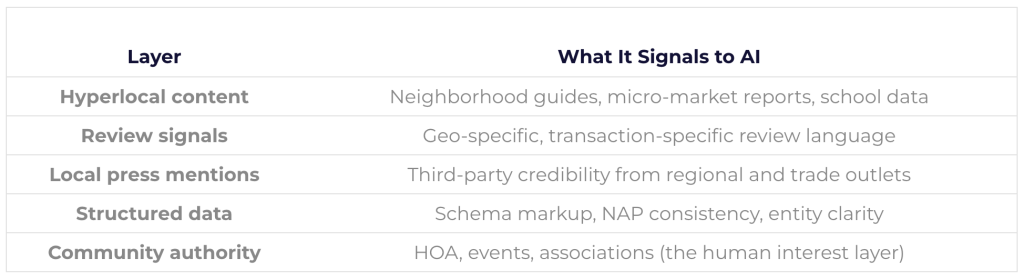
The following framework identifies the five categories of signals that AI search engines weigh the most heavily when surfacing real estate professionals for local queries. Think of it as a foundation you build from the ground up: each layer reinforces the one below it.
Layer 1: Hyperlocal content ownership
This is the foundation of the entire stack. Before an AI model can recommend you as a local expert, it needs to find evidence that you are one. That evidence lives in the content you create and publish.
But not just any content. reference either an exact address or a named neighborhood, not a city, metro area, or ZIP code. AI engines calibrated to that behavior are increasingly sophisticated at distinguishing generic city-level content from genuinely hyperlocal knowledge. The kind of content that moves the needle includes neighborhood-specific buyer guides covering walkability, schools, HOA structures, commute patterns, and price history by street or subdivision; monthly micromarket reports for specific ZIP codes with actual MLS data and agent commentary; school district breakdowns written for families relocating to the area; and lifestyle content that captures what it actually feels like to live in a neighborhood.
There鈥檚 also a tactical wrinkle worth knowing: Statistics with a source and a date are what get cited. AI tools are built to reference numbers, not opinions. Something like 鈥渁ccording to Austin Board of Realtors data from Q1 2026, median days on market in 78746 dropped from 34 to 18 days year over year鈥� could get cited, but 鈥渢he market is moving fast鈥� won鈥檛. Every neighborhood page should include at least three to five current, sourced statistics, and they should be updated quarterly.
The test for whether your content qualifies: Could a competitor in another market copy it by just swapping the city name? If yes, it鈥檚 not hyperlocal enough. AI models are looking for content that鈥檚 specific to the point of being irreplaceable.
Action step: Audit your existing content. Identify your top three most active markets. For each one, build at least one definitive neighborhood guide that goes deeper than anything currently ranking for that area and anchor it with sourced, date-stamped local data.
Layer 2: Review signals with market context
Reviews have always mattered for local SEO. In AI search, they matter in a fundamentally different way. It鈥檚 no longer enough to have a high star rating and a large review count. AI models are reading review content for signals of geographic specificity and transaction expertise.
A review that says, 鈥淕reat agent, highly recommend!鈥� contributes almost nothing to your AI search authority. On the other hand, a review that says, 鈥淲e were nervous about buying in the Riverside district with our budget, but she knew every pocket of that neighborhood and found us a home on Elm Street that checked every box,鈥� is doing serious work. It鈥檚 tying your name to a specific geography, a specific transaction type, and a specific positive outcome, which is exactly the kind of signal AI engines weigh when constructing recommendations.
What this means for your review strategy: Stop asking for generic five-star reviews and instead prompt clients to describe the neighborhood, the challenge you solved, and the outcome they achieved. Respond to every review with market-specific language, as those responses are also indexed. Also, prioritize review recency and responsiveness. want a review response by the following day (up from 18% last year), and 81% expect to hear back within a week. And expand beyond Google: While Google reviews continue to dominate, Apple Maps nearly doubled in usage , and reviews on Zillow, Realtor.com, Yelp, and Facebook all contribute to your overall AI authority profile.
Action step: Rewrite your post-closing review request to include a specific prompt: 鈥淚f you鈥檙e comfortable, mention the neighborhood where we worked together and one challenge we solved along the way.鈥�
Layer 3: Local press and publication mentions
This is the layer most real estate professionals are leaving entirely on the table, and it represents one of the highest-leverage opportunities in the entire stack.
AI models place significant weight on third-party credibility. When a local newspaper, regional business journal, or real estate trade publication mentions your name in connection with a specific market, it functions as an authoritative endorsement. The model interprets it as an independent, trusted source identifying you as an expert in this geography.
There is a timing urgency here worth understanding. Local news sites fell sharply as a consumer recommendation source, . This is a paradox: Local press is becoming more valuable as an AI authority signal at exactly the same time the outlets themselves are under pressure. Agents who build relationships with local journalists now are securing a channel that will be harder to access as these outlets contract.
The most valuable types of press mentions for real estate AI authority include market commentary quotes in local news, features in regional business publications about neighborhood development or investment trends, contributed columns or expert roundups in real estate trade outlets, podcast appearances on local business or real estate shows, and awards or recognition from community organizations and industry associations.
You don鈥檛 need to be in The Wall Street Journal. Local and regional coverage in publications that serve your market carries tremendous weight with AI models precisely because it is geographically precise, which is exactly what AI real estate queries are asking for.
Action step: Build a targeted media list of 10 to 15 local journalists and editors who cover real estate, business, and community development in your market. Develop a simple outreach strategy for positioning yourself as a go-to market commentary source.
Layer 4: Structured data and entity clarity
While the first three layers are about building authority, this layer is about making sure AI models can correctly attribute all of that authority to you. is the technical foundation that ties your entire stack together.
AI models construct a model of who you are based on data signals across the web. If your name, brokerage name, phone number, address, and market area are inconsistent across platforms, the model can鈥檛 confidently connect all those signals to a single entity. That fragmentation directly reduces your authority score.
will use generative AI search in 2026, and every one of those users encountering your name in an AI answer is relying on the model having correctly assembled your identity from dozens of data sources. The key elements of entity clarity for real estate: NAP (name, address, phone) consistency across every platform where you have a profile; RealEstateAgent schema markup on your website with your geographic service area, license number, and brokerage affiliation clearly structured; complete and keyword-rich agent profiles on every major real estate platform; and a consistent professional headshot and bio across all platforms.
Agents who began AI SEO work in early 2025 now of agents who began the same work 12 months later, despite the latter group spending more on average. Entity clarity is the reason early movers compound their advantage so rapidly. Once an AI model has a strong, consistent entity understanding of who you are and where you work, it becomes the default answer for local queries in your market.
Action step: Run a NAP audit across your top 10 platforms. Fix any inconsistencies and add RealEstateAgent schema markup to your website if it鈥檚 not already in place.
Layer 5: Community authority signals
This is the newest and most underappreciated layer of the stack, and in a competitive market, it might become the deciding factor.
Community authority signals are the evidence that you鈥檙e not just selling in a neighborhood but are genuinely embedded in it. AI models are trained on a wide range of web content, including community forums, neighborhood Facebook groups, HOA communications that appear publicly, local event coverage, and civic organization websites. An agent who appears in these contexts, not as a salesperson but as a community participant, earns a category of trust that can鈥檛 be manufactured through content alone.
Broader consumer research reinforces why this matters. , 82% of Americans are using AI tools for real estate insights, yet real estate agents remain the most trusted source of housing information. That gap between AI usage and agent trust is your opportunity. Community authority signals are what close it: They鈥檙e the proof, visible to AI engines, that you are a trusted human presence in the market, not just a website.
The types of community signals that register with AI engines include mentions in HOA newsletters or community organization websites; sponsorship of local events that generate online coverage; participation in neighborhood Facebook or Nextdoor groups (publicly indexed posts); involvement with local charities, schools, or civic organizations that publish their supporters online; and coverage in community blogs, neighborhood newsletters, or local lifestyle publications.
This layer takes the longest to build, but it creates the deepest kind of authority. It signals to AI engines that your expertise is not only professional but also personal and verified by the community itself.
How the Layers Compound
The power of the local authority stack is not in any single layer; it鈥檚 in how the layers reinforce one another. Consider what an AI model sees when all five are active: Your hyperlocal content establishes that you understand the market in granular detail; your geo-specific reviews confirm that real clients have experienced that expertise firsthand; local verify that independent third parties recognize your authority; your structured data ensures every signal is correctly attributed to your entity; and community signals confirm that your presence in the market is human, ongoing, and trusted.
Agents who haven鈥檛 built durable citation shares by year-end will face a structural disadvantage that paid advertising alone can鈥檛 solve. The window for early-mover advantage is narrowing. When a consumer asks AI a question, it delivers . The only path in is organic authority built over time across all five layers.
Where to Start: A 90-Day Priority Sequence
Building all five layers simultaneously isn鈥檛 realistic for most agents or small teams. Here is a prioritized sequence designed to generate early momentum while building toward a complete stack:
Days 1-30: Audit and foundations. Complete a NAP audit across your top 10 platforms and fix all inconsistencies. Add RealEstateAgent schema markup to your website. Identify your top three neighborhoods and outline a comprehensive guide for each. Update your review ask to prompt geographic and transaction specificity.
Days 31-60: Content and credibility. Publish your first neighborhood guide. Aim for at least 1,500 words of genuinely original, hyperlocal content anchored by sourced local data. Build your local media outreach list and send five introductory pitches positioning yourself as a market commentary source. Respond to every existing review with market-specific language. Identify three community organizations where visible involvement would be authentic.
Days 61-90: Authority building. Publish your second and third neighborhood guides. Follow up on media outreach and pitch a specific story angle tied to current market conditions. Begin or deepen community involvement in at least one local organization. Establish a monthly micromarket report cadence for your primary ZIP code.
The real estate professionals who build local authority now will be extraordinarily difficult to displace once AI models have learned to associate their names with their markets.
The good news is that most of your competitors haven鈥檛 started yet. The local authority stack is not a secret, but it requires patience, consistency, and a genuine commitment to being the most knowledgeable, credible, and community-embedded presence in your market. That鈥檚 not something that can be automated or rushed.
It can, however, be built. And the agents who build it first will find that AI search doesn鈥檛 just give them leads; it gives them category ownership.
was produced by and reviewed and distributed by 爆料TV.