
4 risk treatment strategies that separate proactive businesses from reactive ones
A business functions within a continuous state of risk, whether it's through systems, vendors, data flows, , or operational processes. Per Vanta's 2025 鈥攂ased on a survey of 3,500 business and information technology leaders鈥�56% of organizations encounter threat activity at least once a week, while 79% encounter it at least once a month.鈥�
With risks compounding, traditional governance, risk, and compliance programs, and even many , struggle in two key areas: maintaining risk visibility across complex vectors and translating risk data into structured decision-making. The result is drowned in noise signals that offer little direction on how to prioritize or address sensitive items. In the absence of clear guidance for risk treatment strategies, 鈥渁ccept鈥� becomes the default in many scenarios.
There are four , and understanding when to apply each influences the effectiveness of risk mitigation. This guide from , an agentic trust platform, walks through each and also explores steps to operationalize them.
What are the four risk treatment strategies?
The four risk treatment strategies are systematic approaches used to address specific threats that organizations face. They are:鈥�
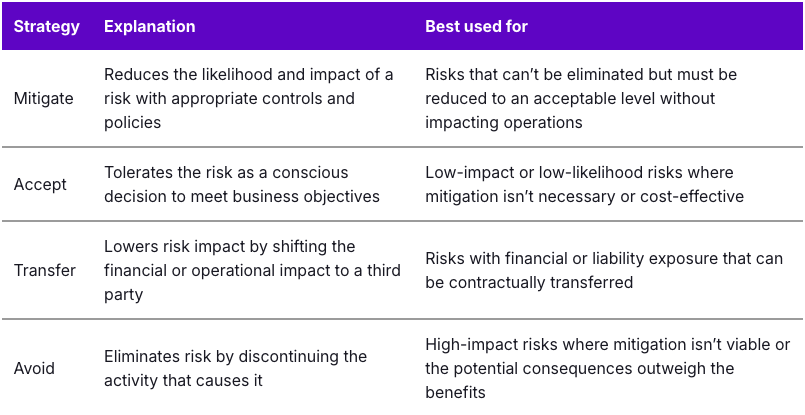
These strategies are part of your broader . They鈥檙e typically applied after you鈥檝e identified and assessed risks, so you can prioritize responses based on likelihood and impact.
Navigating strategies for risk treatment (with examples)
Risk treatment strategies are not one-size-fits-all and require deliberate alignment with the type and severity of the risk. The problem is, many GRC teams default to a predictable pattern when it comes to applying them:
- Mitigate accounts for a majority of the responses.
- Accept is frequently overused due to unclear ownership or limited guidance.
- Transfer tends to be underutilized, especially when there鈥檚 the option to get vendor or insurance backing.
- Avoid is rare due to its operational trade-offs (and is often misapplied).
Let鈥檚 look at some key contexts and examples to guide each strategy.
1. Mitigate
Mitigation, or risk reduction, is the most widely used risk treatment strategy. It refers to organizations implementing measures to reduce both the likelihood and potential impact of a risk event.
In practice, these measures can be grouped into two categories: preventive actions and impact-limiting controls to contain damage and enable recovery. Here are some examples:
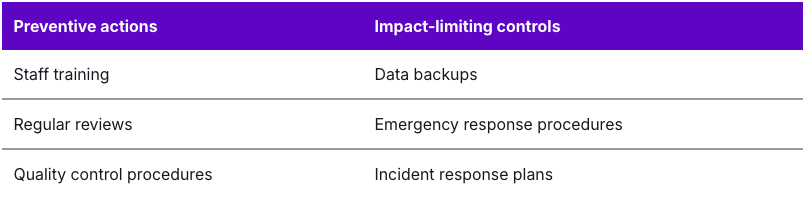
A mature GRC program should layer both measures for balanced risk reduction. Keep your and up to date to avoid being underprepared for failure scenarios.
This treatment strategy should be paired with because the applied controls can weaken over time.
Sample scenario: When onboarding a cloud service provider, an organization combines both preventive controls (, contractual protections, access controls) with impact-limiting controls (, incident response reporting) to reduce the likelihood and impact of a potential breach on the vendor's end.
2. Accept
Risk acceptance strategy means that your organization accepts specific types of risk as an operational necessity to meet business objectives. What risks you can safely accept depends on your .
鈥淩isk acceptance is only valid when the cost of mitigation, both in capital and operational friction, clearly exceeds the potential impact of the threat. If you can鈥檛 point to a specific 'why' in your risk register that justifies this trade-off, then it鈥檚 not risk acceptance, but rather unmanaged risk,鈥� said Niya Raina, a go-to-market GRC subject matter expert at Vanta.
3. Transfer
Risk transfer involves shifting the potential financial or operational impact to a instead of addressing it directly. It鈥檚 typically done through contracts, service level agreements (SLAs), or insurance policies, and most commonly involves insurers or vendors.鈥�
While transfer can reduce the impact of a risk, it doesn鈥檛 affect its likelihood or eliminate the organization鈥檚 accountability. For instance, under the , remain responsible for personal data even if they outsource processing. To effectively handle the threat, you have to pair transference with appropriate mitigation measures.
鈥淩isk transference is a commonly misapplied strategy,鈥� Raina explained. 鈥淔or example, many leaders mistakenly believe that buying cyber insurance or outsourcing to a cloud provider absolves them of the underlying risk. In reality, while you can transfer the financial impact, you can never outsource the ultimate accountability for your customers' data or the resulting reputational damage.鈥�
If you鈥檙e considering this strategy, revisit your , especially regarding third-party security reviews. You can use a dedicated third-party risk management software for continuous risk detection and management.鈥�
Sample scenario: When onboarding a vendor, an organization may include indemnification and limitation of liability clauses in the contract to transfer portions of financial risk. In some cases, it may purchase additional cyber insurance to offset potential losses due to security incidents.
4. Avoid
Risk avoidance means eliminating the exposure to the risk entirely, typically by discarding the activity that creates it. In practice, this can look like not pursuing a process, system, or initiative, or even deleting a dataset associated with the risk.
While this approach eliminates the need for mitigation, such decisions often mean slower organizational growth or missed potential opportunities. That鈥檚 why avoidance is generally reserved for high-impact threats where the potential consequences outweigh the benefits of continuing the activity, or mitigation is just not accessible or viable.
Naturally, risk avoidance should be used selectively and only after careful consideration of the operational and strategic trade-offs in the long term.
Sample scenario: An organization can choose to avoid risk by decommissioning a system鈥檚 legacy feature, which collects personally identifiable information (PII) that鈥檚 no longer used. By removing the data from the operating environment, the organization eliminates the associated risk of it being breached.
How to choose the right risk treatment strategy
These five steps can help you determine which risk treatment technique fits which risk:
- Evaluate and classify risks
- Align with risk appetite and tolerance
- Determine the feasibility and cost of treatment
- Select primary treatment technique
- Define supporting measures
Step 1: Evaluate and classify risks
Start by to map your organization's threat landscape. Then, evaluate each risk based on its likelihood and impact. You should use a or other defined scoring system to measure the risks within a standard framework.
As you begin risk classification, ground the process in historical data and incident logs rather than just new assumptions. This will help validate and refine your assessment findings (likelihood and impact assessments) and reveal patterns in how some risks may have behaved over time.
Accuracy during this step also depends on a structured . Standardizing how risks are categorized will help your team map them to group-specific treatment strategies more directly.
To streamline risk evaluation, consider using risk management software with customizable risk categories, AI-supported risk registers, and prebuilt risk libraries with common scenarios and treatment suggestions.
Step 2: Align with risk appetite and tolerance
Risk appetite defines the types and levels of risk your organization is willing to accept to favor business objectives, while risk tolerance outlines risk thresholds within the appetite.
鈥峊hese two metrics help guide risk treatment decisions:
- If the risk falls within your appetite and tolerance, you can consider accepting it.
- If the risk exceeds thresholds, rely on one or more treatment techniques, depending on the risk severity.
鈥峊o ensure consistency, refer to your organization's , , and other governance criteria when finalizing treatment options. The goal is to standardize how risks are handled downstream across departments, so there鈥檚 a lower chance of ad hoc decision-making.
鈥峉tep 3: Determine the feasibility and cost of treatment
Assessing the feasibility and costs for each treatment option involves several considerations, such as:鈥�
- Whether mitigation is cost-effective relative to the potential impact of the risk
- Whether available transfer options are practical and reliable
- The opportunity costs of the treatment option鈥�
Ideally, your choice shouldn't negatively impact operational efficiency鈥攕ince that comes with its own opportunity cost. If you鈥檙e mitigating low-impact threats, make sure that the measures are proportionate to the threat, as you wouldn鈥檛 want to over-allocate time and resources without providing meaningful risk reduction.鈥�
Always document the trade-offs and reasoning for your decisions. This gives you both an audit trail and historical data to support risk assessments in the future.
Step 4: Select primary treatment technique
After you鈥檝e established a clear overview of all aspects of a specific threat, select a primary treatment strategy to serve as your foundation. In many cases, you鈥檒l have to layer multiple treatment techniques since a single strategy can鈥檛 effectively minimize the operational or reputational impact of a risk.
For example, when handling a high-probability technical vulnerability, you could first apply mitigation techniques to lower its baseline severity. Then, you can transfer the remaining financial exposure to a third-party provider or insurer and formally accept whatever remains within your tolerance threshold.
Step 5: Define supporting measures
The final step is to operationalize your chosen treatment strategy. You can do this by defining:鈥�
- Operating procedures, such as control frequency and risk mitigation processes
- Risk owners
- Escalation paths for incidents
- Continuous monitoring and reporting flows
- Documentation requirements
- Contingency plans鈥�
When choosing risk management software, look for a solution that can translate your risk management program into action by automating control mapping, suggesting controls based on risk scenarios, assigning workflows to risk owners, and monitoring residual risk.
Building a resilient risk treatment program
Effective risk treatment isn鈥檛 about eliminating every threat鈥攊t鈥檚 about making deliberate, structured decisions about which risks to mitigate, transfer, accept, or avoid. Organizations that match treatment strategies to the type and severity of each risk, and revisit those decisions as conditions change, will spend less time reacting and more time building resilience.鈥�
The difference between a mature risk program and an ad hoc one often comes down to consistency: standardized evaluation criteria, clearly defined ownership, and treatment plans that are documented, monitored, and adjusted over time. When risk treatment becomes an ongoing discipline rather than a one-time exercise, organizations are better positioned to protect what matters most. For teams evaluating how to operationalize these strategies at scale, comparing the can help identify the right platform for your organization鈥檚 risk profile and compliance needs.
was produced by and reviewed and distributed by 爆料TV.