
Google drops support for 7 schema types: What marketers must refocus on as search evolves
Google announced that it鈥檚 scaling back support for seven structured data types to 鈥渟implify the search results page.鈥� This move reflects Google鈥檚 continuous effort to enhance its results pages for searchers.
For marketers, this change reminds us to keep our SEO strategies focused on what really matters: clarity, expertise, and value to users. That鈥檚 not to say it鈥檚 time to bid goodbye to all schema markups.
Technical SEO best practices remain crucial today 鈥� most schema markups are still widely used and will continue to be relevant in the future. Google鈥檚 latest move simply means marketers must strategically use schema markups, especially if they want to earn citations in AI-powered searches.
By dropping support for certain schema types, Google is streamlining how it presents information and focusing support on structured data types that users find useful and relevant.
With these latest changes, marketers must evaluate and rethink their SEO strategies. In this article, digital marketing agency outlines these changes and how marketers should adapt.
Which structured data types is Google retiring?
Over the past several months, Google has been gradually phasing out support for multiple structured data types and related search features as part of its effort to improve a user鈥檚 search experience.
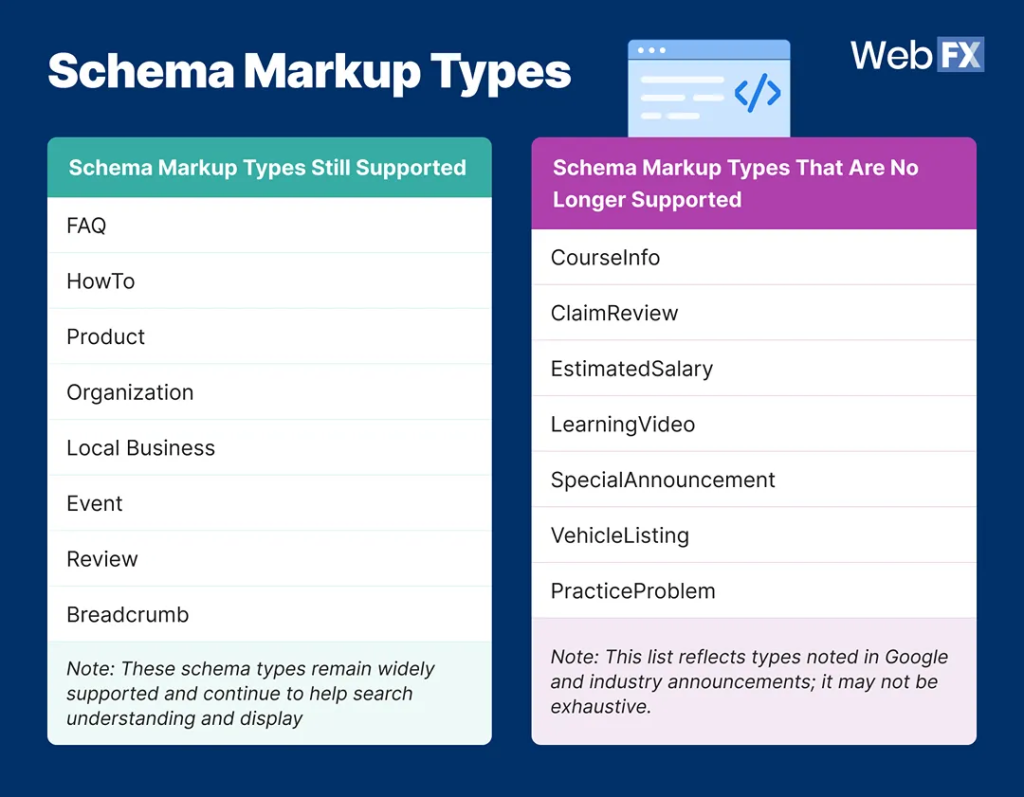
In June, the on the Google Search Central Blog to simplify search results by removing several rich result features and their associated structured data types, including:
- CourseInfo
- ClaimReview
- EstimatedSalary
- LearningVideo
- SpecialAnnouncement
- VehicleListing
By September, Google removed documentation for these schema types, noting that they are 鈥渘o longer shown in Google Search results.鈥� In November, Google confirmed that that are underused or add limited value, including PracticeProblem.
also reported that Google will remove search features that relied on structured data, such as:
- Nutrition Information
- Nearby Offers and Events
- Local Bikeshare Station Status
- TV Season Selector
The core ranking systems remain the same. What鈥檚 changing is how Google supports and displays certain structured data types.
From markup to meaning: Why this change affects your SEO strategy
Google鈥檚 decision to retire certain structured data isn鈥檛 just a technical cleanup 鈥� it鈥檚 part of a larger shift in how search engines understand content.
It鈥檚 like a spring cleaning of the search results page to make it tidier. It eliminates outdated or redundant features, making the user experience feel simpler and more useful. Each of these updates signals a gradual but clear move away from overreliance on markup cues toward an emphasis on content clarity, context, and purpose.
For years, structured data gave marketers a way to 鈥渓abel鈥� their content for Google, helping it define products, events, and reviews. Now, Google鈥檚 systems are increasingly capable of interpreting that information on their own.
The shift isn鈥檛 eliminating the need for schema markup. Instead, it鈥檚 recalibrating its role.
Rather than marking up everything, marketers must use structured data strategically. There is still value in using these schema types if they are relevant to a page, as they help crawlers better understand and serve content.
Use it to highlight the most important information for your audience. By doing so, you鈥檙e helping users understand your page鈥檚 purpose, and enabling search and answer engines to show it in the right context.
In short, Google鈥檚 structured-data deprecations reflect a broader confidence in its ability to understand meaning rather than rely on technical signals alone. For marketers, this reinforces a familiar truth: Your SEO success depends less on how much code you add and more on how effectively your content communicates experience, expertise, authority, and trustworthiness.
The 3 Rs framework: How to adapt your structured data strategy
Marketers are no strangers to change. As Google simplifies search results pages and structured data, marketers know they should recalibrate their schema markup strategy.
That鈥檚 where the 3 Rs framework of Retire, Refocus, and Reinvent comes in. It鈥檚 a simple way to assess your structured data and SEO priorities.
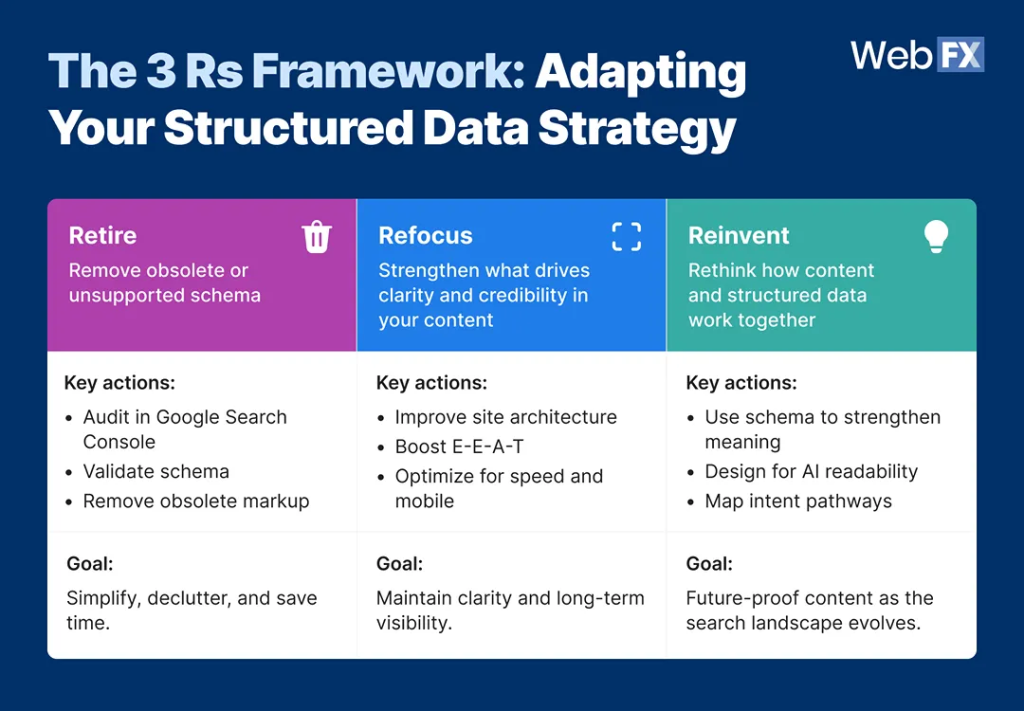
Retire: Schema markup and tasks that are no longer worth maintaining
Start by retiring what no longer adds value. If your pages rely on structured data types or features Google has stopped supporting (like PracticeProblem, NearbyOffers, or other niche markup), remove or ignore them in your workflow. Keeping them won鈥檛 harm your site, but maintaining unnecessary code creates clutter.
To identify what to retire:
- Audit your site in Search Console for structured data that Google has removed from reporting or announced as unsupported.
- Use validation tools such as or .
- Remove or deprioritize markup that no longer triggers rich results or affects visibility.
Streamline your process by removing obsolete schema so you can focus your time on activities that enhance user understanding and improve visibility, especially in AI-driven search.
Refocus: Core schema and SEO priorities that still drive visibility
Even as Google simplifies its use of structured data, the fundamentals of technical SEO and content quality remain essential. Refocusing doesn鈥檛 mean starting over 鈥� it means directing your attention toward the areas that continue to reinforce clarity, authority, and user trust.
Most schema types (such as FAQ, Product, Organization, and Breadcrumb) play a valuable role in SEO and GEO. These markups help search engines and users interpret relationships, hierarchy, and relevance within your site.
Beyond structured data, this is the time to focus on SEO practices that have always sustained visibility:
- Clear navigation and internal linking
- Clean content hierarchy
- E-E-A-T signals (Experience, Expertise, Authoritativeness, and Trustworthiness)
- Strong technical performance (fast loading, mobile friendliness, and crawlability)
Refocusing means channeling your energy into what consistently improves clarity, user trust, and long-term visibility. It鈥檚 not about chasing new, short-lived features. These SEO best practices also improve your chances of getting cited by AI answer engines.
Reinvent: Build for visibility, clarity, and context
Reinvention isn鈥檛 about abandoning what works 鈥� it鈥檚 about rethinking how your content and structured data work together to help both users and search systems understand meaning.
Google鈥檚 recent announcements reinforce its ongoing focus on understanding content quality and context, rather than relying solely on technical signals. Schema still plays an important supporting role by reinforcing context instead of defining every element.
Here鈥檚 how to reinvent your approach:
- Use schema to strengthen meaning, not mirror it: Mark up elements that clarify context 鈥� like authorship, product details, or review information 鈥� instead of tagging everything on a page.
- Design for AI readability: Create sections, summaries, and question-driven headers that make your content easy for both people and machine learning systems to understand and parse.
- Map intent pathways: Organize internal links and subtopics around how users seek answers, not just around keywords.
- Think 鈥渃itable,鈥� not just 鈥渞ankable鈥�: Write and structure content so it can be quoted or summarized accurately by AI-driven features in Search.
Note that reinvention isn鈥檛 about replacing SEO fundamentals 鈥� it鈥檚 about reframing them for an environment where search systems derive meaning more natively from your content.
was produced by and reviewed and distributed by 爆料TV.