
Human connection: The ultimate differentiator in an AI-saturated market
As AI penetrates every industry and business operation to boost productivity, efficiency, and personalization, a bigger problem arises: the paradox of connection. AI creates more interactions than ever, but fewer that feel meaningful, reports.
Yes, AI is essential for staying competitive. But it often falls short at one big thing: Differentiation. When in at least one business function, it鈥檚 no longer a competitive advantage 鈥� it鈥檚 table stakes.
The challenge for businesses is how to stand out if AI is used in uniform ways, such as sending out AI-personalized email sequences, using AI chatbots to answer FAQs, and automating customer service responses with identical scripts.
The answer is not choosing between humans and machines, but seamlessly blending AI with human skills. Done right, the combination enhances both: AI brings speed, scale, and accuracy, while humans bring trust, empathy, and credibility. That鈥檚 where real differentiation lives.
How AI-saturated is the market?
The impact of AI saturation is already being felt, with .
AI has taken over so many processes that now, everywhere you turn, there鈥檚 AI-generated content and campaigns. The question is no longer whether or not an organization is integrating AI, but how it is done to resonate with its audiences.
Other than cookie-cutter AI use cases, another reason why AI is no longer the differentiator, but the baseline, is that popular AI tools like ChatGPT, Gemini, and Perplexity have low entry barriers, making them widely available.
So, now that everyone, from solopreneurs to Fortune 500 companies, is using the same tools, the results are the same in quality and quantity. This means a two-person startup can now produce the same volume of content or customer touchpoints as a mid-size company, at a comparable speed. As a result, the competitive advantage of adopting AI is diminished.
The 6 essential layers of human connection in the AI era
AI may have leveled the playing field by giving everyone access to the same tools, but now comes the challenge of setting a business apart. So, if the technology is not the differentiator, what is? The people behind it.
The following human characteristics form connections that AI cannot replicate.
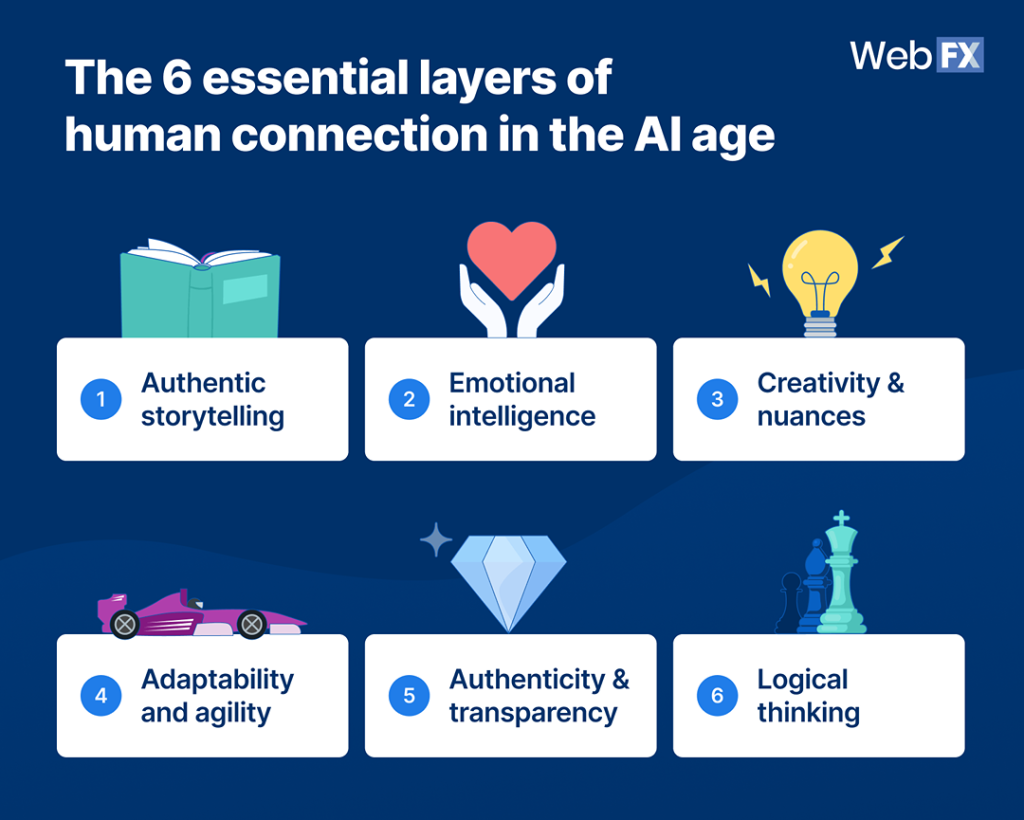
1. Authentic storytelling
AI can create narratives, but it cannot live a journey. It can write the 鈥渨hy鈥� behind your brand, but may fall short in elaborating the battles you鈥檝e fought and the values you refuse to compromise on with as much heart and soul as you would.
Customers don鈥檛 want yet another AI-polished 鈥淎bout Us鈥� filled with buzzwords, like 鈥渃utting-edge鈥� and 鈥渟olutions-oriented,鈥� or cookie-cutter promises emphasizing quality and results. They want to know what the raw, real story is that makes your brand human and relatable.
Unfortunately, AI cannot provide that. It鈥檚 limited to patterns of corporate language and avoids imperfections. You can use AI to structure your content, but you鈥檒l need a human to give it heart and meaning by sharing lived experiences, a company鈥檚 authentic behind-the-scenes stories, and ownership of past mistakes.
2. Emotional intelligence
AI can detect and mimic sentiment and human emotions, but it doesn鈥檛 feel. AI tools don鈥檛 understand the layered emotions hidden behind words.
Genuine empathy can only come from humans because they can listen, read between the lines, sense frustration or excitement, and respond with compassion. This emotional resonance turns transactions into meaningful, long-term relationships.
A good example of how you can infuse emotional intelligence into everyday workflows that are currently running on AI is replacing template responses, like 鈥淲e apologize for the inconvenience,鈥� with more personalized responses, like 鈥淚 can hear how frustrating this must have been, and I want to help you fix it.鈥�
Additionally, your customers will appreciate emotionally charged follow-ups with human team members after having AI-powered chatbots handle FAQs.
3. Creativity and nuances
AI creates replies based on the patterns and probabilities observed from the information it鈥檚 trained on. Humans, on the other hand, are the baseline for originality and creativity thanks to our ability to create from lived experiences, cultural context, emotions, and failures.
True creativity isn鈥檛 about generating more options 鈥� it鈥檚 about making unexpected connections that move people. And that鈥檚 still a uniquely human skill.
For example, an AI can generate a hundred slogans for a shoe brand, but it takes a human who鈥檚 actually run a marathon in the rain to come up with one that feels raw and real.
Before AI, Nike landed the unforgettable slogan 鈥淛ust Do It鈥� based on the last words of a convicted criminal facing execution. In today鈥檚 AI era, we鈥檇 probably be working with the likes of 鈥淧ush Forward鈥� or 鈥淩un Faster鈥� as AI tools may rule them as more relatable to Nike鈥檚 audience.
4. Adaptability and agility
AI, unlike humans, can鈥檛 pivot in real time. It thrives on patterns and instructions while also being risk-averse and defaults to safe outputs when circumstances are messy, unpredictable, or ambiguous.
On the flip side, people can easily adapt to evolving trends, market shifts, and cultural sensitivity, bringing a fresh perspective to every campaign. A human touch in digital marketing campaigns leaves room to pivot campaigns in response to real-life events and trends.
While AI can help create high-performing campaigns and offer options to optimize as you go, it requires an experienced marketer with a good understanding of the expected campaign results to reframe the strategy while it鈥檚 already rolling.
The human ability to adapt, read the room, and pivot under pressure is what keeps AI-led strategies relevant and resilient. Plus, the human ability to experiment, test bold ideas, and learn from failure, and adjust accordingly.
5. Authenticity and transparency
Authenticity is the new currency of trust. Yet, AI is known for publishing polished but sometimes hollow outputs that avoid messy truths, vulnerability, and controversial conversations. Unfortunately, this won鈥檛 cut it for today鈥檚 audiences that have access to businesses using the same AI playbook, but are limited to scarce genuine human connections.
Human connection is the key to unlocking unmatched authenticity and transparency because who else can tell your story as well as you?
Humans are innately more transparent and authentic because they can admit imperfection and flaws. For instance, an AI-generated response to an airline canceling numerous flights would be, 鈥淲e apologize for the inconvenience.鈥� This response is likely to spark even more frustration and cynicism among clients, which could fuel backlash and erode trust.
In contrast, when a human CEO goes on record saying, 鈥淲e failed our customers this weekend. I take full responsibility, and here鈥檚 what we鈥檙e doing so it never happens again,鈥� it can solicit warmth and understanding from clients. They will feel seen and heard, and as a result, restore their trust and credibility in the brand.
6. Logical thinking
Human intelligence or logic sets us apart from other creatures because it enables us to assess situations and environments and make consequent decisions. For every encounter, we make small compounding decisions based on not only what to do, but why it matters.
Wait, isn鈥檛 that the same thing AI does? On the surface, yes. However, AI models mimic logic by processing big data and producing outputs that look like reasoned decisions. Contrastingly, human logic isn鈥檛 just pattern recognition 鈥� it鈥檚 context-driven, value-informed, and consequence-aware.
Here鈥檚 the catch: Logic is not only about computation but also about consequence. A human marketer can help differentiate a business better than an AI tool because they can project second-order effects.
They鈥檒l foresee that launching this now might look opportunistic, but it may damage a brand's reputation in the long term. However, AI doesn鈥檛 understand reputation risk the way humans do, so an organization may end up celebrating short-term wins without considering the consequent long-term risks.
was produced by and reviewed and distributed by 爆料TV.