
What鈥檚 a good profit margin for your business?
There鈥檚 a quick answer to this question.
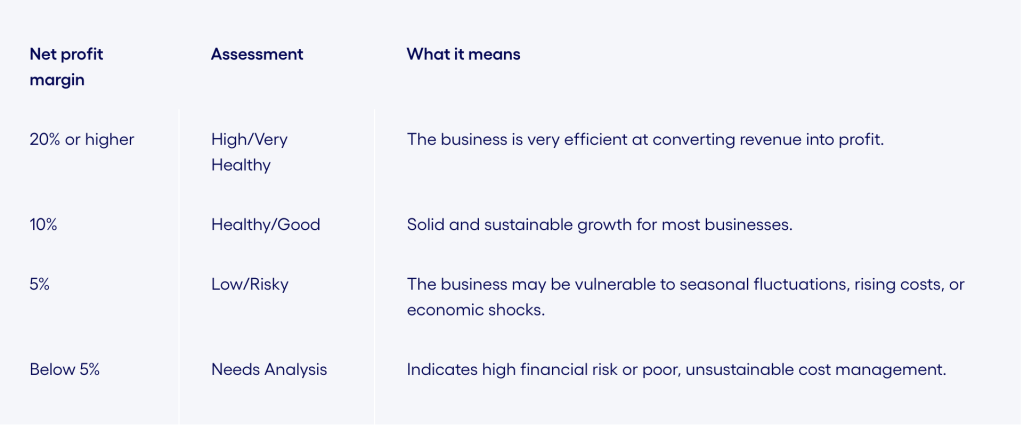
A good profit margin is usually 10% or higher for most businesses, though this varies significantly by industry. A net profit margin of 5% is considered low, 10% is healthy, and 20% or above indicates strong profitability. Compare your margin to industry-specific benchmarks for a more accurate assessment.
It鈥檚 common for small businesses to struggle with cash flow management, especially as operations begin to scale. According to , 39% of small businesses have less than one month of cash on hand, meaning almost two of every five small businesses are operating without consistent profit.
To help you make informed financial decisions, this guide from will explain different types of , the benchmarks you can use to assess them, and which investment and cost-cutting strategies can improve your margins.
Key takeaways:
- There are three types of profit margins: gross, operating, and net. They each measure profitability at different stages of your business operations.
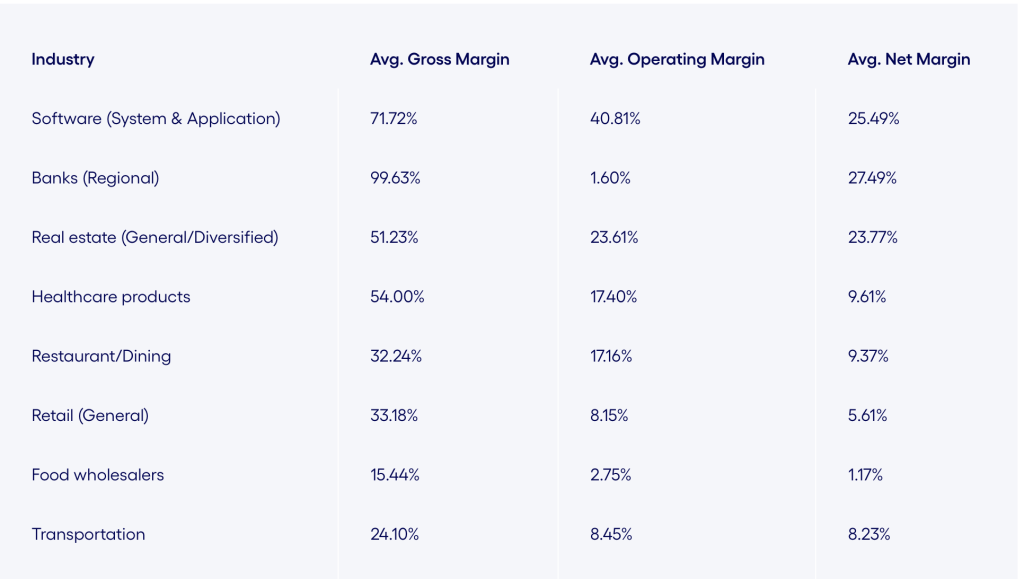
- Industry benchmarks vary dramatically: Software companies average 71% gross margins while food wholesalers average just 15%.
- Improving profit margins requires the right balance of strategic pricing and cost control.
- Always benchmark against direct competitors rather than generic targets, as margin norms differ significantly across sectors.
What is a good net profit margin?
The answer varies slightly based on your industry, business model, cost structure, and business stage. The table below offers a general view of net profit margins across industries, but you should use industry-specific benchmarks to assess your progress. For example, a grocery store can be considered comfortably profitable with a low margin of 2%鈥�3% because they sell a high volume of products and pay high distribution costs.
Specialized expertise, intellectual property, and premium positioning can also affect a business鈥檚 profit margin. These are unique to each company, so you鈥檒l have to assess them in addition to industry benchmarks. These expenses also tend to be non-necessary, so consider the value they add to your business if you鈥檙e looking to cut costs during a .
Types of profit margin
Small business owners tend to focus on net profit margins (鈥渢he bottom line鈥�), but gross and operating profit margins are just as important for cash flow management鈥攅ach metric measures profitability at different stages.
Keep in mind that measuring profit is more than just adding up inflows and subtracting outflows. It鈥檚 important to understand the before making financial decisions. A business can show healthy profit margins while still struggling with cash flow if customers pay slowly or inventory ties up working capital.
Gross profit margin
Think of the three categories of profit margin as your business鈥檚 profitability at each stage of the accounting process. Gross profit margin is the first level: You calculate it by dividing your gross profit (Revenue 鈥� Cost of Goods Sold) by your revenue, then multiplying the result by 100 to get a percentage.
Gross Profit = Revenue 鈥� Cost of Goods Sold
Gross Profit Margin = (Gross Profit 梅 Revenue) 脳 100
Example: If your business generates $500,000 in revenue and your COGS is $300,000, your gross profit is $200,000. Your gross profit margin is ($200,000 梅 $500,000) 脳 100 = 40%.
A healthy gross profit margin typically ranges from 50% to 70% for product-based businesses, while service businesses often achieve higher margins due to lower direct costs. This metric is essential for making pricing and product decisions.
Bluevine Tip: To improve gross profit margin, negotiate better rates with suppliers, consider bulk purchasing for discounts, or explore alternative vendors without sacrificing quality.
Operating profit margin
To calculate operating profit margin, subtract the cost of goods sold (COGS) and operating expenses from your total revenue. (Operating expenses include rent, utilities, salaries, marketing, and other day-to-day business costs.)
Operating Profit = Revenue 鈥� COGS 鈥� Operating Expenses
Operating Profit Margin = (Operating Profit 梅 Revenue) 脳 100
Example: If your business has $500,000 in revenue, $300,000 in COGS, and $100,000 in operating expenses, then your operating profit is $100,000. Your operating profit margin is ($100,000 梅 $500,000) 脳 100 = 20%.
This profit margin ratio is useful because it excludes interest and taxes, focusing purely on operational efficiency and cost control.
Bluevine tip: Audit your operating expenses quarterly. Look for redundant software subscriptions, renegotiate lease terms, or implement automation to reduce labor costs on repetitive tasks.
Net profit margin
Net profit margin is often called 鈥渢he bottom line鈥� because it appears at the bottom of the income statement. It measures the percentage of revenue remaining as profit after subtracting all expenses (including COGS, operating expenses, interest, and taxes). This is the most comprehensive measure of your business鈥檚 overall profitability.
Net Profit = Revenue 鈥� All Expenses
Net Profit Margin = (Net Profit 梅 Revenue) 脳 100
Example: If your $500,000 revenue business has a net income of $50,000 after all expenses, your net profit margin is ($50,000 梅 $500,000) 脳 100 = 10%.
Track net profit margin over time and compare your business to others in your industry. Viewing your different profit margins at each stage of your accounting can provide the insights you need to improve your profit margins sustainably.
Bluevine tip: Work with a tax professional to identify deductions and credits you may be missing. Strategic tax planning can significantly impact your net profit margin without changing your operations.
Profit margin benchmarks by industry
Let鈥檚 look at how industry benchmarks work. The table below shows the average gross, operating, and net profit margins for a select group of industries, as . Understanding your industry standards and how margins fluctuate across the stages of accounting can help you set realistic expectations for your business.
Data as of January 2026
*Banks have unique cost structures where traditional operating margin calculations don't apply in the same way as other industries.
Additional factors affecting profit margins
Industry benchmarks help provide an idea of where you should be, but you鈥檒l need to assess how the factors below are affecting your business鈥檚 individual profit margins. For a more complete analysis, track a few key , too.
- Cost structure: Industries with fluctuating cost of goods sold (COGS) tend to have lower profit margins. Restaurants are good examples of this because labor and food costs account for a large share of their operating expenses.
- Growth stage: Startups and early-stage companies may have low or inconsistent margins while they build products and expand into their market. Mature businesses may see unpredictable margins during times of investment and ambitious growth.
- Margin trends: Cutting costs or increasing your prices can improve profit margins, but these things can also decrease profit margins if done incorrectly or without proper consideration. Make adjustments regularly, as needed.
- Tax considerations: Taxes are only factored in when calculating net profit. That鈥檚 important to remember when assessing your gross and operating margins.
Bluevine Tip: Don鈥檛 confuse higher revenue with strong margins. A business generating $2 million with a 5% margin keeps less money than one generating $1 million with a 15% margin. Focus on profitability percentages, not just top-line growth.
Ways to improve your profit margin
There are many :
- Raise prices strategically: Don鈥檛 be afraid to when your costs go up, but pricing should be fluid and transparent, especially in industries with inflationary costs or products in high demand.
- Reduce cost of goods sold: You can cut back on necessary costs by , switching to more affordable vendors, or taking advantage of bulk order pricing offers.
- Streamline operating expenses: Newer companies usually don鈥檛 have much operational waste, while more established businesses may accumulate inefficiencies over time. Assess which expenses can be streamlined or eliminated.
- Improve product or service mix: Low-margin offerings can be eliminated or bundled with higher-margin products to improve profitability. Retail companies often use clearance sales to do this. A paid service contract can also improve your margins.
- Increase customer lifetime value: of each customer. Look for ways to increase it. Upsells and secondary offerings are good for this. Customer loyalty programs also work if you offer discounts or buying incentives.
- Improve inventory management: Reduce holding costs by implementing better demand forecasting and purchasing discipline.
Get funding that helps your margins grow
Understanding profit margins is a positive step toward building a financially healthy business. Learn to track gross, operating, and net margins. Find industry-specific benchmarks you can use to measure your company against your closest competitors. With accurate expectations, you can work on cutting costs and increasing revenue to improve your margins.
If you need funds to take the next step, a business line of credit gives you the flexibility to invest in margin-improving initiatives when opportunities arise, without the pressure of a lump-sum loan or the need to reapply each time.
Profit margin FAQs
Is 50% profit margin good in a small business?
A 50% profit margin is excellent by most standards, but the answer depends on which type of margin (gross, operating, or net) you鈥檙e measuring and which industry you鈥檙e in. For instance, a 50% gross margin is below average for a software-as-a-service or healthcare product business, but a 50% operating or net profit margin is excellent for any business type.
How can operating expenses affect operating margin?
Operating expenses directly reduce operating margin because they're subtracted from gross profit to calculate operating income. Every dollar spent on rent, salaries, utilities, marketing, insurance, or software subscriptions reduces your operating profit.
What is a good profit margin for a small business?
The average profit margin for a small business varies by sector, with service businesses often achieving higher margins (15%-20%) than retail or manufacturing (5%-10%). Many small businesses also face that can impact margins.
How much profit should you make on a product?
Ideal profit margins vary significantly by industry, business model, and competitive positioning. In addition, your gross, operating, and net margins will vary significantly as you factor in costs at each stage of your accounting process.
was produced by and reviewed and distributed by 爆料TV.