This city turned its rooftops into a climate shield
This city turned its rooftops into a climate shield
From the top of Zürichberg hill, the panorama reveals a city wrapped by lake and forest but insulated in a basin where heat collects. On hot summer days, the center of Zürich, Switzerland’s largest city, warms like a bowl, with street surfaces radiating heat well into the night, amplifying the growing pressures of climate change.
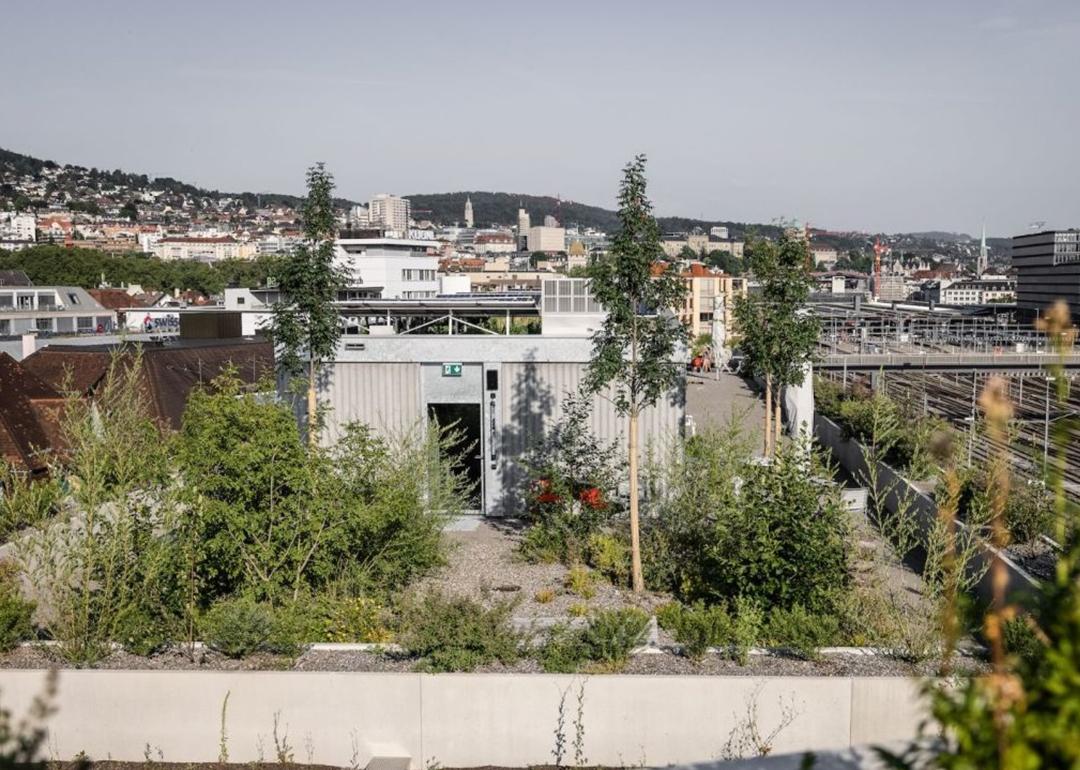
Yet this vantage point also reveals a solution: A patchwork of green roofs softens the cityscape.
Zürich has spent more than three decades transforming its rooftops into living infrastructure. As this article from explains, that approach may hold lessons for cities worldwide.
Zürich’s green-roof mandate dates back to 1991, when the city began requiring vegetation on all new or renovated flat roofs. It was a remarkably prescient step. Today, according to by Zürcher Kantonalbank, one of the largest banks in Switzerland, up to 12% of roofs in some neighborhoods are vegetated, and roughly 40% of the city’s flat roofs now support plants. Yet the same study underscores that the potential remains vast: In some districts, more than half of all flat roofs are suitable for greening, especially gravel roofs that can already support additional load. The need is urgent. Switzerland is warming at roughly twice the global average, and a 3 degrees Celsius (5.4 degrees Fahrenheit) increase scenario is translate into a of up to 5.7 degrees Celsius (10.3 degrees Fahrenheit) in the country. That means more heatwaves, more “tropical nights” and intensified flood-and-drought cycles.
For Dr. Stephan Brenneisen, head of the Urban Ecology Research Group at Zurich University of Applied Sciences, the city’s early actions helped seed an entire field. Widely known as the “father of green roofs and biodiversity,” Brenneisen has been studying, designing and advocating for these habitats for more than 30 years. His career began with beetles and spiders, and in some ways it still revolves around them. “Green roofs,” he “are important to cool our cities and provide a living space for nature.”
“Beside this," Brenneisen adds, "they make us able to give back nature a part of its space while constructing a building.”
He points out that roof gardens were already popular 3,500 years ago in Egypt and later in ancient Greece and Rome, both for the pleasure of the wealthy and as improved insulation for structures. Brenneisen quotes , the late visionary Austrian architect, who famously said: “We must again live in houses where nature is above us, for it is our duty to put nature, which we destroy by building the house, back on the roof. The nature we have on the roof is this piece of earth that we killed by putting the house there.”
As a pioneer, Zürich has been studying the benefits of roof vegetation for over three decades. Green roofs cool the air, improve insulation, capture rainfall and filter pollutants. They reduce heat gain on the building below, lowering energy demand for cooling in summer and heating in winter. notes that extensive green roofs (those with a substrate thickness of up to 10-15 centimeters) are on average 9 degrees Fahrenheit cooler at the surface than those without vegetation, while intensive green roofs (those with a thickness of 15 centimeters or more) can be up to 33.3 degrees Fahrenheit cooler. Even two meters above the roof, air temperatures drop measurably.
Green roofs also play an unsung role in stormwater management. By absorbing and slowly releasing rainfall, they ease pressure on aging urban drainage systems. Studies from Zürich and Basel show that vegetated roofs last twice as long as gravel roofs because plants shield waterproofing layers from ultraviolet radiation and extreme temperature swings.
The ecological impact is equally significant. As the Swiss biodiversity organization — part of a Swiss alliance of more than 70 organizations including cities, municipalities, NGOs, companies, professional associations and foundations — notes, properly designed green roofs act as “stepping-stone biotopes,” critical habitat patches that help insects, birds and plants move across fragmented urban landscapes.
Brenneisen’s research proves that vulnerable species — including some listed as threatened — thrive on roofs that mimic the flora once common across the region. These “inverted meadows” show how biodiversity can be restored in the tightest urban spaces.
“Green roofs can improve the habitat mosaic of birds and butterflies, providing feeding or nesting sites,” Brenneisen , adding: “We have been identifying red-listed species that exist on green roofs in different countries.”
One of the most striking examples lies just outside Zürich: A century-old roof at the Seewasserwerk Moos, a water filtration plant, which has evolved into 30,000 square meters of an orchid-rich meadow with more than 175 plant species. Brenneisen calls it “a stable, ecological treasure” — living proof of the ecological oasis long-term roof habitats can become.
Zürich’s leadership is nearly matched by Basel in northwestern Switzerland, which turned to green roofs in the early 1990s as an energy-saving measure and now sports more than 4.6 square meters of green rooftop per resident, or almost 50% of all flat roofs. Residents agreed to channel part of their utility payments into a fund supporting building retrofits, and the city soon made green roofs mandatory on all new or renovated buildings with slopes under 10 degrees.
“The solution has to be quantitative,” Brenneisen insists. Cities that try to improve the percentage of green roofs only by offering subsidies are significantly less successful than the cities and communities that make them mandatory. “Here, it’s simply a requirement. Period,” Brenneisen says. “Especially in bigger cities, it’s the job of city planners to include climate adaptation, and when you simply put gravel on a roof, you haven’t done your job.”
Basel’s roofs, as a recently highlighted, have become complex wildflower communities more akin to brownfield ecological hotspots than decorative lawns. Many of the guidelines that shaped them — including minimum substrate depths and planting schemes — were developed by Brenneisen. He calls it “a simple technology,” but also concedes that “in reality, it is not so easy to change a city.”
If green roofs offer so many benefits, why doesn’t every roof sport one?
The answer often comes down to economics and planning inertia. Although Zürich and Basel require green roofs on new and renovated buildings, the cities provide exemptions for rooftop terraces, restaurant spaces, or technical installations. As a result, in Zürich’s dense urban core only about 1% of roofs are vegetated.
Cost also remains a consistent hurdle. While most residential concrete roofs can handle planted roofs easily, large-span industrial buildings often require reinforcement. Replacing gravel with substrate and vegetation adds weight, ranging from 100 kilograms per square meter for extensive roofs to over 1,000 kg for rooftop gardens with shrubs or trees.
“If a hall costs 10 million [Swiss francs] and you can demonstrate that spending 12 million on a higher value environment will pay itself back in 15 years, someone always asks: Can we do it for nine million?” Brenneisen told the . Gravel roofs, though less sustainable, are cheaper up front. Part of Brenneisen’s work is to convince architects and city planners to factor in the positive impact of green roofs on the long-term ecological footprint of a building, but also to impress on them the beauty of these patches of nature. “I really wish for more courage and creativity in designing green roofs.”
The thicker the substrate, the more diverse the plants, the greater the ecological relevance.
Brenneisen emphasizes that habitat roofs, which use varying substrate height, multiple vegetation layers, logs and stones, show greater diversity and more complex ecosystems than simpler roofs with thinner substrates and monotonous vegetation.
His likewise shows that intensely greened roofs can have biodiversity and carbon benefits similar to gardens, attracting birds and other creatures. But lush rooftop parks also require more care, periodic maintenance like weeding, inspection and occasional replanting. Without care, plants can die off, diminishing ecological and cooling performance. Brenneisen therefore calls for cities and communities to factor in the cost of maintaining green roofs and green facades “just like they’re factoring in the cost of maintaining trees in public spaces and parks.”
Few cities have embraced the potential of rooftops as fully as Zürich, yet even here the opportunities dwarf the achievements. The city has roughly five million square meters of vegetated roofs today, but its environmental department stresses that both “quality and quantity” could be substantially improved.
Better substrates, deeper soil layers and biodiversity-focused design all enhance ecological and cooling performance. In 2015, the city adapted its green roof mandate to include better substrate and regional seeds after it found many green roofs only met minimal standards. (Curiously, city officials sent some stats but refused to make anybody available for an interview about the topic, claiming their communication efforts are primarily directed at experts.)
Meanwhile, Switzerland continues to build or retrofit three to 5 million square meters of flat roofs every year — an immense opportunity for climate adaptation.
One of the most dynamic shifts in the last decade is the rise of photovoltaics, another essential climate solution that competes for roof space. Zürich has required solar panels on many green roofs since 2015 and embraces integration rather than trade-offs. The combination works: Vegetation cools PV systems, increasing their efficiency, and elevated panels create microclimates that support diverse plant species.
The German city Hamburg is going even further, planning to make “solar green roofs” compulsory on new buildings and major renovations by 2027.
Zürich seems committed to continuing its green roof policy and providing its studies as blueprints for other cities. The city cites that greening 50% of roofs in New York would reduce the heat island effect by up to 1.44 degrees Fahrenheit. Greening all the roofs of Toronto could reduce the heat by up to 3.6 degrees Fahrenheit.
To boost green roofs, Singapore has implemented a policy for the government to cover half the cost of green roof installations. Chicago now fast-tracks permits for buildings with green roofs. And in 2016, San Francisco adopted a green roof mandate as the first U.S. city, requiring 15% to 30% of roof space on new buildings to be green or use solar.
Green roofs alone won’t prevent glacial melt or landslides in the Alps. But they can act like giant natural thermostats and sponges, absorbing extremes of the urban climate and returning clean air, resiliency and life to the dense environment.
As cities worldwide confront increasingly extreme weather, Zürich’s long-running experiment offers a clear takeaway: Policy matters.
“Authorities should understand that the tops of buildings should be used for climate adaptation and to bring nature to our cities,” Brenneisen . “For a reasonable price, we can make simple and effective roofs that are good for people and nature. We have clearly demonstrated this in Switzerland.”
Three decades after Zürich made that leap, the city’s roofs prove how transformative that decision was. The rest of the world need only look down from the Zürichberg, and then up at its own empty rooftops, to imagine what’s possible.
was produced by and reviewed and distributed by ±¬ÁÏTV.