A town ‘built by industry’ adjusts to life as the liquefied natural gas capital of Canada
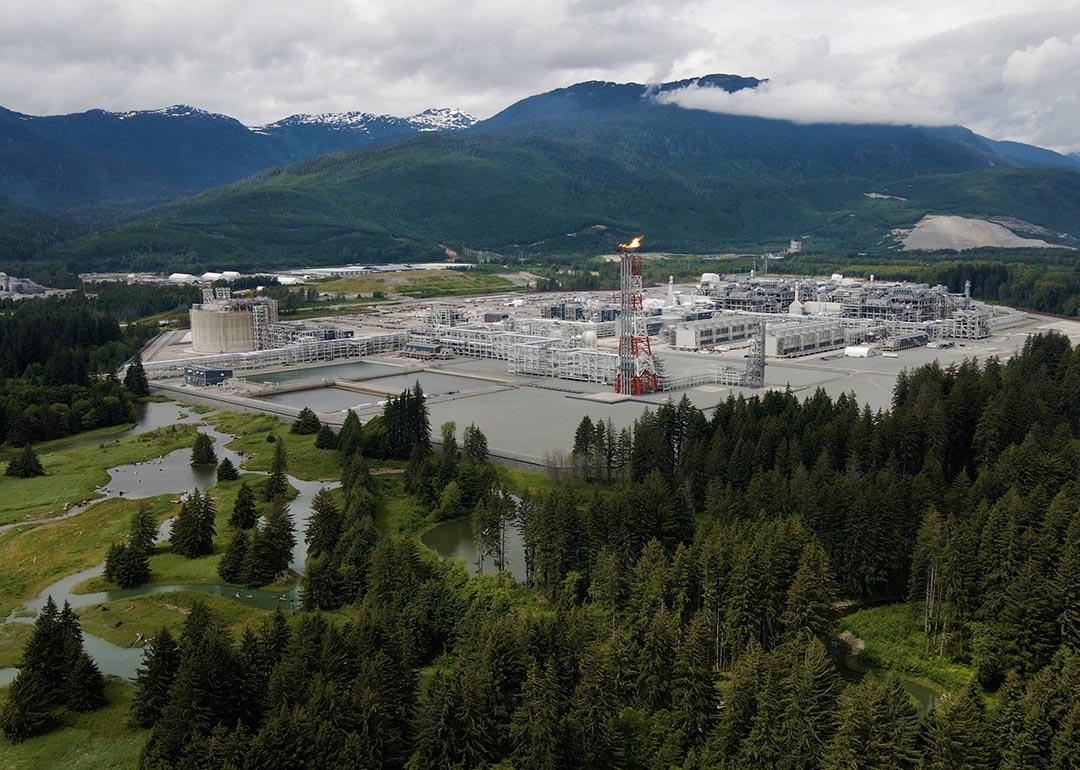
For the past few months, the buzz in the small coastal community of Kitimat, B.C., has been all about the flares.
, the newly completed gas liquefaction and export plant, began firing up its smokestack last fall, lighting the skies with a flame that got as tall as 90 metres at one point. That’s roughly the equivalent of four 18-wheeler trucks, stacked end-to-end on top of each other. It could be seen from more than 50 kilometres away, reports.
“When they first started the flaring, myself, my boy, and even my cats were affected by it,” Dustin Gaucher, a Haisla cultural researcher and educator, said on a phone call in early July. Gaucher lives more than a dozen kilometres up the hill from the industrial site, which was built on the Kitimat River estuary on Haisla Nation lands. “It sounded like a rocket ship going off all night and it smelled like my grandfather’s [boat’s] diesel engine, when that black burn-off initially comes out — but it smelled like that for about two days.”
The flame burns off natural gas, which is mostly composed of methane. According to LNG Canada, the largest flares are an expected part of getting the factory online. Now that production has started, the intensity of the noise and smell from the flare has abated — but the plant’s impacts are just beginning.
“Right now, I can’t really smell it,” Gaucher said. “I just came to my front door again, and I’m looking at it, and there’s lots of black coming out of there. Those particulates are floating right over our river and we have the salmon running into it — that’s what’s concerning to me.”
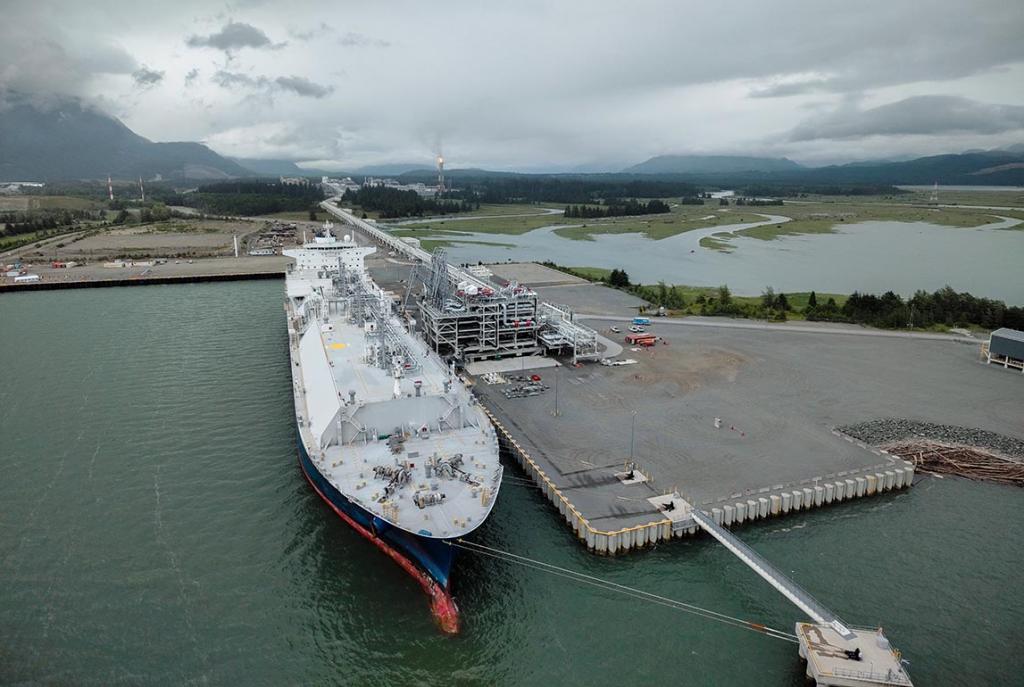
On June 30, LNG Canada successfully filled the belly of a with . It was the first of an estimated 170 ships it will fill and send overseas every year — for now. This is the project’s first phase. A second, which would double production, was previously and is pending a final investment decision.
Kitimat has been an industrial hub since it was settled in the 1950s to serve as a company town to Alcan, an aluminum smelter now owned and operated by international mining giant Rio Tinto, which was powered by the newly built Kemano generating station. About 700 kilometres north of Vancouver, the town has seen its share of industries come and go: a methanol plant and a pulp mill both brought an influx of jobs before shuttering their doors in 2005 and 2010, respectively, leaving the town in an economic slump.
LNG Canada — a joint venture including some of the largest and wealthiest fossil fuel companies in the world — represents a massive industrial investment in the community. Including the , which supplies the facility and other upstream operations, the value of the project is estimated at $40 billion. Some in the community see it as a much-needed resurgence.
“It’s been a long journey to get here, to have the plant up and running — we’re very happy that it is done,” District of Kitimat mayor Phil Germuth told The Narwhal. “We can now say that we are the LNG capital of Canada.”
Haisla leadership celebrates LNG Canada
For Germuth, a lifelong Kitimat resident and third-term mayor, launching Canada’s nascent LNG export industry from Kitimat is clearly a point of pride.
“Back in 1956, National Geographic described the Alcan and Kemano project as the most expensive project ever attempted by private industry here in Canada,” he said. “Fast forward just over 70 years and we were able to attract LNG Canada, which is the largest private sector investment in Canadian history. It’s quite something for a small town of just over 9,000 people to have two projects like that in its lifetime.”
The National Geographic article, in which the reporter complains about a $3.25 taxi fare and waxes poetic about the scenery — “milky-green water followed the long, winding, U-shaped bathtubs scoured out of the mountains by Ice Age glaciers” — outlined the engineering audacity of the Alcan project, which included through a 16-kilometre tunnel bored into a mountain.
The article doesn’t cover the forcible removal and displacement of the Cheslatta, Saik’uz and Stellat’en First Nations, all of which by the smelter’s operations. Nor did it discuss the generational impacts on the Haisla, only mentioning the nation in a brief aside: “A few years ago the only humans here were ‘Kit-a-maat’ Indians, the ‘People of the Falling Snow.’ ” Cʼimaucʼa (Kitamaat Village) is a reserve currently home to around 700 members of the Haisla Nation. The village sits directly opposite Alcan on the eastern shoreline of Douglas Channel.
Haisla Nation Chief Councillor Crystal Smith said the industry consortium behind LNG Canada was “unlike so many others” in that they “chose to build a relationship first before even considering building a project.”
“They focused on understanding what mattered first and foremost to Haisla Nation, and to Indigenous communities in the region,” she said in a .
The Haisla, in addition to signing agreements with LNG Canada, which include direct financial benefits as well as employment and contract opportunities, are also majority shareholders of another project in Kitimat called , which is currently under construction.
When LNG Canada announced it had successfully sent its first cargo last month, Prime Minister Mark Carney lauded the milestone and celebrated the involvement of the Haisla in the new project.
“Canada is exporting its energy to reliable partners, diversifying trade and reducing global emissions — all in partnership with Indigenous Peoples,” he said in a published by the consortium. (Carney’s claim about reducing global emissions is a .)
Germuth previously told The Narwhal one of the best things to come from LNG Canada was strengthening the relationship between the settler community in Kitimat and Haisla leadership.
“The political relationship between the District of Kitimat and the Haisla Nation Council, it wasn’t there, it was terrible,” he said at the time. “LNG Canada came in … and they would bring us into the same meeting. That’s all it really took, was the two councils just hanging out together, getting to know each other at a project that we both support and that we’re both going to be greatly benefiting from.”
Now, he’s hopeful the consortium will move ahead with the second phase.
Teresa Waddington, a vice-president with LNG Canada, told The Narwhal the five corporations — Shell, Petronas, Korea Gas, Mitsubishi and PetroChina — that make up the consortium are in discussions about the potential expansion.
“A phase-two final investment decision will take into account factors such as overall competitiveness, affordability, pace, future [greenhouse gas] emissions and stakeholder needs,” she said in an emailed statement. “We see an opportunity to build on our early phase-one successes and the benefits it’s already providing First Nations, communities, British Columbians and Canadians.”
‘Built by industry’: Kitimat mayor says residents are willing to live with the flare
Gaucher, who emphasized he’s not against industrial projects, said he’s still worried about potential health impacts from the LNG plant’s operations — including impacts on wildlife.
“What is this doing to the wolf pack that usually lives down around that area? What’s going on with the moose and the deer? We have lynx around here, we have cougars around here — how are they being affected by it?”
Emissions from flaring are permitted and monitored by the . At the Kitimat site, they include carbon monoxide, nitrous oxides, fine particulate matter, sulphur dioxide and carbon dioxide, according to .
Melissa Lem, a family doctor and president of Canadian Physicians for the Environment, said it’s important to remember LNG Canada does not operate in isolation — all of the gas it liquefies for export at the Kitimat facility is extracted from underground reserves, mostly by , which also has consequences for community health.
“Fracking and LNG production accelerate climate change and release harmful pollutants — including benzene, toluene, formaldehyde, and particulate matter linked with asthma, heart disease, birth defects, and childhood leukemia,” she said in a . “Communities near fracking operations in northeastern B.C. are already experiencing these impacts, with higher rates of and . Indigenous communities are disproportionately affected, with showing elevated levels of fracking-related chemicals in household air, water, and the bodies of pregnant women compared to unexposed populations.”
Kitimat, in part because of its long history of exposure to potentially harmful emissions, has an abundance of data on air quality, with recording publicly available information daily. LNG Canada did not directly answer questions about potential impacts to wildlife, referring The Narwhal instead to its .
Germuth admitted residents were concerned about the flaring when it was at its loudest and brightest, but said most people he’s talked to are relieved the project is finally operating.
“Being a town that was built by industry, people understand that every once in a while, you’re going to have to put up with something to get the bigger goal in the end,” he said.
Lucy McRae, a member of local environmental group Douglas Channel Watch, said LNG Canada has done a good job of engaging with the community over the years and addressing concerns when they arose.
“Yesterday, we were in an all-day meeting with LNG Canada as we do every three months,” she wrote in an email in late June. She said several local organizations are involved in the quarterly meetings, including conservationists, hunters and fishers, community health groups and more.
“We talk about many topics to do with the project, including environment and social issues,” she said, adding that industry representatives at the meeting provide “extensive and all-encompassing” updates and LNG Canada “brings in the people who can and do answer our questions and address our concerns.”
McRae said she does not support the expansion of fossil fuels, “but at the same time, I understand how desperate many Canadians feel in creating jobs under any circumstances.”
“I don’t feel that I have experienced any ill effects from the project, and truthfully speaking it has been good for the community,” she said.
was produced by and reviewed and distributed by ±¬ÁÏTV.