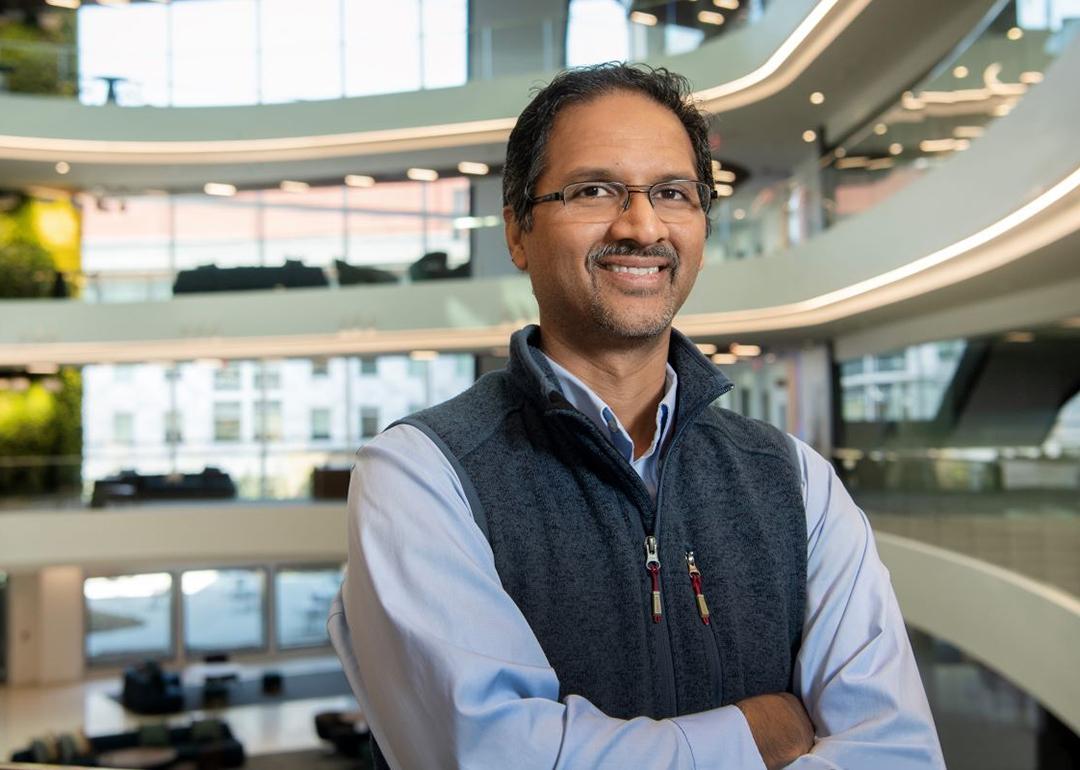
Emory researcher explains how ‘frugal’ AI could reshape global public health
Emory researcher explains how ‘frugal’ AI could reshape global public health
As the U.S. public health system weighs how to integrate artificial intelligence, an Emory University lab is patenting new ideas for precision medicine that its leader says could bring AI research into practical use — quickly and with nuance.
Professor Anant Madabhushi’s work covers AI options for detecting and treating a dizzying range of diseases, from cancer to HIV to cardiovascular disease, in countries from China to Tanzania to Brazil.
The bioengineer’s upbringing in Mumbai, India, and work with researchers around the world have driven his focus on finding uses for AI to save money, time, and resources in public health and health care.
Madabhushi holds more than 225 issued or pending patents and has headed the Empathetic AI for Health Institute at Emory since 2023. He’s also co-founded several companies focused on AI in health.
The U.S. Department of Health and Human Services an intention to incorporate AI into public health.
Artificial intelligence could have major public health benefits across the world, including the rural United States, Madabhushi said. But he’s concerned the United States is falling behind in the large-cohort studies needed to fuel AI’s promise.
“The necessity of these technologies, frugal and opportunistic, have implications not just in the Global South, but also in rural America,†he said. “We really owe it to Americans to be able to do whatever we can, particularly in this time of health care costs and some of the challenges with access.â€
shares seven takeaways from a recent conversation with Madabhushi.
- Artificial intelligence will not replace clinicians.
“In reality, the real value lies in augmenting clinical decision-making, reducing variability, and expanding access — especially where clinical expertise is limited,†Madabhushi said. That includes parts of the world with limited resources, whether that’s his native India or rural Georgia.
- Artificial intelligence has the power to transform lives and health systems, but the breakthroughs aren’t “plug-and-play.â€
“In truth, they require careful validation, bias mitigation, regulatory oversight, and thoughtful deployment to ensure they actually help patients rather than introduce new inequities,†Madabhushi said.
He pointed to the example of a cancer center in India that sees about 1 million patients a year.
“Whatever technology you bring into play not only has to be able to deliver accurate insights, it also has to be done in a way that doesn’t add time to the system,†Madabhushi said. “You can’t add more complexity. You can’t add more seconds to the diagnosis, to the clinical workflow.â€
With 1 million patients a year, just one second added to the workflow means “suddenly you’re talking about some serious amount of time.â€
- Eyes are diagnostic windows to health.
Using AI, eyes can predict heart failure among patients with chronic kidney disease, as well as early forms of blood cancers.
“It turns out that even the simple fundus image [of the eye] has so much information, which, with the opportunistic use of AI, could start to tell us about a whole bunch of systemic conditions and systemic diseases,†Madabhushi said. That, in turn, could catch diseases very early and allow people to make lifestyle changes to mitigate their risks.
- A “frugality constraint†could be “a game changer.â€
Madabhushi and his team studied 10 diseases commonly seen in emergency rooms and found that AI could help reduce the costs of diagnosis while preserving accuracy. The point is to reduce the number of tests — and costs — required to get to a correct diagnosis.
“When you have this frugality constraint encoded into the AI algorithm, then we only require something like 10% or 11% of the total tests that were ordered for that particular patient to get to that diagnosis right,†Madabhushi said. That could dramatically reduce system and individual costs in a variety of settings.
Madabhushi’s longtime obsession with imaging has driven his commitment to saving money on the front end of diagnosis. AI can save “some very, very serious money†on pathology slides. Pathologists often need multiple stains of slides to diagnose disease. Those costs can add up quickly, with the burden falling on patients in countries like India. AI could obviate that by producing the multiple stains all at once.
In places like India, “You don’t have the luxury of these additional [pathology] stains, and if we could learn all of these various stains and parameters from a single HD [high definition] image with the power of AI, now that becomes a game changer,†Madabhushi said.
- AI can reduce human suffering.
Madabhushi published on Dec. 1 highlights this. The paper reports that AI could distinguish which types of prostate cancer would benefit from a particular type of chemotherapy drug (docetaxel) without the need for additional biopsies. The ability to distinguish which types of prostate cancer would benefit from the strong drug could prevent people from needlessly suffering serious side effects, which can include neurotoxicity and, very rarely, death.
- AI research should reflect diverse populations.
“We want to make sure that we have diversity in these data sets for training the models. We want to make sure these tools that we’re developing truly are going to work across a plurality of populations,†Madabhushi said.
He pointed to a published this summer that found differences in endometrial cancer in Black and white patients.
“When we explicitly incorporated those differences in creating more population-tailored models for Black women, those AI models work much, much better compared to a what is called a population-agnostic one,†Madabhushi said.
- The United States is losing its edge in AI health research.
“Maybe there was a time where we had a bit of an edge, but I think we’ve really given up that edge,†Madabhushi said, noting China is “quite significantly ahead†in the health care and AI space. Chinese researchers are more easily able to access and share large datasets about patients, which are key to validating AI algorithms.
“The Chinese have been able to figure this out at speed compared to us,†Madabhushi said, in part through robust data-sharing arrangements.
He also pointed to India, saying the country’s entrepreneurial spirit of doing more with less has driven innovative technologies that are now being deployed in the United States.
Madabhushi gave the example of Mumbai-founded , a company with AI products that can help detect lung cancer and tuberculosis. The company’s technology has been deployed in over 100 countries, according to its website, including the United States and across Europe.
was produced by and reviewed and distributed by ±ŹÁÏTV.