The troubling personal side of public surveillance
The troubling personal side of public surveillance
On March 4, former Milwaukee police officer Josue Ayala accusing him of using the department鈥檚 Flock-branded Automated License Plate Reader system (ALPR) for personal reasons. He resigned from the department hours before his initial court appearance, according to local reporting.
Ayala, 33, is charged with attempted misconduct in public office, a misdemeanor. Prosecutors say he used Flock鈥檚 plate-tracking platform to look up the location of a woman he was dating, as well as that of her ex-boyfriend, more than 170 times in total over a roughly two-month period. Ayala and his lawyer did not speak with reporters at his court appearance.
Jon McCray Jones, a policy analyst with the Wisconsin chapter of the American Civil Liberties Union, told Urban Milwaukee that the accusation exemplifies 鈥渏ust how easily Flock cameras can be turned against the very people the technology purports to protect,鈥� . Indeed, Ayala is the second officer in the state to face charges related to misuse of surveillance technology in recent weeks. In February, Menasha police officer Cristian Morales pleaded not guilty to the same charge after allegedly . Morales, accused of running five unauthorized searches, is on administrative leave, according to reports.
examines cases in which public surveillance tools like license plate readers have been misused and how lawmakers have reacted.
Over the past few years, officers have been accused or convicted of misusing license plate readers to track people for personal reasons in , and . It鈥檚 not just young, inexperienced cops either: In Kansas and Georgia, the officers in question were both police chiefs.
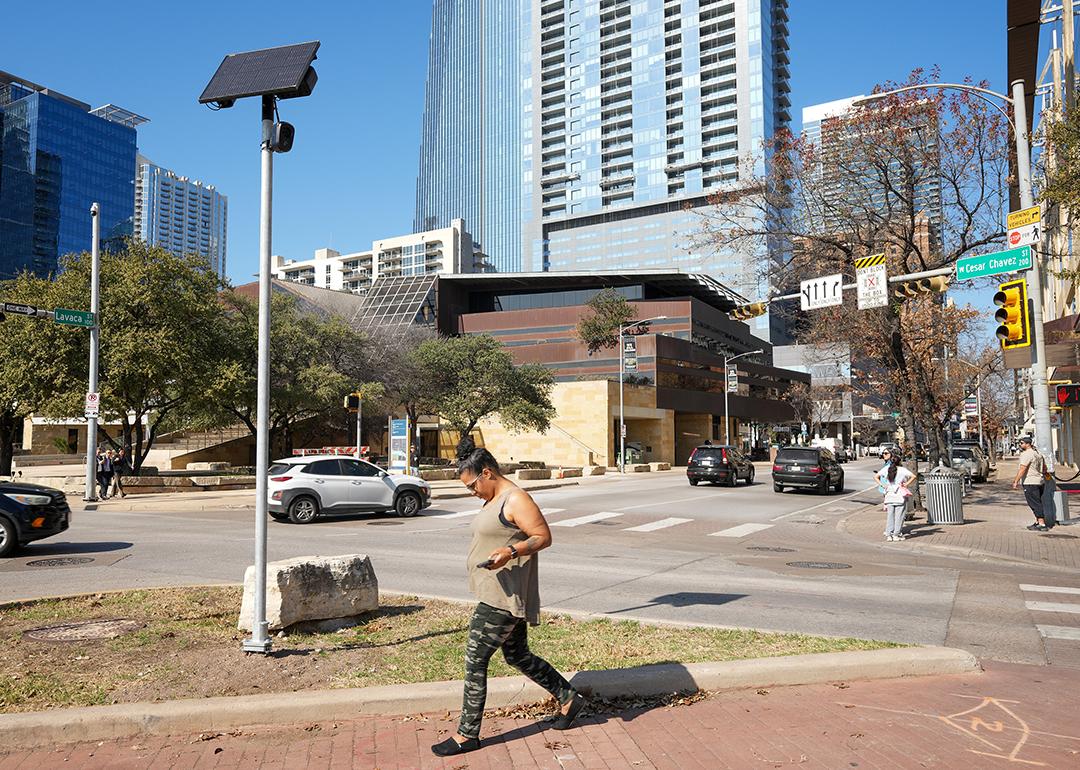
, but the devices became common tools for law enforcement over the last 20 years or so. Fundamentally, they are cameras that capture point-in-time images of license plates on public roads and store those sightings in a searchable database.
In recent years, Atlanta-based Flock Safety has become one of the largest vendors of the technology. Supporters 鈥� including Flock itself 鈥� argue the systems are an important force multiplier: a year nationwide, especially vehicle-linked cases. That includes some high-profile cases like the Police credited Flock technology as a primary tool in locating the alleged shooter.
Flock cameras don鈥檛 provide continuous real-time tracking like GPS. But as the number of camera locations increases, and data is increasingly being shared across jurisdictions, civil libertarians worry that the systems are creating a kind of panoptic surveillance infrastructure 鈥� especially when like artificial intelligence.
Then there鈥檚 the problem of misuse. Police abusing official databases and tech for personal reasons is not a new phenomenon. A decade ago, , The Associated Press found hundreds of cases where officers had used confidential law enforcement databases to get information on romantic partners, neighbors, journalists or business associates. But as police data systems rapidly increase in sophistication, speed and granularity, the potential for abuse grows in kind.
Even when these technologies are used for crime-solving purposes, officers can slip into inappropriate personal use. Last week, The San Francisco Standard reported that a city officer was , possibly violating department rules about conflicts of interest, as well as other policies. The officer posted a picture of the vehicle on social media, and the unauthorized use was discovered when another officer in a neighboring jurisdiction saw the post.
That aspect of Flock鈥檚 ALPR technology, where police can search the movements of vehicles beyond their own jurisdiction, is one that has grown increasingly worrying to individual cities. Last week the and switch to a competitor that doesn鈥檛 have a nationwide search option, citing concerns that Flock systems could be accessed by federal agents for immigration arrests.
Flock Safety spokesperson Holly Beilin acknowledged there have been cases of officer misuse, but said they represent a small fraction of overall use. She argued that the company鈥檚 audit logs represent a key accountability feature, because they can鈥檛 be changed after the fact 鈥� meaning essentially that an officer who abuses the technology can鈥檛 hide their tracks. She also said the company has added compliance tools, including search filters tied to immigration and reproductive healthcare investigations where state law restricts those searches. Flock has also and updated its systems after scrutiny over federal access and network sharing.
Still, Denver isn鈥檛 the only city jumping ship. At least with Flock over the first two months of the year, according to NPR, a trend that has been especially pronounced in college towns. On March 4, Ithaca, New York, home to Ithaca College and Cornell University, Public sentiment about Flock and surveillance cameras in general also took a hit after a depicted a network of smart cameras being fed to AI databases to locate lost pets. The ad had nothing to do with Flock, but a pending partnership between Ring and Flock raised alarm bells for civil libertarians. The .
Lawmakers in a handful of states have , but even when they do, it鈥檚 not always clear how to enforce them. A January report from the Virginia State Crime Commission found that related to ALPR use, despite a state law requiring certain public notices before deployment.
The report also found that 20 Virginia agencies were providing data to out-of-state law enforcement, and nine were providing continuous access to federal agencies, even though the state law forbids both kinds of sharing.
Against that backdrop, some local governments are trying an approach that is rare in surveillance governance: contractual consequences. The week of March 2, the Chicago suburb of Arlington Heights announced a contract with Flock that has penalties of $22,000 to $70,000 per incident of 鈥�.鈥� This provision does not protect against misuse within the police department, but is intended to protect against Flock鈥檚 platform settings, allowing outside agencies to query Arlington Heights' camera data without the department鈥檚 permission or knowledge.
鈥淏y adding this penalty into our contract, my hope is that other communities will do the same,鈥� Arlington Heights trustee Wendy Dunnington told The Marshall Project by email.
was produced by and reviewed and distributed by 爆料TV.